Stable Frames in Model Categories
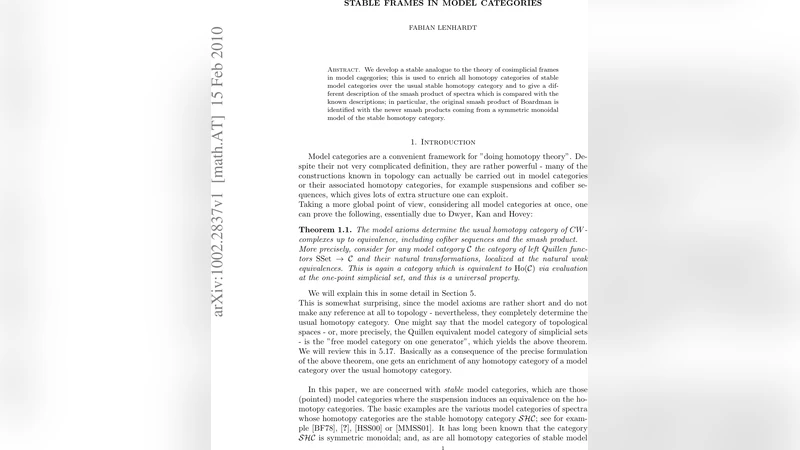
We develop a stable analogue to the theory of cosimplicial frames in model cagegories; this is used to enrich all homotopy categories of stable model categories over the usual stable homotopy category and to give a different description of the smash product of spectra which is compared with the known descriptions; in particular, the original smash product of Boardman is identified with the newer smash products coming from a symmetric monoidal model of the stable homotopy category.
💡 Research Summary
The paper develops a stable analogue of the classical theory of cosimplicial frames within the setting of model categories, and uses this construction to achieve several significant goals in stable homotopy theory. The authors begin by recalling the role of cosimplicial frames in providing a convenient way to model mapping spaces and homotopy limits in a general model category. They then introduce the notion of a “stable frame,” which is a system of cosimplicial objects equipped with compatible suspension and loop structures that satisfy the usual Quillen model‑category axioms. The key requirement is that the shift functor Σ and its right adjoint Ω act on the frame in a way that mimics the behavior of spectra, ensuring that ΣFⁿ ≃ Fⁿ⁺¹ and ΩFⁿ⁺¹ ≃ Fⁿ up to weak equivalence.
With stable frames in hand, the authors construct an enrichment of the homotopy category Ho(𝓜) of any stable model category 𝓜 over the classical stable homotopy category SH. For objects X and Y in 𝓜, one chooses stable frames FX and FY, forms their tensor product in the underlying cosimplicial world, and then applies a cofibrant‑fibrant replacement to obtain a mapping spectrum R Hom(X,Y). This spectrum lives naturally in SH, and composition of morphisms is realized by the smash product of the corresponding mapping spectra, thereby turning Ho(𝓜) into an SH‑enriched triangulated category.
The second major contribution concerns the smash product of spectra. Historically, Boardman’s original smash product was defined using a point‑set level construction that did not make the symmetric monoidal structure transparent. Modern approaches (symmetric spectra, orthogonal spectra, S‑modules, etc.) provide a clean symmetric monoidal model for SH, but the relationship between these models and Boardman’s construction has remained somewhat indirect. By exploiting the tensor product of stable frames, the authors define a new smash product: for spectra X and Y represented by stable frames FX and FY, set X ∧ Y = Real(FX ⊗ FY), where Real denotes the realization functor that converts a stable frame back into an honest spectrum. They prove that this definition coincides with the smash product in any of the standard symmetric monoidal models and, crucially, that it is naturally isomorphic to Boardman’s original product. The proof relies on the Quillen equivalences between the various models, the homotopical invariance of the frame construction, and careful analysis of the interchange law for Σ and Ω within the frame.
The paper includes a thorough comparison of the new construction with existing ones. In the case of symmetric spectra, the authors exhibit an explicit Quillen equivalence that carries the stable frame tensor product to the usual smash product. Similar arguments are given for orthogonal spectra and S‑modules, showing that the stable‑frame approach is model‑independent. Moreover, they demonstrate that module spectra, E∞‑ring spectra, and other structured objects inherit their monoidal structures via the enriched homotopy category, providing a unified framework for many familiar constructions.
Finally, the authors discuss several applications. The enrichment over SH simplifies the formulation of spectral sequences, duality theories, and the study of monoidal functors between stable model categories. The identification of Boardman’s product with the modern symmetric monoidal smash product resolves a longstanding conceptual gap and suggests new avenues for point‑set level refinements of stable homotopy theory. In conclusion, stable frames serve as a powerful bridge between abstract model‑categorical homotopy theory and concrete point‑set constructions of spectra, yielding a coherent picture of the smash product and enriching the homotopy categories of all stable model categories over the classical stable homotopy category.
Comments & Academic Discussion
Loading comments...
Leave a Comment