Bayesian computational methods
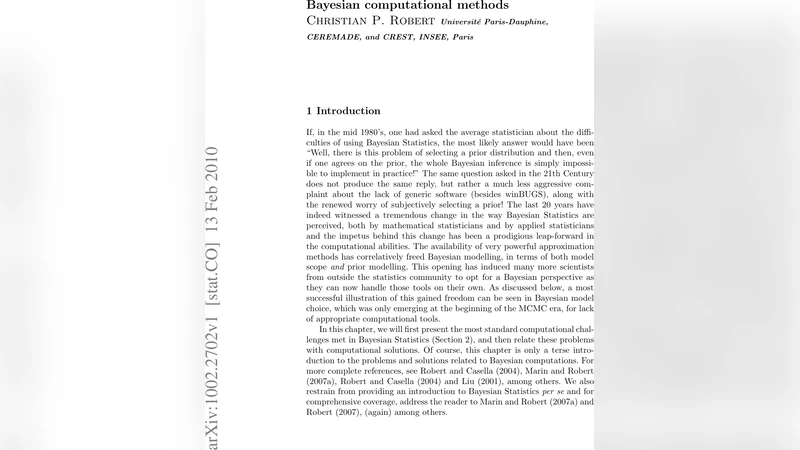
In this chapter, we will first present the most standard computational challenges met in Bayesian Statistics, focussing primarily on mixture estimation and on model choice issues, and then relate these problems with computational solutions. Of course, this chapter is only a terse introduction to the problems and solutions related to Bayesian computations. For more complete references, see Robert and Casella (2004, 2009), or Marin and Robert (2007), among others. We also restrain from providing an introduction to Bayesian Statistics per se and for comprehensive coverage, address the reader to Robert (2007), (again) among others.
💡 Research Summary
This chapter provides a concise yet comprehensive overview of the principal computational challenges encountered in Bayesian statistics, with a particular focus on mixture model estimation and model selection, and outlines the most widely used algorithmic solutions. The authors begin by emphasizing that, while Bayesian inference offers a coherent framework for quantifying uncertainty through posterior distributions, the practical computation of these posteriors is often intractable, especially when the model involves latent structure such as finite mixtures. In mixture models, each observation is associated with an unobserved component label, leading to a high‑dimensional parameter space that includes component parameters, mixing proportions, and the latent allocation variables. This structure generates multimodal posterior surfaces and the notorious label‑switching problem, both of which complicate standard Monte‑Carlo approaches.
The chapter proceeds to discuss the classic Markov chain Monte Carlo (MCMC) family of methods. The Metropolis–Hastings (MH) algorithm is presented as a flexible, generic sampler that can be applied to virtually any posterior, provided a suitable proposal distribution is chosen. The authors note that the efficiency of MH hinges on careful tuning of the proposal’s scale and covariance; adaptive variants such as the Adaptive Metropolis algorithm are mentioned as practical ways to learn an appropriate proposal during the burn‑in phase. Gibbs sampling is then introduced as a special case of MH that exploits analytically tractable full conditional distributions. For mixture models, a data‑augmentation scheme is described: latent allocation indicators are sampled conditional on the current component parameters, and vice‑versa. This alternating scheme yields a straightforward Gibbs sampler but still suffers from label switching, which the authors suggest can be mitigated by imposing identifiability constraints, post‑processing cluster assignments, or using asymmetric priors.
Recognizing the limitations of basic MH and Gibbs samplers in high‑dimensional settings, the authors turn to Hamiltonian Monte Carlo (HMC) and its No‑U‑Turn Sampler (NUTS) variant. By introducing auxiliary momentum variables and simulating Hamiltonian dynamics, HMC can propose distant states with high acceptance probability, dramatically improving mixing for complex posteriors. The discussion highlights the need to select an appropriate mass matrix and step size, and acknowledges that automatic tuning (as implemented in software such as Stan) has made HMC increasingly accessible.
Model comparison is treated in a separate section. The authors review information‑criterion‑based approaches (BIC, DIC) and then focus on the Bayesian evidence or marginal likelihood, which underlies the Bayes factor. Because exact evaluation of the marginal likelihood requires integrating the likelihood over the prior—a high‑dimensional integral—various approximation strategies are surveyed. Variational Bayes (VB) is described as an optimization‑based method that approximates the posterior with a tractable family (often mean‑field Gaussian), offering speed at the cost of bias. Importance sampling and bridge sampling are presented as Monte‑Carlo techniques that can provide accurate estimates of the evidence when a good proposal distribution is available. The authors also mention thermodynamic integration and nested sampling as more sophisticated, albeit computationally intensive, alternatives.
Practical guidance concludes the chapter. The authors recommend running multiple chains from dispersed initial values, monitoring convergence with diagnostics such as the Gelman–Rubin statistic, and employing posterior predictive checks to validate model fit. For mixture models, they suggest a hybrid workflow: use variational inference or a short HMC run to locate high‑probability regions, then refine the posterior estimates with a longer, well‑tuned Gibbs or HMC sampler. In model selection, they advise combining information‑criterion screening with Bayes‑factor calculations based on bridge sampling to balance computational cost and statistical rigor.
Overall, the chapter serves as a succinct primer that maps the landscape of Bayesian computational methods, from foundational MCMC algorithms to modern gradient‑based samplers and evidence‑approximation techniques, while providing actionable recommendations for researchers confronting mixture estimation and model choice problems.
Comments & Academic Discussion
Loading comments...
Leave a Comment