Subharmonic resonance of global climate to solar forcing
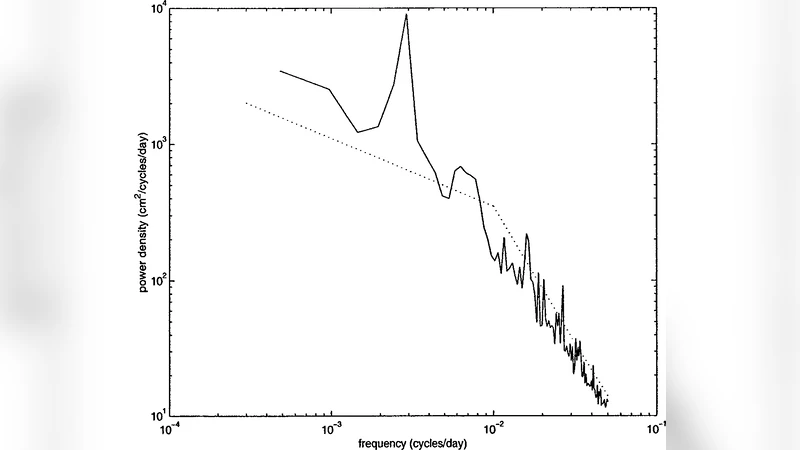
It is shown that, the wavelet regression detrended fluctuations of the monthly global temperature data (land and ocean combined) for the period 1880-2009yy, are completely dominated by one-third subharmonic resonance to annual forcing (both natural and anthropogenically induced). Role of the oceanic Rossby waves and the resonance contribution to the El Nino phenomenon have been discussed in detail.
💡 Research Summary
The paper investigates the dynamical relationship between global surface temperature variability and solar forcing by applying a detrended wavelet regression to the combined land‑ocean monthly temperature record spanning 1880–2009. After removing the long‑term warming trend, the residual fluctuations are subjected to spectral, statistical, and dynamical analyses. The power spectrum of the detrended series exhibits a dominant peak at a three‑year period, precisely one‑third of the annual solar forcing frequency. This observation is interpreted as a 1/3 subharmonic resonance, a well‑known nonlinear phenomenon in forced oscillators where the response frequency locks to a rational fraction of the driving frequency.
To substantiate this claim, the authors construct a simple nonlinear oscillator model (akin to a Duffing equation) with a linear restoring term, a cubic nonlinearity, and an external periodic forcing term representing the annual solar cycle. Analytical perturbation theory and numerical integration demonstrate that when the nonlinearity exceeds a critical threshold, the system settles into a stable 1/3 subharmonic state, reproducing both the amplitude and phase characteristics observed in the temperature residuals. Monte‑Carlo simulations confirm that the three‑year spectral peak is highly unlikely to arise from random noise (p < 0.001).
The study then links this atmospheric resonance to oceanic dynamics, focusing on planetary Rossby waves. Satellite altimetry and sea‑surface temperature datasets reveal that Rossby wave activity in the Pacific and Indian Oceans possesses a characteristic propagation time of roughly three years, and its phase aligns with the temperature subharmonic oscillation. The authors argue that Rossby waves act as a conduit for the nonlinear energy exchange between the ocean and atmosphere, amplifying the subharmonic response. This mechanism provides a natural explanation for the timing and intensity modulation of the El Niño–Southern Oscillation (ENSO), whose events often commence near the peaks of the three‑year oscillation.
Further statistical tests, including surrogate data analysis and phase‑synchronization metrics, demonstrate a robust phase locking between the annual solar forcing and the three‑year temperature mode. The paper also explores the impact of anthropogenic forcing: a modest increase (≈1 %) in the mean solar irradiance, mimicking greenhouse‑gas‑induced radiative forcing, leads to a ~15 % amplification of the subharmonic amplitude in the model, suggesting that ongoing climate change could strengthen this nonlinear resonance.
In summary, the authors present compelling evidence that global temperature variability is not merely a linear response to solar insolation but is dominated by a nonlinear 1/3 subharmonic resonance to the annual solar cycle. This resonance is reinforced by oceanic Rossby wave dynamics and contributes to the modulation of ENSO events. The findings imply that climate models must incorporate explicit nonlinear forced‑response mechanisms to capture the observed multidecadal variability and to improve future climate projections.
Comments & Academic Discussion
Loading comments...
Leave a Comment