n-ary Fuzzy Logic and Neutrosophic Logic Operators
We extend Knuth's 16 Boolean binary logic operators to fuzzy logic and neutrosophic logic binary operators. Then we generalize them to n-ary fuzzy logic and neutrosophic logic operators using the smarandache codification of the Venn diagram and a def…
Authors: Florentin Smar, ache, V. Christianto
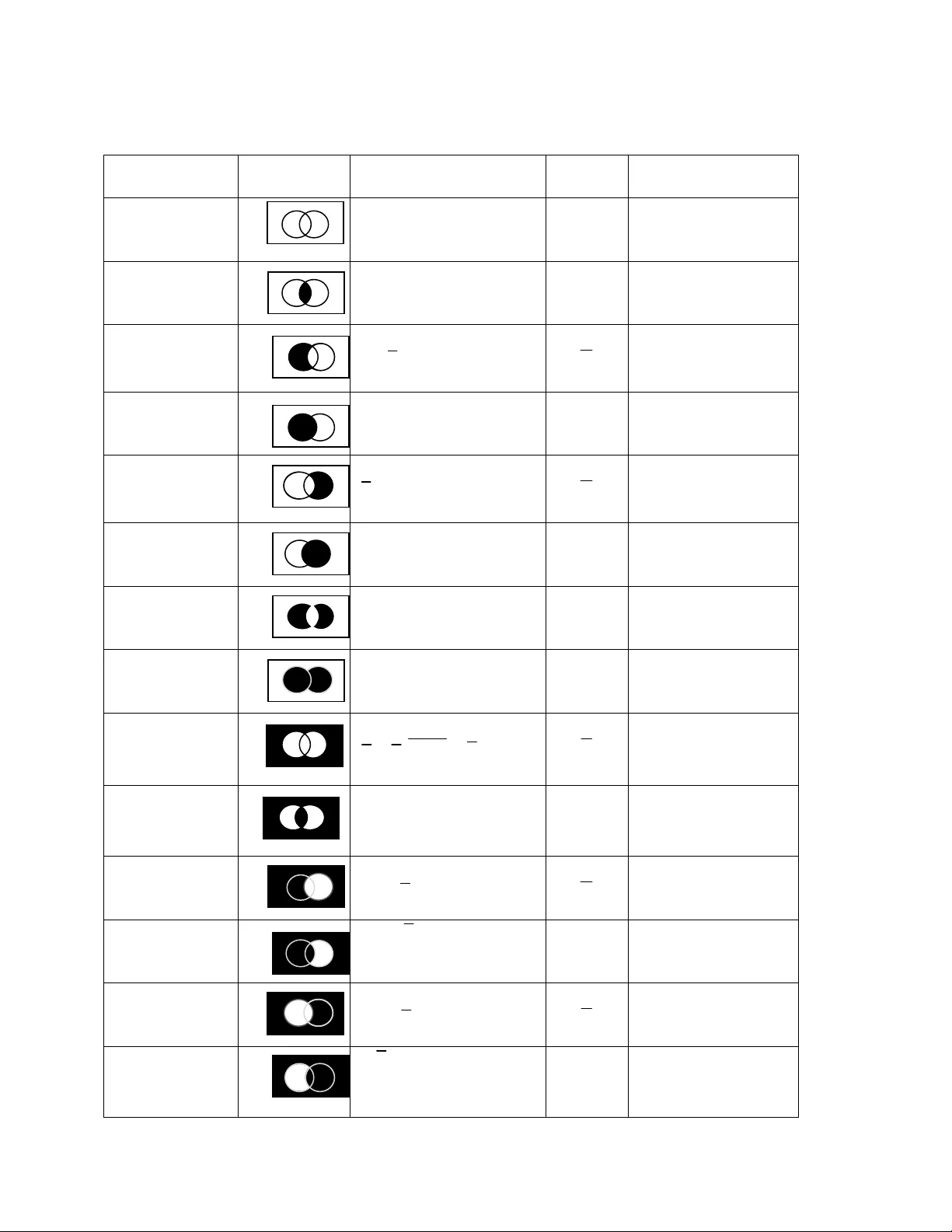
1 n-ary Fuzzy Logi c and Neutrosophic Logi c Operators Florentin Smarandache, Chair of Math & Sc. D ept. University of New Mexico, Gall up, NM 87301, USA, smarand@unm.edu and V. Christianto, SciPrint.org administrator, vxianto@yahoo.com Abstract . We extend Knuth's 16 Boolean binary logic op erators to fuzzy logic and neutrosophic logic binary operators. Then we generalize them to n-ary fuzzy logic and neutrosophic logic operators using the smarandache cod ification of the Venn diagram and a defined vector neutrosophic law. In such way, new operators in neutrosoph ic logic/set/probability are built. Keywords : binary/trinary/n-ary fuzzy logic operators, T-norm, T-conorm, binary/trinary/n-ary neutrosophic logic operators, N-norm, N-conorm Introduction . For the beginning let’s consider th e Venn Diagram of two variab les x and y , for each possible operator, as in Knuth’s table, but we ad just this table to the Fuzzy Logic (FL). Let’s denote the fuzzy logic values of these variab les as 11 () ( , ) FL x t f = where 1 t = truth value of variable x , 1 f = falsehood value of variable x, with 11 1 1 0 , 1 and 1 tf t f ≤≤ + = ; and similarly for y : 22 () ( , ) FL y t f = with the same 22 2 2 0, 1 a n d 1 tf t f ≤≤ + = . We can define all 16 Fuzzy Logical Operators with respect to two F L operators: F L conjunction () FLC and F L negation () FLN . Since in F L the falsehood value is equal to 1- truth v alue , we can deal with only one component: the truth value. The Venn Diagram for two sets X and Y 1 2 12 O 2 has 2 24 = disjoint parts: 0 = the part that does not belong to any set (the complement or negation) 1 = the part that belongs to 1 st set only; 2 = the part that belongs to 2 nd set only; 12 = the part that belongs to 1 st and 2 nd set only; {called Smarandache’s codification [1]}. Shading none, one, two, three, or four part s in all poss ible comb inations will m ake 2 42 22 1 6 == possible binary operators. We can start using a T norm − and the negation operator. Let’s take the binary conjunction or intersection (which is a T norm − ) denoted as (, ) F cx y : [] [] () [] [] 2 : 0 ,1 0 ,1 0 ,1 0 ,1 F c ×→ × and unary negation operator denoted as () F nx , with: [ ] [ ] [ ] [ ] : 0,1 0 ,1 0 ,1 0 ,1 F n ×→ × The fuzzy logic value of each part is: 12 12 P part == intersection of x and y ; so ( 12) ( , ) F FL P c x y = . 11 P part == intersection of x and negation of y ; (1 ) ( , () ) FF FL P c x n y = . 22 Pp a r t == intersection of negation of x and y ; (2 ) ( ( ) ,) FF FL P c n x y = . 00 P part == intersection of negation of x and the negation of y ; ( 0) ( ( ), ( )) FF F FL P c n x n y = , and for normalization we set the condition : () ( ) ( ) (, ) (() , , ( ) () , ( ) ( 1 , 0 ) FF F F F F F cx y c n x y c x n y c nx n y ++ + = . ( ) (() , ( ) FF cn x n y O 1 2 ( ) ,( ) FF cx n y ( ) () , FF cn x y 12 (, ) F cx y 3 Then consider a binary T conorm − (disjunction or union), denoted by (, ) F dx y : [] [] () [] [] 2 : 0, 1 0, 1 0, 1 0, 1 F d ×→ × () ( ) 12 1 2 ,, 1 F dx y tt f f =+ + − if x and y are disjoint and 12 1 tt +≤ . This fuzzy disjunction operator of disjoint variables allows us to add the fuzzy truth- values of disjoint parts of a sh aded area in the below table. W h en the truth-value increases, the false value decreases. More general, ( ) 12 , , ..., k Fk dx x x , as a k- ary disjunction (or union), for 2 k ≥ , is defined as: [] [] () [] [] : 0 ,1 0,1 0 ,1 0 ,1 k k F d ×→ × () ( ) 12 1 2 1 2 , , ..., ... , ... 1 k Fk k k dx x x t t t f f f k =+ + + + + + − + if all i x are disjoint two by two and 12 ... 1 k tt t + ++ ≤ . As a particular case let’s take as a binary fuzzy conjunction: () ( ) 12 1 2 1 2 ,, F cx y t t f f f f =+ − and as unary fuzzy negation: () ( ) 11 1 1 () 1 , 1 , F nx t f f t =− − = , where 11 () ( , ) FL x t f = , with 11 1 tf + = , and 11 0, 1 tf ≤ ≤ ; 22 () ( , ) FL y t f = , with 22 1 tf + = , and 22 0, 1 tf ≤ ≤ . whence: () 1 21 2 1 2 (1 2 ) , F LP t t f f f f =+ − () 12 1 2 1 2 (1 ) , FL P t f f t f t =+ − () 12 1 2 1 2 (2 ) , F LP f t t f tf =+ − () 12 1 2 1 2 (0 ) , FL P f f t t t t =+ − The Venn Diagram for 2 n = and considering only the truth values, becomes: 1 2 11 2 tt t − 21 2 tt t − 12 12 tt O 121 2 1 tt t t − −+ 4 since 12 1 2 1 1 2 (1 ) tf t t t t t =− = − 12 1 2 2 12 (1 ) f tt t t t t =− =− 12 1 2 1 2 1 2 (1 ) (1 ) 1 f ft t t t t t =− − = − − + . We now use: () ( ) ( ( ) ( ) ( ) 12 1 12 2 12 1 2 12 12, 1 , 2, 0 1 k F dP P P P t t t t t t t t tt t t = + −+ −+ − − + , () ( ) ( ) ( )) ( ) 12 1 2 1 2 1 2 12 1 2 1 2 1 2 31 , 0 ff f f f t f t t f t f t t t t +− + + − + +− + + − − = . So, the whole fuzzy space is normalized under ( ) FL ⋅ . For the neurosophic logic, we consider 11 1 () ( , , ) NL x T I F = , with 11 1 0, , 1 TI F ≤ ≤ ; 22 2 () ( , , ) NL y T I F = , with 22 2 0, , 1 TI F ≤ ≤ ; if the sum of components is 1 as in Atan assov’s intuitionist fuzzy logic, i.e. 1 ii i TI F ++ = , they are considered normalized ; otherwise non-norm alized , i.e. the sum of the components is <1 ( sub - normalized ) or >1 ( over-normalized ). We define a binary neutrosophic conjunction (int ersection) operator, which is a particular case of an N-norm (neutrosophic norm, a generalization of the fuzzy t-norm): [] [] [] () [] [] [] 2 : 0 ,1 0 ,1 0 ,1 0 ,1 0 ,1 0 ,1 N c ×× → ×× () 12 12 12 12 1 2 12 1 2 21 21 (, ) , , N cx y T T I I I T T I F F F I F T F T F I =+ + + + + + . The neutrosophic conjuncti on (intersection) operator N x y ∧ component truth, indeterminacy, and falsehood values result f rom the multiplicatio n () ( ) 11 1 2 2 2 TI F T I F ++ ⋅ + + since we consider in a prudent way TIF ≺≺ , where “ ≺ ” means “weaker”, i.e. the products ij TI will go to I , ij TF will go to F , and ij I F will go to F (or reciprocally we can say that F prevails in front of I and of T , So, the truth value is 12 TT , the indeterm inacy value is 12 1 2 12 I II T T I ++ and the false valu e is 12 1 2 1 2 2 1 2 1 FF FI F T FT F I +++ + . The norm of N x y ∧ is () ( ) 11 1 2 2 2 TI F T I F ++ ⋅ + + . Thus, if x and y are normalized, then N x y ∧ is also normalized. Of course, the reader can redefine the neutrosophic conjunction operator, depending on application, in a different way, for example in a more optimistic way, i.e. I TF ≺≺ or T prevails with respect to I , then we get: () 12 12 21 12 1 2 12 12 21 21 (, ) , , N ITF cx y T T T I T I I I F F F I F T F T F I =+ + + + + + . Or, the reader can consider the order TFI ≺≺ , etc. Let’s also define the unary neutrosophic negation operator: [] [] [][] [] [] : 0,1 0,1 0,1 0 ,1 0 ,1 0,1 N n ×× → ×× (T 1 I 1 F 1 ) (T 2 I 2 F 2 ) (T 1 I 1 F 1 ) (T 2 I 2 F 2 ) (T 1 I 1 F 1 ) (T 2 I 2 F 2 ) 5 () () ,, ,, N nT I F F I T = by interchanging the truth T and falsehood F vector components. Then: () 12 12 12 21 1 2 12 12 21 2 1 ( 12) , , N L P T T I II T I T F F F IF T F T F I = + + ++++ () 12 1 2 12 2 1 1 2 1 2 12 2 1 2 1 (1 ) , , N L P T F I II F I T F T F IF F T T T I =+ + + + + + () 12 12 12 2 1 1 2 12 12 2 1 2 1 (2 ) , , N L P F T I I I TI F T F T IT TF F F I =+ + + + + + () 12 1 2 12 21 1 2 1 2 12 21 2 1 (0 ) , , NL P F F I I I F I F T T T I T F T F T I = ++ + +++ Similarly as in our above fuzzy l ogic work, we now define a binary N conorm − (disjunction or union), i.e. neutrosophic conform. [] [] [] () [] [] [] 2 : 0 ,1 0 ,1 0,1 0 ,1 0 ,1 0 ,1 N d ×× → ×× () () 12 12 12 1 2 1 12 1 2 12 1 2 (, ) , , N TT TT dx y T TI I F F I IF F I IF F ττ ⎛⎞ −− −− ⎟ ⎜ ⎟ =+ + ⋅ + ⋅ ⎜ ⎟ ⎜ ⎟ ⎜ ++ + ++ + ⎝⎠ if x and y are disjoint, and 12 1 TT +≤ where τ is the neutrosophic norm of N x y ∨ , i.e. () ( ) 11 1 2 2 2 TI F T I F τ =+ +⋅+ + . We consider as neutrosophic norm of x , where 11 1 () NL x T I F =+ + , the sum of its components: 11 1 TI F ++ , which in many cases is 1, but can also be positive <1 or >1. When the truth value in creases ( ) 12 TT + is the above definition, the indeterminacy and falsehood values decrease proportiona lly with respect to their sums 12 I I + and respectively 12 FF + . This neutrosophic disjunction op erator of disjoint variables allows us to add neutrosophic truth values of disjoi nt parts of a shaded area in a Venn Diagram. Now, we complete Donald E. Knut h’s Tabl e of the Sixteen Logical Operators on two variables with Fuzzy Logical op erators on two variables with Fuzzy Logic truth values, and Neutrosophic Logic truth/indetermin acy/false values (for the case TIF ≺≺ ). 6 Table 1 Fuzzy Logic Truth Values Venn Diagram Notations Operator symbol Name(s) 0 0 ⊥ Contradiction, falsehood; constant 0 12 tt , , & x yx yx y ∧ ∧ Conjunction; and 11 2 tt t − ,, [ ] , x yx y x y x y ∧⊃ /> − ⊃ Nonimplication; difference, but not 1 t x L Left projection 21 2 tt t − ,, [ ] , x yx y x y y x ∧⊂ /< − ⊂ Converse nonimplication; not…but 2 t y R Right projection 12 1 2 2 tt t t +− ,, x yx yx y ∧ ⊕≡ / ⊕ Exclusive disjunction; nonequivalence; “xor” 12 1 2 tt t t +− ,| x yx y ∨ ∨ (Inclusive) disjunction; or; and/or 12 1 2 1 tt t t −− + ,,, x yx y x y x y ∧∨ ∨↑ ∨ Nondisjunction, joint denial, neither…nor 12 1 2 12 tt t t −− + ,, x yx yx y ≡↔ ⇔ ≡ Equivalence; if and only if 2 1 t − ,, ! , yy y y ¬ ∼ R Right complementation 21 2 1 tt t −+ ,, , x yx y x y ∨⊂⇐ [] , y x yx ≥ ⊂ Converse implication if 1 1 t − ,, ! , x xx x ¬ ∼ L Left complementation 11 2 1 tt t −+ ,, , x yx yx y ∨⊃ ⇒ [] , x x yy ≤ ⊃ Implication; only if; if..then 7 12 1 tt − ,,, | x y x yx yx y ∨∧ ∧ ∧ Nonconjunction, not both…and; “nand” 1 1 T Affirmation; validity; tautology; constant 1 8 Table 2 Venn Diagram Neutrosophic Logic Value s (0 , 0,1 ) () 12 12 1 2 ,, T T I I I T F F FI FT ++ + , where 12 21 I TI T I T =+ similarly , FI FT ; 12 12 1 2 ,, PP yy y y y IF TF I I I T F F F I F T ⎛⎞ ⎟ ⎜ ⎟ ⎜ ⎟ ++ + ⎜ ⎟ ⎜ ⎟ ⎜ ⎟ ⎜ ⎝⎠ () 11 1 ,, TI F 22 12 12 ,, PP xx x x x IF FT I I I T F F F I F T ⎛⎞ ⎟ ⎜ ⎟ ⎜ ++ + ⎟ ⎜ ⎟ ⎜ ⎟ ⎟ ⎜ ⎝⎠ ( ) 22 2 ,, TI F () () 12 1 2 12 1 2 12 1 2 ,, PP P P PP P P PP P P TF TF TF I I F F I IF F I IF F ττ ⎛ ⎞ −− ⎟ ⎜ ⎟ +⋅ + ⋅ ⎜ ⎟ ⎜ ⎟ ⎜ ++ + ++ + ⎝ ⎠ Where () ( ) 11 1 2 2 2 TI F T I F τ =+ +⋅ + + which is the neutrosophic norm () 12 12 1 2 ,, TT T I T F I I I F F F ++ + () 12 1 2 1 2 ,, FF I I I F T T T I T F ++ + () () 12 1 2 12 1 2 12 1 2 ,, PP P P PP P P PP P P TF TF F FI I T F II F F II F F ττ ⎛ ⎞ −− ⎟ ⎜ ⎟ +⋅ + ⋅ ⎜ ⎟ ⎜ ⎟ ⎜ ++ + ++ + ⎝ ⎠ ( ) 222 ,, FIT ( ) 12 1 2 ,, xx x x x FF FI F T I I I T F T ++ + () 111 ,, FIT ( ) 12 1 2 ,, yy y y y F FF I F T I II T T F ++ + 9 () 12 1 2 1 2 ,, F FF I F T I I I T T T ++ + ( 1 ,0 ,0 ) These 16 neutrosophic binary operators are approximated, since the binary N-conorm gives an approxim ation because of ‘indeterminacy ’ component. Tri-nary Fuzzy Logic and Neutrosophic Logic Operators In a more general way, for 2 k ≥ : [] [] [] () [] [] [] : 0 ,1 0 ,1 0 ,1 0 ,1 0,1 0 ,1 N k k d ×× → ×× , () () () 11 12 11 1 11 , , ..., , , kk ki ki kk k k ii Nk i i i kk ii i ii ii ii TT dx x x T I F I FI F ττ == == = == ⎛⎞ ⎟ ⎜ −− ⎟ ⎜ ⎟ ⎛⎞ ⎛ ⎞ ⎜ ⎟ ⎜ ⎟⎟ ⎜⎜ ⎟ =⋅ ⋅ ⎟⎟ ⎜ ⎟ ⎜⎜ ⎟⎟ ⎜ ⎟ ⎜⎜ ⎟⎟ ⎝⎠ ⎝ ⎠ ⎜ ⎟ ⎟ ⎜ ++ ⎟ ⎜ ⎟ ⎜ ⎝⎠ ∑∑ ∑∑ ∑ ∑∑ if all i x are disjoint two by two, and 1 1 k i i T = ≤ ∑ . We can extend Knuth’s Table from binary ope rators to tri-nary operators (and we get 3 2 2 256 = tri-nary operators) and in gene ral to n-ary operators (and we get 2 2 n n-ary operators). Let’s present the tri-nary Venn Diagram , with 3 variables ,, x yz using the name Smarandache codification. This has 3 28 = disjoint parts, and if we shade none , one, two, …, or eight of them and consider all possible combinations we get 8 22 5 6 = tri-nary operator s in the above tri-nary Venn Diagram. For n=3 we have: O 1 2 3 13 12 23 123 10 () () () () () () () 123 ( , , ) 12 , , ( ) 13 , ( ), 23 ( ), , 1, ( ) , ( ) 2( ) , , ( ) 3( ) , ( ) , 0( ) , ( ) , ( ) F FF FF FF FF F FF F FF F FF F F Pc x y z Pc x y n z Pc x n y z Pc n x y z Pc x n y n z Pc n x y n z Pc n x n y z P c nx n y nz = = = = = = = = Let 11 () ( , ) FL x t f = , with 11 1 1 1, 0 , 1 tf t f += ≤ ≤ , 22 () ( , ) FL y t f = , with 22 2 2 1, 0 , 1 tf t f += ≤ ≤ , 33 () ( , ) FL z t f = , with 33 3 3 1, 0 , 1 tf t f += ≤ ≤ . We consider the particular case defin ed by tri-nary conjunction fuzzy operator: [] [] () [] [] 3 : 0 ,1 0 ,1 0,1 0,1 F c ×→ × () 12 3 1 2 3 1 2 2 3 3 1 1 2 3 (, , ) , F c x yz t t t f f f ff f f f f ff f =+ + − − − + because () ( ) () () ( ) () 1 1 2 2 33 1 21 2 1 2 33 ,, , , , FF F t f t f tf t t f f f f tf ∧∧ = + − ∧ = () 12 3 1 2 3 1 2 2 3 3 1 1 2 3 , t t t f f f ff f f f f ff f =+ + − − − + and the unary negation operator: [] [] () [] [] : 0 ,1 0 ,1 0,1 0,1 F n ×→ × 11 1 1 () ( 1 , 1 ) ( , ) F nx t f f t =− − = . We define the function: [] [] [][] 1 : 0,1 0,1 0 ,1 0 ,1 L ×× → 1 (, , ) L αβ γ α β γ =⋅ ⋅ and the function [] [] [] [] 2 : 0, 1 0, 1 0, 1 0, 1 L ×× → 2 (, , ) L α β γ α β γ αβ βγ γα αβγ =+ + − − − + then: 11 ( ) () () () () () 112 3 2 1 2 3 112 3 2 1 2 3 1 1 2 3 21 23 11 2 3 2 12 3 11 2 3 2 12 3 11 2 3 2 1 2 3 (1 2 3 ) ( , , ) , ( , , ) (1 2 ) ( , , ) , ( , , ) (1 3 ) ( , , ) , ( , , ) (2 3 ) ( , , ) , ( , , ) (1 ) ( , , ) , ( , , ) (2 ) ( , , ) , ( , , ) ( FL P L t t t L f f f FL P L t t f L f f t FL P L t f t L f t f FL P L f t t L t f f FL P L t f f L f t t FL P L f t f L t f t FL = = = = = = () () 112 3 2 1 2 3 112 3 2 1 2 3 3) ( , , ) , ( , , ) (0 ) ( , , ) , ( , , ) PL f f t L t t f FL P L f f f L t t t = = We thus get the fuzzy truth-values as f ollows: 12 3 12 3 12 12 3 12 3 1 3 1 2 3 12 3 2 3 1 2 3 12 3 1 1 2 1 3 1 2 3 1 2 3 2 12 23 123 ( 123) ( 12) ( 1 ) (1 3 ) ( 1 ) (2 3 ) ( 1 ) (1 ) ( 1 ) ( 1 ) (2 ) ( 1 ) ( 1 ) (3 ) t t t t t t t FL P t t t FL P t t t t t t t t FL P t t t t t t t t F L P t tt tt t t t FL P t t t t t t t t t t t FL P t t t t t t t t t t t FL P = =− = − =− = − =− = − = − − = −−+ =− − =− − + 12 3 3 1 3 2 3 1 2 3 1 2 3 1231 2 1 3 2 3 1 2 3 (1 ) (1 ) (0 ) ( 1 ) ( 1 ) ( 1 ) 1 t tt t t t t t t t t t F L P t t t t ttt t t tt t t t t =− − = − − + = − − − = − −−+ + + − . We, then, consider the same disjunction or union operator 12 1 2 (, ) , 1 F dx y t t f f =+ + − , if x and y are disjoint, and 12 1 tt +≤ allowing us to add the fuzzy truth values of each part o f a shaded area. Neutrophic Composition Law Let’s consider 2 k ≥ neutrophic variables, () ,, ii ii x TI F , for all {} 1 , 2, ..., ik ∈ . Let denote () () () 1 1 1 ,. . . , , ..., , ..., k k k TT T I II FF F = = = . We now define a neutrosophic com position law N o in the following way: {} [ ] :, , 0 , 1 N oT I F → If {} ,, zT I F ∈ then 1 N k oi i zz z = = ∏ . If {} ,, , zw T I F ∈ then 12 {} {} () ( ) () () 11 11 1 1 1 1 ,..., , ,..., 1,2 ,..., ,..., 1,2 ,..., ,..., 1,2 ,.. ., ... ... NN r r k rr k r r kr rk k oo i i j j r ii j j k ii C k jj C k zw wz z z w w + + − + − = ≡ ∈ ∈ == ∑ where ( ) 1 , 2, ..., r Ck means the set of com binations of the elements {} 1 , 2, ..., k taken by r . [Similarly for ( ) 1 , 2, ..., kr Ck − ]. In other words, N o zw is the sum of all pos sible products of the components of vectors z and w , such that each product has at least a i z factor and at least j w factor, and each product has exactly k factors where each factor is a different vector component of z or of w . Similarly if we multiply three vectors: {} {} () ( ) () 1 ... 1 1 11 1 11 ... , , 1 ,..., , ,..., , ,..., 1, 2 ,..., ,..., 1,2 ,..., , ,..., ... NN uj j u v k uu v u u uv uv k u uu u v oo i i l l uvk u v ii j j l l k ii C k j j TI F T I F F ++ ++ ++ + + ++ −−= ≡ ∈∈ = () () () 1 2 1 , 2 ,..., , ,..., 1 , 2 ,..., vk u v uv k k Ck l l C k −− ++ − ∈∈ ∑ Let’s see an example for 3 k = . () () () 11 11 22 22 33 33 ,, ,, ,, x TI F x TI F x TI F 12 3 123 1 2 3 , , F NN N oo o TT T T T I I I I I F F F F == = 12 3 1 2 3 12 3 1 2 3 12 3 12 3 N o T I T I I I TI II T T TI T I T I T T =+ + + + + 12 3 1 2 3 12 3 1 2 3 12 3 1 2 3 N o T F T F F F TF F F T T TF T F T F T T = + + +++ 1 23 1 23 1 2 3 1 23 12 3 1 2 3 N o I F I FF F I F F FI I I F I FI F I I = + + +++ 12 3 1 2 3 1 2 3 1 2 3 12 3 1 2 3 NN oo TI F T I F T F I I T F I F T F I T F T I = +++++ For the case when indeterminacy I is not decomposed in subcomponents {as for example I PU =∪ where P =paradox (tru e and false simultaneously) and U =uncertainty (true or false, not sure which one)}, the previous formulas can be easily written using only three components as: ,, ( 1 , 2 , 3 ) NN oo i j r ij r TI F T I F ∈ = ∑ P where (1, 2 , 3 ) P means the set of permutations of (1, 2 , 3 ) i.e. {} ( 1 , 2 ,3 ) , ( 1 ,3 , 2 ) ,( 2 , 1 ,3 ) , ( 2 ,3 , 1 ,) ,( 3 , 1 , 2 ) , ( 3 , 2 , 1 ) 2 3 i1 (, , ) ( 1 , 2 , 3 ) (, ) ( 1 , 2 , 3 ) r N oi j j i j r ij r jr zw z w w w z z = ≡ ∈ =+ ∑ P This neurotrophic law is a ssociative and commutative. Neutrophic Logic Operators 13 Let’s consider the neutrophic lo gic cricy values of variables ,, x yz (so, for 3 n = ) () 11 1 11 1 ( ) , , with 0 , , 1 NL x T I F T I F =≤ ≤ () 22 2 22 2 () , , w i t h 0 , , 1 NL y T I F T I F =≤ ≤ ( ) 33 3 33 3 () , , w i t h 0 , , 1 NL z T I F T I F =≤ ≤ In neutrosophic logic it is not necessary to ha ve the sum of components equals to 1, as in intuitionist fuzzy logic, i.e. kk k TI F ++ is not necessary 1, for 1 3 k ≤≤ As a particular case, we define the tr i-nary conjunction neutrosophic operator: [] [] [] () [] [] [] 3 : 0 ,1 0 ,1 0,1 0 ,1 0 ,1 0 ,1 N c ×× → ×× () (, ) , , NN N N N N No o o o o o c x y T T I II T F FF IF T =++ + If x or y are normalized, th en ( , ) N cx y is also normalized. If x or y are non-normalized then (, ) N cx y x y =⋅ where ⋅ m eans norm. N c is an N-norm (neutrosophic norm, i.e. generalization of the fuzzy t-norm). Again, as a particular case, we define the unary negation ne utrosophic operator: [] [] [][] [] [] : 0, 1 0, 1 0, 1 0, 1 0, 1 0, 1 N n ×× → ×× () () 11 1 111 ( ) ,, ,, NN nx nT I F F I T == . We take the same Venn Diagram for 3 n = . So, ( ) 11 1 () , , NL x T I F = () 22 2 () , , NL y T I F = () 33 3 () , , NL z T I F = . Vectors 1 2 3 T= T T T ⎛⎞ ⎟ ⎜ ⎟ ⎜ ⎟ ⎜ ⎟ ⎜ ⎟ ⎜ ⎟ ⎜ ⎟ ⎟ ⎜ ⎝⎠ , 1 2 3 I = I I I ⎛⎞ ⎟ ⎜ ⎟ ⎜ ⎟ ⎜ ⎟ ⎜ ⎟ ⎜ ⎟ ⎜ ⎟ ⎟ ⎜ ⎝⎠ and 1 2 3 F= F F F ⎛⎞ ⎟ ⎜ ⎟ ⎜ ⎟ ⎜ ⎟ ⎜ ⎟ ⎜ ⎟ ⎜ ⎟ ⎟ ⎜ ⎝⎠ . We note 1 2 3 T= x F T T ⎛⎞ ⎟ ⎜ ⎟ ⎜ ⎟ ⎜ ⎟ ⎜ ⎟ ⎜ ⎟ ⎜ ⎟ ⎟ ⎜ ⎝⎠ , 1 2 3 T= y T F T ⎛⎞ ⎟ ⎜ ⎟ ⎜ ⎟ ⎜ ⎟ ⎜ ⎟ ⎜ ⎟ ⎜ ⎟ ⎟ ⎜ ⎝⎠ , 1 2 3 T= z T T F ⎛⎞ ⎟ ⎜ ⎟ ⎜ ⎟ ⎜ ⎟ ⎜ ⎟ ⎜ ⎟ ⎜ ⎟ ⎟ ⎜ ⎝⎠ , 1 2 3 T= xy F F T ⎛⎞ ⎟ ⎜ ⎟ ⎜ ⎟ ⎜ ⎟ ⎜ ⎟ ⎜ ⎟ ⎜ ⎟ ⎟ ⎜ ⎝⎠ , etc. and similarly 1 2 3 F= x T F F ⎛⎞ ⎟ ⎜ ⎟ ⎜ ⎟ ⎜ ⎟ ⎜ ⎟ ⎜ ⎟ ⎜ ⎟ ⎟ ⎜ ⎝⎠ , 1 2 3 = y F FT F ⎛⎞ ⎟ ⎜ ⎟ ⎜ ⎟ ⎜ ⎟ ⎜ ⎟ ⎜ ⎟ ⎜ ⎟ ⎟ ⎜ ⎝⎠ , 1 2 3 F= xz T F T ⎛⎞ ⎟ ⎜ ⎟ ⎜ ⎟ ⎜ ⎟ ⎜ ⎟ ⎜ ⎟ ⎜ ⎟ ⎟ ⎜ ⎝⎠ , etc. For shorter and easier notations let’s denote N o zw z w = and respectively NN oo zw v z w v = for the vector neutrosophic law defined previously. Then () ( ) 123 ( , ) , , N NL P c x y TT II IT FF FI FT FIT == + + + + = 14 ( 1 2 3 12 3 12 3 12 3 12 3 12 3 12 3 12 3 ,, TT T II I II T I TI T I I I T T T I T T TI =+ + + + + + 1 2 3 1 2 3 12 3 1 2 3 12 3 1 2 3 12 3 FF F FF I FI F I F F FI I I F I I I F ++++ + + + 1 2 31 2 3 1 2 31 2 3 1 2 3 1 2 3 F F T F TF T FF F T T T F T T TF + +++ + + + ) 12 3 1 2 3 1 2 3 12 3 12 3 12 3 TI F TF I I F T I T F FI T F T I + +++++ () ( ) () 12 , , ( ) , , N N zz z z z z zz z z N L P c x y n z T T I I I T FF FI F T FI T == + + + + () ( ) () 13 , ( ), , , N N yy y y y y yy y y NL P c x n y z T T II IT F F F I F T F IT == + + + + () ( ) () 23 ( ), , , , N N xx x x x x xx x y N L P c n x y z T T I I I T FF FI F T FI T == + + + + () ( ) () 1, ( ) , ( ) , , N N N y zy z y z y z y z y z y zy z y z y z N L P c x n y n z T T I II T F F F IF T F I T == + + + + () ( ) () 2( ) , , ( ), , N N N x z x z x z x z x zx z x z x zx z x z N L P cn x y n z T TI I I TF F F I F T F I T == + + + + () ( ) () 0( ) , ( ) , ( ) , , N N N N xyz xyz xyz xyz xyz x yz xyz xyz xyz xyz N L P c n x n y n z T T I I I T FF FI F T FI T == + + + + = () ,, F FI I I F T T T I T F T I F =+ + + + . n-ary Fuzzy Logic and Neutrosophic Logic Operators We can generalize for any integer 2 n ≥ . The Venn Diagram has 2 2 n disjoint parts. Each part has the form 11 ... ... kk n Pi i j j + , where 0 kn ≤≤ , and of course 0 nk n ≤−≤ ; {} 1 , ..., k ii is a combination of k elements of the set {} 1 , 2, ..., n , while {} 1 , ..., kn j j + the nk − elements left, i.e. {} {} { } 11 , ..., 1 , 2, ..., \ , ..., kk k j jn i i + = . {} 1 , ..., k ii are replaced by the corresponding numbers from {} 1 , 2, ..., n , while {} 1 , ..., kn j j + are replaced by blanks. For example, when 3 n = , {} { } 12 3 1 2 13 if , 1 , 3 Pi i j P i i == , {} { } 12 3 1 1 i f 1 Pi j j P i == . Hence, for fuzzy logic we have: () () () 11 11 ... ... , ..., , , ..., kk n k k n F i i Fj Fj P i i j j cx x nx nx + + = whence () () () 11 1 2 11 ... ... 1 , , ..., rs kn kk n i j n rs k FL Pi i j j t t f f f ϕ + == + ⎛⎞ ⎛⎞ ⎛⎞ ⎟ ⎜⎟ ⎟ ⎜ ⎜ ⎟ ⎟ =− ⎟ ⎜ ⎜ ⎜ ⎟ ⎟ ⎟ ⎜ ⎜ ⎟ ⎜ ⎟ ⎜ ⎟ ⎜ ⎝⎠ ⎝⎠ ⎝⎠ ∏∏ where [] [] :0 , 1 0 , 1 n ϕ → , () 11 12 1 2 3 1 , , ..., ... ( 1 ) ( 1 ) n nl nn l l SS S S S ϕα α α ++ = =− + + + − = − ∑ where 15 12 12 1 1 2 1 1. . . 12 ......................................... ... ......................................... ... l l n i i ij ij n li i i ii in nn S S S S α αα αα α αα α = ≤< ≤ ≤< < <≤ = = = =⋅⋅ ⋅ ∑ ∑ ∑ And for neutrosophic logic we have: () () () 11 11 ... ... , ..., , , ..., kk n k k n N i i Nj Nj P i i j j c x x nx nx + + = whence: () () 1 1 12... 12... 12... ... ... , , kk n n n n NL Pi i j j T I F + = , where 11 12... ... ... 11 jj jj r s nn kk kn nx x x x i j rs k TT T T F ++ == + ⎛⎞ ⎟ ⎜ == ⋅ ⎟ ⎜ ⎟ ⎟ ⎜ ⎝⎠ ∏∏ . 1 12... ... jj n k nx x II I I T + =+ , 11 1 1 1 1 1 12... ... ... ... ... ... ... ... jj jj jj jj jj jj jj nn n n n n n kk k k k k k n x x x xx x x x x xx x x x FF F F I F T F I T ++ + + + + + =+ + + Conclusion: A generalization of Knuth’s Bool ean binary operations is presen ted in this paper, i.e. we present n-ary Fuzzy Logic Operators and Neutro sophic Logic Operators based on Smarandache’s codification of the Venn Diagram and on a defi ned vector neutrosophic law which helps in calculating fuzzy and neut rosophic operators. Better neutrosophic operators th an in [2] are proposed herein. References: [1] F. Smarandache & J. Dezert, Advances and Applications of DSm t for Information Fusion, Am. Res. Press, 2004. [2] F. Smarandache, A unifying field in logics: Neutrosophic Logic, Neutrosophy, Neutrosophic Set, Neutrosophic Probab ility and Statistics, 1998, 2001, 2003. [3] Knuth, Art of Comput er Programming, The, Volum es 1-3 Boxed Set (2nd Edition), Addison-Wesley Professional, 1998. [4] Zadeh, Fuzzy Sets, Information and Control, Vol. 8, 338-353, 1965. [5] Driankov, Dimiter; Hellendoorn, Hans; and Reinf rank, Michael: An Introduction to Fuzzy Control. Springer, Berlin/Heidelberg, 1993. [6] Atanassov, K., Stoyanova, D., Remarks on the intuitionistic fuzzy sets. II, Notes on Intuitionistic Fuzzy Sets, Vol. 1, No. 2, 85 – 86, 1995.
Original Paper
Loading high-quality paper...
Comments & Academic Discussion
Loading comments...
Leave a Comment