Descent properties of equivariant K-theory
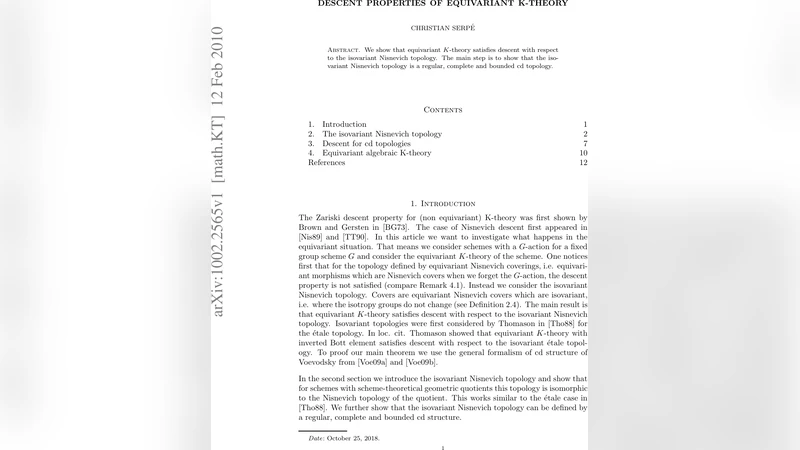
We show that equivariant K-theory satisfies descent with respect to the isovariant Nisnevich topology. The main step is to show that the isovariant Nisnevich topology is a regular, complete and bounded cd topology.
💡 Research Summary
The paper establishes that equivariant algebraic K‑theory satisfies descent with respect to the isovariant Nisnevich topology. The authors begin by recalling the classical descent results for ordinary K‑theory in the Zariski, étale, and Nisnevich settings, and then explain why these topologies are insufficient when a finite group G acts on schemes. In the equivariant context one needs a topology that respects the orbit structure; this motivates the definition of the isovariant Nisnevich topology. A morphism f : U → X is called an isovariant Nisnevich cover if it is a Nisnevich cover in the usual sense and, in addition, for every point x ∈ X the induced map on stabilizer subgroups is an isomorphism and the G‑orbit of any point of U maps bijectively onto the G‑orbit of its image. In other words, the covering families preserve isotropy groups and orbit stratifications.
The central technical contribution is the proof that this topology is a cd‑structure in the sense of Voevodsky and that it enjoys three crucial properties: regularity, completeness, and boundedness. Regularity means that any two distinguished squares can be refined to a third distinguished square; completeness guarantees that any covering sieve can be built from finitely many distinguished squares; boundedness provides a dimension function that strictly decreases along distinguished squares, ensuring that the associated cohomological dimension is finite. The authors verify each property by a careful analysis of equivariant blow‑ups, equivariant étale neighborhoods, and the behavior of stabilizer subgroups under base change. The finiteness of G and the Noetherian hypothesis on schemes are used repeatedly to control the orbit decomposition and to guarantee that isotropy groups vary in a constructible way.
Having established the cd‑structure, the paper turns to equivariant K‑theory. The functor K_G assigns to a G‑scheme X the spectrum representing G‑equivariant vector bundles (or, equivalently, perfect complexes with G‑action). Two key features of K_G are invoked: homotopy invariance (K_G(X) ≅ K_G(X × A^1)) and Nisnevich excision (Mayer–Vietoris squares for ordinary Nisnevich covers induce homotopy push‑out squares on K‑theory). The authors show that these properties extend verbatim to isovariant Nisnevich covers because the additional isotropy‑preserving condition does not interfere with the usual patching arguments; rather, it simplifies them by ensuring that the local pieces share the same stabilizer data.
Combining the cd‑structure results with the homotopy‑invariant, excisive nature of K_G, the authors apply Voevodsky’s general descent theorem for cd‑topologies: any presheaf of spectra that is homotopy invariant and satisfies Nisnevich excision automatically becomes a sheaf for any regular, complete, bounded cd‑topology. Consequently, K_G is a sheaf for the isovariant Nisnevich topology, i.e., it satisfies descent. The main theorem is stated precisely as: for any G‑scheme X, the canonical map from K_G(X) to the homotopy limit of K_G evaluated on an isovariant Nisnevich hypercover is a weak equivalence.
The paper concludes with several remarks on future directions. First, the descent result opens the way to construct an equivariant motivic spectral sequence converging from equivariant motivic cohomology to equivariant K‑theory. Second, it suggests a framework for equivariant cdh‑cohomology and for comparing equivariant K‑theory with equivariant higher Chow groups. Finally, the authors point out that the techniques should extend to more general group schemes (e.g., diagonalizable groups) and to other equivariant cohomology theories such as equivariant algebraic cobordism, provided suitable cd‑structures can be identified. Overall, the work fills a notable gap in the literature by providing the first systematic treatment of descent for equivariant K‑theory in a topology that respects isotropy, thereby laying essential groundwork for the development of an equivariant motivic homotopy theory.
Comments & Academic Discussion
Loading comments...
Leave a Comment