Motivic connective K-theories and the cohomology of A(1)
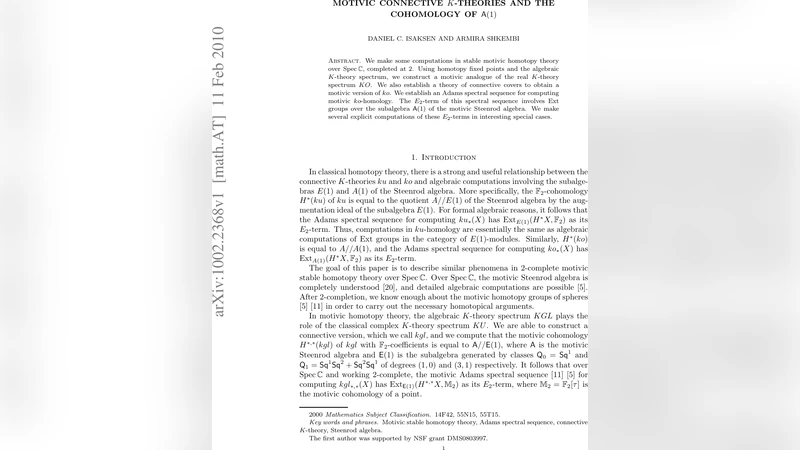
We make some computations in stable motivic homotopy theory over Spec \mathbb{C}, completed at 2. Using homotopy fixed points and the algebraic K-theory spectrum, we construct a motivic analogue of the real K-theory spectrum KO. We also establish a theory of connective covers to obtain a motivic version of ko. We establish an Adams spectral sequence for computing motivic ko-homology. The E_2-term of this spectral sequence involves Ext groups over the subalgebra A(1) of the motivic Steenrod algebra. We make several explicit computations of these E_2-terms in interesting special cases.
💡 Research Summary
The paper develops a comprehensive framework for constructing and computing motivic analogues of real K‑theory (KO) and its connective version (ko) over the complex numbers, completed at the prime 2. The authors begin by taking the algebraic K‑theory spectrum KGL, 2‑completed, and equip it with the natural C₂‑action coming from complex conjugation. By forming the homotopy fixed points of this action they obtain a new motivic spectrum, denoted KÔ, which they prove is equivalent to the classical real K‑theory spectrum when viewed through the Betti realization functor. This construction mirrors the topological passage from complex K‑theory to real K‑theory via Galois descent, but now in the motivic setting.
Next, they introduce a connective cover of KÔ, called kô, by killing the π₀‑motivic homotopy groups. This connective cover behaves exactly like the ordinary connective real K‑theory ko: its motivic homotopy groups in bidegree (n,n) agree with the classical groups for n≥0, and the extra weight grading records the motivic twist. The authors carefully analyze the Postnikov tower of KÔ and show that the connective cover can be realized as a suitable colimit of truncations, preserving the C₂‑action and the motivic Steenrod algebra structure.
Having defined kô, the central computational tool is a motivic Adams spectral sequence (ASS) converging to kô‑homology. The E₂‑page of this ASS is given by Ext groups over the subalgebra A(1) = ⟨Sq¹, Sq²⟩ of the motivic Steenrod algebra 𝔄. The paper provides a detailed description of A(1)‑module structures for a range of motivic spectra, including the motivic sphere, the motivic real projective space, the quotient S^{0,0}/η, and the 2‑local BPGL‑module. Using minimal free resolutions and the bar construction adapted to the motivic grading (cohomological degree, internal degree, and weight), the authors compute Ext^{s,t,w}_{A(1)}(𝔽₂, M) for each module M of interest.
These Ext calculations reveal a rich pattern: while the underlying algebraic structure mirrors the classical topological case (periodic families, hidden extensions, and v₁‑periodicity), the motivic weight introduces new families and shifts that are invisible topologically. For example, in the case of the motivic real projective space ℝP^{∞}_{mot}, the Ext groups reproduce the familiar KO‑cohomology but with an extra weight filtration that distinguishes classes coming from the Tate twist. In the case of S^{0,0}/η, the Ext groups are particularly simple, leading to a 2‑periodic kô‑homology that matches the known topological result after forgetting the weight. For the BPGL/2‑module, the authors obtain a more intricate Ext chart, displaying higher‑filtration classes that correspond to exotic motivic phenomena such as non‑trivial η‑extensions in weight.
Finally, the paper assembles these calculations into explicit descriptions of kô‑homology groups for the selected spectra, demonstrating how the motivic Adams spectral sequence collapses at a finite stage in each case. The authors also discuss the implications for future work: the methods extend to other subalgebras of 𝔄, to higher chromatic analogues (e.g., motivic tmf), and to computations of motivic stable stems via the slice filtration. In summary, the work provides the first systematic construction of motivic KO and ko, establishes a workable Adams spectral sequence based on A(1), and delivers concrete Ext computations that open the door to a broad program of motivic K‑theoretic calculations.
Comments & Academic Discussion
Loading comments...
Leave a Comment