In this paper offers a simple and lossless compression method for compression of medical images. Method is based on wavelet decomposition of the medical images followed by the correlation analysis of coefficients. The correlation analyses are the basis of prediction equation for each sub band. Predictor variable selection is performed through coefficient graphic method to avoid multicollinearity problem and to achieve high prediction accuracy and compression rate. The method is applied on MRI and CT images. Results show that the proposed approach gives a high compression rate for MRI and CT images comparing with state of the art methods.
Deep Dive into Medical Image Compression using Wavelet Decomposition for Prediction Method.
In this paper offers a simple and lossless compression method for compression of medical images. Method is based on wavelet decomposition of the medical images followed by the correlation analysis of coefficients. The correlation analyses are the basis of prediction equation for each sub band. Predictor variable selection is performed through coefficient graphic method to avoid multicollinearity problem and to achieve high prediction accuracy and compression rate. The method is applied on MRI and CT images. Results show that the proposed approach gives a high compression rate for MRI and CT images comparing with state of the art methods.
Image compression is required to minimize the storage space and reduction of transmission cost. Medical images like MRI and CT are Special images require lossless compression as a minor loss can cause adverse effects. Prediction is one of the techniques to achieve high compression. It means to estimate current data from already known data [1].
The advance image compression techniques for medical images are JPEG 2000 [2] which combines integer wavelet transform with Embedded Block Coding with Optimized Truncation (EBCOT). It is an compression rate. Context based adaptive compression rate. Context based adaptive advanced technique which provides high lossless image codec (CALIC) is offered by Wu and Memon [3]. They utilized the prediction in the original CALIC but offered inter band prediction technique for remotely sensed images. A better technique for lower quality ultrasound images is offered by Przelaskrwski [4] to achieve a high compression rate. Buccigrossi and Simoncelli [5] made a statistical model and used conditional probabilities for prediction. That is a lossy method called Embedded Predictive Wavelet Image Coder(EPWIC). Yao-Tien Chen & Din-Chang Tseng proposed the Wavelet-based Medical Image Compression with Adaptive Prediction (WCAP).They used correlation analysis of wavelet coefficients to identify the basis function and further for prediction. They used lifting integer wavelet scheme for image decomposition. It is a lossless scheme to achieve highest bit rate per pixel (bpp). In (WCAP) they used backward elimination method for predictor variable selection and quantized the prediction error into Three levels (-1, 0, 1) to achieve the higher compression rate. They used DPCM for coarse bands and finally used adaptive arithmetic coding.
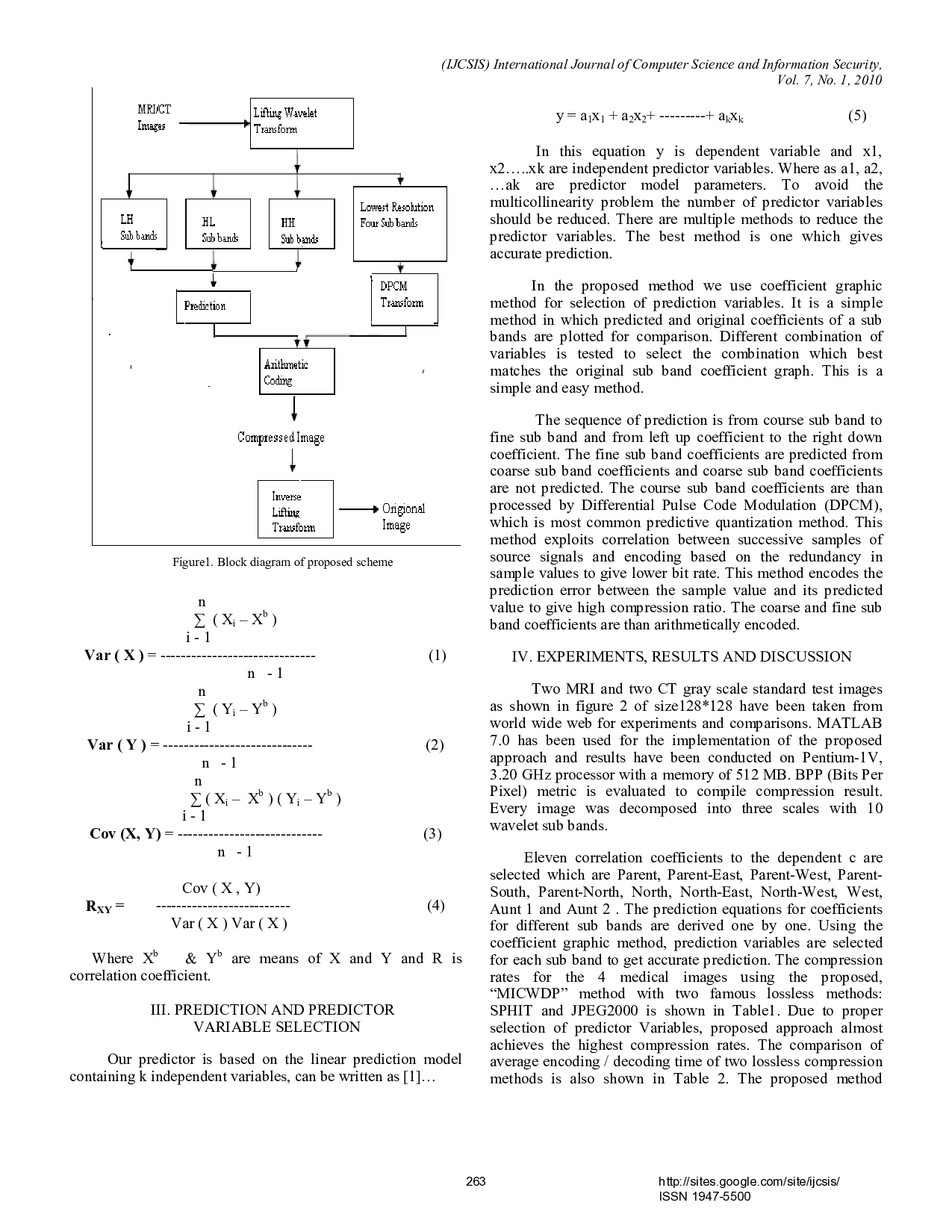
To achieve a high compression rate for medical images we propose wavelet based compression scheme using prediction, “Medical Image Compression using wavelet decomposition for Prediction method”. The scheme uses the correlation analysis of wavelet coefficients like WCAP but adds simplicity and accuracy by excluding the requirement of selection of basis function and quantization of prediction error in coarse bands. A simple, graphic method for variable selection is introduced. The proposed scheme block diagram shown in figure.1, consists of six major stages including, image decomposition, correlation analysis of wavelet coefficients, development of prediction equation for each sub band, predictor variable selection using graphic method, arithmetic coding and reconstruction of original image. The remaining sections of this paper is organized as following, section-2 covers the Lifting Wavelet Transform of group of similar images, predictor variable selection in section-3, experiments, results and discussion in section 4 and conclusion in the final.
The wavelet transform is a very useful technique for image analysis and Lifting Wavelet Transform is an advance form of wavelet transform which allows easy computation, better reconstruction of original image and close approximation of some data sets. The inter scale and intra scale dependencies of wavelet coefficients are exploited to find the predictor variable. All coefficients of current, parent and aunt sub bands of each processing coefficient are found.
The correlation coefficient is based on variance and covariance. Covariance is always measured between two matrices or dimensions while the variance is measured for a dimension with itself. The formulae for variance and covariance are as following. —————————–( —————————-( —————————(
Where X b & Y b are means of X and Y and R is correlation coefficient.
Our predictor is based on the linear prediction model containing k independent variables, can be written as [1]… y = a 1 x 1 + a 2 x 2 + ———+ a k x k (5) In this equation y is dependent variable and x1, x2…..xk are independent predictor variables. Where as a1, a2, …ak are predictor model parameters. To avoid the multicollinearity problem the number of predictor variables should be reduced. There are multiple methods to reduce the predictor variables. The best method is one which gives accurate prediction.
In the proposed method we use coefficient graphic method for selection of prediction variables. It is a simple method in which predicted and original coefficients of a sub bands are plotted for comparison. Different combination of variables is tested to select the combination which best matches the original sub band coefficient graph. This is a simple and easy method.
The sequence of prediction is from course sub band to fine sub band and from left up coefficient to the right down coefficient. The fine sub band coefficients are predicted from coarse sub band coefficients and coarse sub band coefficients are not predicted. The course sub band coefficients are than processed by Differential Pulse Code Modulation (DPCM), which is most common predictive qu
…(Full text truncated)…
This content is AI-processed based on ArXiv data.