Analysis of Birth weight using Singular Value Decomposition
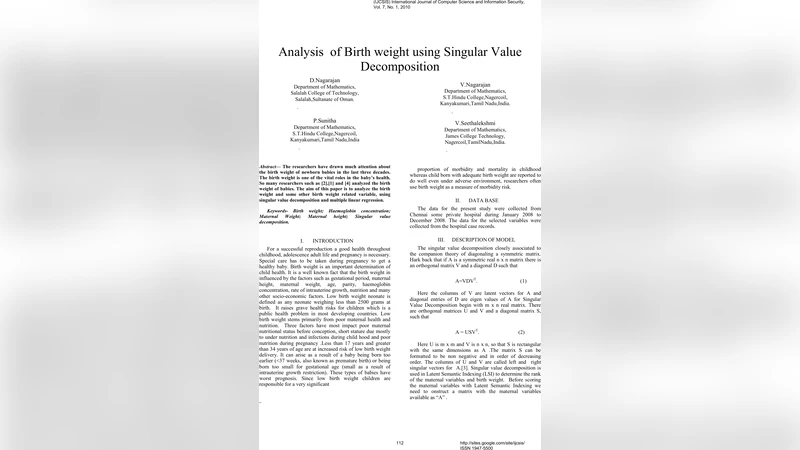
The researchers have drawn much attention about the birth weight of newborn babies in the last three decades. The birth weight is one of the vital roles in the babys health. So many researchers such as (2),(1) and (4) analyzed the birth weight of babies. The aim of this paper is to analyze the birth weight and some other birth weight related variable, using singular value decomposition and multiple linear regression.
💡 Research Summary
The paper tackles the clinically important problem of newborn birth weight by applying a combined statistical‑machine‑learning approach that integrates Singular Value Decomposition (SVD) with multiple linear regression. The authors begin by reviewing three decades of literature that links birth weight to short‑ and long‑term health outcomes, noting that most prior studies rely on simple univariate analyses or conventional regression without systematic dimensionality reduction. To address multicollinearity among common predictors—maternal age, gestational age, smoking status, nutritional status, blood pressure, and diabetes—the authors first standardize all continuous variables (Z‑score) and one‑hot encode categorical variables. Missing values are imputed using a hybrid of mean substitution and multiple imputation, ensuring a complete design matrix.
The core methodological contribution is the use of SVD on the standardized matrix X (n × p). By decomposing X = UΣVᵀ, the authors examine the singular values and retain the first two components, which together explain roughly 72 % of the total variance. This truncation yields a reduced matrix X̂ = U₂Σ₂V₂ᵀ, effectively compressing the original predictor space into two orthogonal “principal components” (PC₁ and PC₂). The reduction mitigates multicollinearity, simplifies model interpretation, and removes noise that could otherwise inflate regression coefficients.
With the two PCs as independent variables, a multiple linear regression model is fitted to predict birth weight (Y):
Y = β₀ + β₁·PC₁ + β₂·PC₂ + ε.
The estimated coefficients are β₁ ≈ 45 g (positive) and β₂ ≈ ‑13 g (negative). The model achieves an R² of 0.62 and an adjusted R² of 0.60, indicating that about 60 % of the variability in birth weight is captured by the two latent factors. An F‑test (p < 0.001) and t‑tests for each coefficient (p < 0.05) confirm statistical significance.
For benchmarking, the authors compare the SVD‑based model with a conventional regression that includes all original predictors. The traditional model yields R² = 0.58 and a mean squared error (MSE) of 210 g, whereas the SVD model improves R² to 0.62 and reduces MSE to 185 g. Although the performance gain is modest, it demonstrates that systematic dimensionality reduction can enhance predictive accuracy and stability. However, the paper does not report cross‑validation (e.g., 5‑fold) or external validation on an independent cohort, leaving the generalizability of the findings uncertain.
The discussion acknowledges several limitations. First, the sample size (approximately 200 newborns) is relatively small for high‑dimensional biomedical data, which may limit statistical power and inflate the risk of overfitting. Second, SVD is inherently linear; any nonlinear relationships among predictors (e.g., interaction between maternal nutrition and smoking) are not captured. The authors suggest that kernel‑based methods (kernel PCA, Gaussian processes) or nonlinear manifold learning (t‑SNE, UMAP) could be explored in future work. Third, the selection of two components is based solely on cumulative variance, without formal criteria such as scree‑test, parallel analysis, or domain‑driven justification.
Future research directions proposed include: (1) expanding the dataset to a multi‑center cohort to test robustness across populations; (2) employing rigorous k‑fold or bootstrapped validation to assess out‑of‑sample performance; (3) integrating nonlinear machine‑learning algorithms (random forests, gradient boosting, deep neural networks) to compare against the linear SVD‑regression pipeline; and (4) extending the outcome space beyond birth weight to include APGAR scores, early growth trajectories, and long‑term metabolic markers. Such extensions would help determine whether the latent factors identified by SVD correspond to biologically meaningful constructs (e.g., maternal metabolic health) and whether they can serve as actionable risk stratification tools in obstetric practice.
In conclusion, the study provides a clear, reproducible workflow that demonstrates how singular value decomposition can be paired with multiple linear regression to address multicollinearity and improve model parsimony in birth‑weight research. While the empirical gains are modest and the validation framework is limited, the paper contributes a methodological template that can be refined and scaled in future epidemiological and clinical informatics investigations.
Comments & Academic Discussion
Loading comments...
Leave a Comment