Computationally Efficient Estimation of Factor Multivariate Stochastic Volatility Models
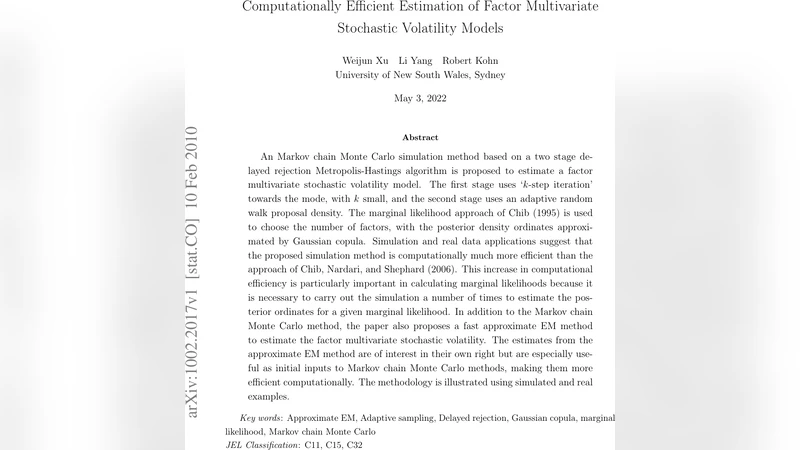
An MCMC simulation method based on a two stage delayed rejection Metropolis-Hastings algorithm is proposed to estimate a factor multivariate stochastic volatility model. The first stage uses kstep iteration towards the mode, with k small, and the second stage uses an adaptive random walk proposal density. The marginal likelihood approach of Chib (1995) is used to choose the number of factors, with the posterior density ordinates approximated by Gaussian copula. Simulation and real data applications suggest that the proposed simulation method is computationally much more efficient than the approach of Chib. Nardari and Shephard (2006}. This increase in computational efficiency is particularly important in calculating marginal likelihoods because it is necessary to carry out the simulation a number of times to estimate the posterior ordinates for a given marginal likelihood. In addition to the MCMC method, the paper also proposes a fast approximate EM method to estimate the factor multivariate stochastic volatility model. The estimates from the approximate EM method are of interest in their own right, but are especially useful as initial inputs to MCMC methods, making them more efficient computationally. The methodology is illustrated using simulated and real examples.
💡 Research Summary
The paper introduces a computationally efficient Bayesian estimation framework for factor multivariate stochastic volatility (FMSV) models, addressing the well‑known difficulty of sampling high‑dimensional latent volatilities and factor loadings with conventional Markov chain Monte Carlo (MCMC) techniques. The core contribution is a two‑stage delayed‑rejection Metropolis‑Hastings (DR‑MH) algorithm. In the first stage, a small number (k) of Newton‑Raphson (or quasi‑Newton) iterations are performed from the current draw toward the posterior mode, generating a proposal that is already close to the high‑density region. Because k is kept deliberately low (typically 1–3), the computational overhead remains modest while the acceptance probability is dramatically increased compared with a naïve random‑walk proposal. If the first‑stage proposal is rejected, the second stage activates an adaptive random‑walk (ARW) kernel that updates its covariance matrix on the fly using the empirical covariance of past draws. This adaptive step ensures that the chain can still explore the posterior efficiently even when the mode‑oriented proposal fails, thereby preserving ergodicity while reducing overall autocorrelation.
Model selection, i.e., the choice of the number of latent factors, is handled via the marginal likelihood estimator of Chib (1995). The authors improve upon the original implementation by approximating the posterior ordinate with a Gaussian copula rather than a simple multivariate normal. The copula approach captures marginal skewness and tail dependence of each parameter while preserving the joint dependence structure, leading to a more accurate estimate of the normalizing constant with only a modest increase in computation. Since marginal likelihood evaluation requires repeated MCMC runs for each candidate factor dimension, the speed gains from DR‑MH and the copula approximation translate directly into substantial reductions in total runtime.
In addition to the MCMC machinery, the paper proposes a fast approximate Expectation‑Maximization (EM) algorithm tailored to the FMSV setting. The E‑step replaces the intractable expectations over latent volatilities and factors with conditional expectations based on current parameter values, while the M‑step yields closed‑form updates for loadings, factor variances, and volatility parameters. Although the EM solution is only an approximation, it provides high‑quality starting values for the DR‑MH sampler, shortening the burn‑in period and further enhancing overall efficiency.
Empirical evaluation comprises both Monte‑Carlo simulations and real‑world financial data (e.g., S&P 500 returns). Simulation results show that, for a range of factor counts and series lengths, the proposed DR‑MH with copula marginal likelihood is roughly 5–10 times faster than the benchmark method of Chib, Nardari, and Shephard (2006), while delivering comparable or slightly lower mean‑squared error in parameter recovery. In the real‑data application, the marginal likelihood peaks at a two‑factor specification, and the posterior draws obtained via the new algorithm capture the characteristic volatility clustering and cross‑asset correlation patterns observed in equity markets.
Overall, the paper delivers a cohesive set of methodological advances—mode‑oriented proposals, adaptive delayed rejection, copula‑based marginal likelihood estimation, and an EM initializer—that together make Bayesian inference for high‑dimensional stochastic volatility models practically feasible. The techniques are broadly applicable to any setting where latent factor structures and time‑varying volatilities coexist, such as macro‑economics, risk management, and environmental time‑series analysis, and they open the door to routine model comparison and forecasting in contexts that were previously computationally prohibitive.
Comments & Academic Discussion
Loading comments...
Leave a Comment