We study suitable parameters and relations in a numerical semigroup S. When S is the Weierstrass semigroup at a rational point P of a projective curve C, we evaluate the Feng-Rao order bound of the associated family of Goppa codes. Further we conjecture that the order bound is always greater than a fixed value easily deduced from the parameters of the semigroup: we also prove this inequality in several cases.
Deep Dive into On some invariants in numerical semigroups and estimations of the order bound.
We study suitable parameters and relations in a numerical semigroup S. When S is the Weierstrass semigroup at a rational point P of a projective curve C, we evaluate the Feng-Rao order bound of the associated family of Goppa codes. Further we conjecture that the order bound is always greater than a fixed value easily deduced from the parameters of the semigroup: we also prove this inequality in several cases.
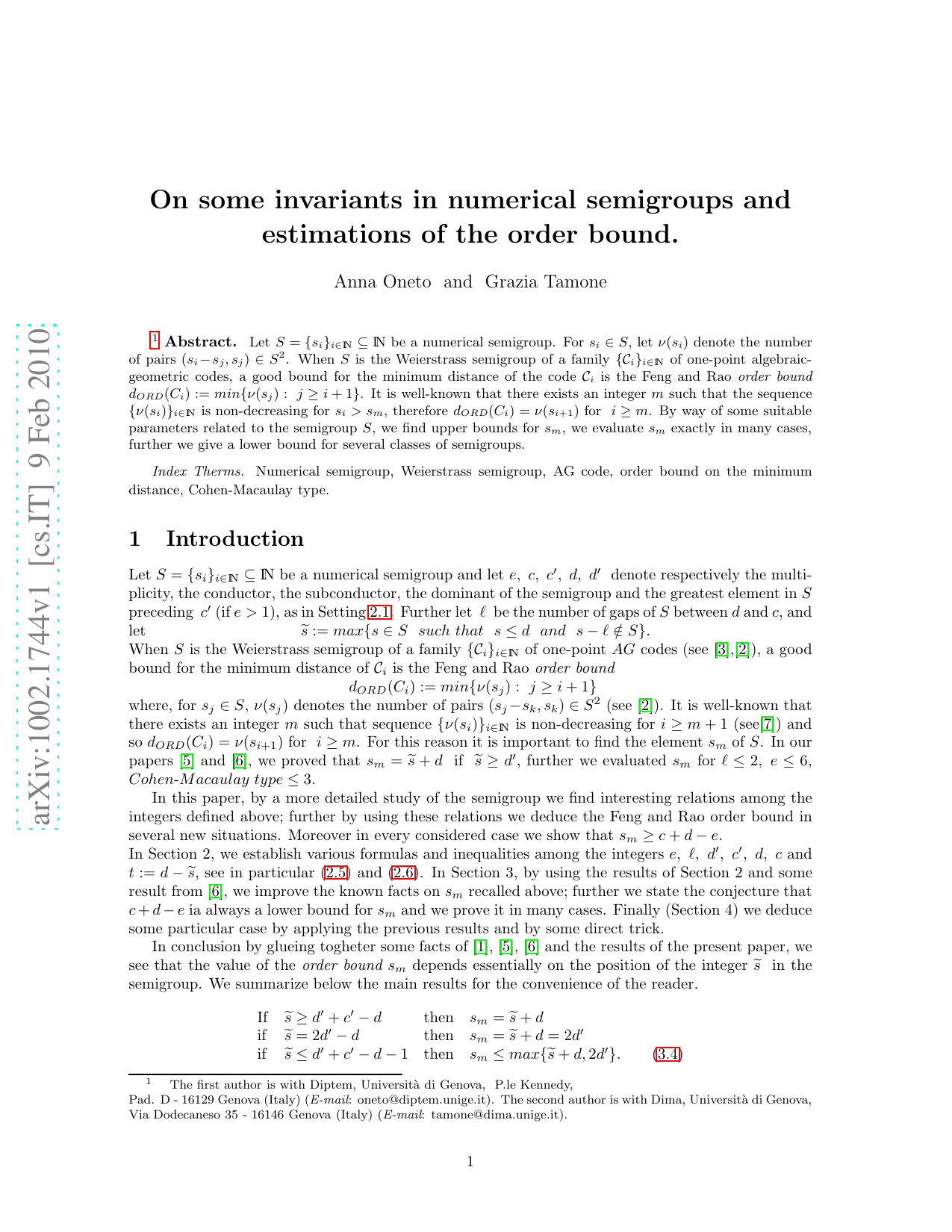
Let S = {s i } i∈IN ⊆ IN be a numerical semigroup and let e, c, c ′ , d, d ′ denote respectively the multiplicity, the conductor, the subconductor, the dominant of the semigroup and the greatest element in S preceding c ′ (if e > 1), as in Setting 2.1. Further let ℓ be the number of gaps of S between d and c, and let s := max{s ∈ S such that s ≤ d and sℓ / ∈ S}. When S is the Weierstrass semigroup of a family {C i } i∈IN of one-point AG codes (see [3], [2]), a good bound for the minimum distance of C i is the Feng and Rao order bound d ORD (C i ) := min{ν(s j ) : j ≥ i + 1} where, for s j ∈ S, ν(s j ) denotes the number of pairs (s j -s k , s k ) ∈ S 2 (see [2]). It is well-known that there exists an integer m such that sequence {ν(s i )} i∈IN is non-decreasing for i ≥ m + 1 (see [7]) and so d ORD (C i ) = ν(s i+1 ) for i ≥ m. For this reason it is important to find the element s m of S. In our papers [5] and [6], we proved that s m = s + d if s ≥ d ′ , further we evaluated s m for ℓ ≤ 2, e ≤ 6, Cohen-M acaulay type ≤ 3.
In this paper, by a more detailed study of the semigroup we find interesting relations among the integers defined above; further by using these relations we deduce the Feng and Rao order bound in several new situations. Moreover in every considered case we show that s m ≥ c + de. In Section 2, we establish various formulas and inequalities among the integers e, ℓ, d ′ , c ′ , d, c and t := ds, see in particular (2.5) and (2.6). In Section 3, by using the results of Section 2 and some result from [6], we improve the known facts on s m recalled above; further we state the conjecture that c + de ia always a lower bound for s m and we prove it in many cases. Finally (Section 4) we deduce some particular case by applying the previous results and by some direct trick.
In conclusion by glueing togheter some facts of [1], [5], [6] and the results of the present paper, we see that the value of the order bound s m depends essentially on the position of the integer s in the semigroup. We summarize below the main results for the convenience of the reader.
(3.4)
The first author is with Diptem, Università di Genova, P.le Kennedy, Pad. D -16129 Genova (Italy) (E-mail: oneto@diptem.unige.it). The second author is with Dima, Università di Genova, Via Dodecaneso 35 -16146 Genova (Italy) (E-mail: tamone@dima.unige.it). where " * " indicates gaps, " * . . . * " interval of all gaps, and " ←→ " intervals without gaps.
Moreover for s i ∈ S we fix the following notation.
Now we recall some definition and former results for completeness. First, a semigroup S is called
Definition 2.2 We define the invariants s, m and t as follows.
) and ν(s m+k ) ≤ ν(s m+k+1 ), for each k ≥ 1).
Theorem 2.3 Let S = {s i } i∈IN be as in Setting 2.1.
(1) ν(s i ) = i + 1g, for every s i ≥ 2c -1. [7,Th. 3.8] (2) ν(s i+1 ) ≥ ν(s i ), for every s i ≥ 2d + 1. In particular: Remark 2.4 (1) By the definition of s it is clear that: sℓ ∈ S f or each s ∈ S such that s < s ≤ d. (2). Theorem 2.3 implies that 0 < s m ≤ 2d for every non-ordinary semigroup.
(3) The condition (a) of (2.3.4) does not imply S acute: see (2.5.2). Analogously there exist non-acute semigroups satisfying the conditions (4.b, iii), as shown in Example 2.9.2.
We complete this section with some general relation among the invariants defined above. Proposition 2.5 [6, Prop. 2.5] Let c ′ = ce + q, with q ≥ 0. Then (1) e ≤ 2ℓ + t + q.
(2) The following conditions
(d) e = 2ℓ + t + q are equivalent and imply
Proof. ( 1) By (2.2.1) we have sℓ ≤ c ′ -1 = ce + q -1, then sℓ ≤ d + ℓe + q and so e ≤ 2ℓ + t + q.
(2) The equivalences (2.a) ⇐⇒ (2.b) ⇐⇒ (2.c) are proved in [6,Prop. 2.5]. Clearly the equality e = 2ℓ + t + q holds if and only if
Proposition 2. 6 The following facts hold.
(2) s ≥ ce (equivalently, e ≥ t + ℓ + 1).
(3) Let t > 0 and let s ′ := min{s ∈ S | s > s}. Then
In particular, s + 1 ∈ S =⇒ e ≥ 2ℓ + t.
(4) One of the following conditions hold
(2) Let c ′ = ce + q, with q ∈ {0, 1}; then dc ′ ≥ ℓ -1 and e = 2ℓ + t + q.
(3
(2) By the assumptions and by ( 5 4) By (2.5.2) we have d-c ′ ≤ ℓ-2, then by )2.6.1-2) and (3a), we deduce that {c ′ℓ, ..
(2) If s ≤ d ′ , we have: (2) When t = 0 the inequality e ≥ 2ℓ + 1 (proved in (2.6.3) for t > 0) in general is not true, even for acute semigroups:
S 3 = {0, 7 e , 12 d ′ , 14 c ′ =d , 19 c →} :
(3) When s ≤ d ′ we can have every case (a), (b), (c) of (2.6.4): 3 General results on s m .
We saw in [6], that s m = s + d, when s ≥ d ′ . To give estimations of s m in the remaining cases we shall use the same tools as in [6]: we recall them for the convenience of the reader and we add some improvement, as the general inequalities (3.1.3) on the difference ν(s + 1)ν(s). Therefore great part of the following (3.1),
(1) If s < d ′ , we have:
(2) For each
(3) Let s = 2dk < 2d and s + 1 ∈ S, then:
Proof. ( 1) By assumption and by (2.6.2) we have ce ≤ s < d ′ and so
(2) By [6, (3.3)…(3.7)] we have only to prove
…(Full text truncated)…
This content is AI-processed based on ArXiv data.