Nucleation dynamics in 2d cylindrical Ising models and chemotaxis
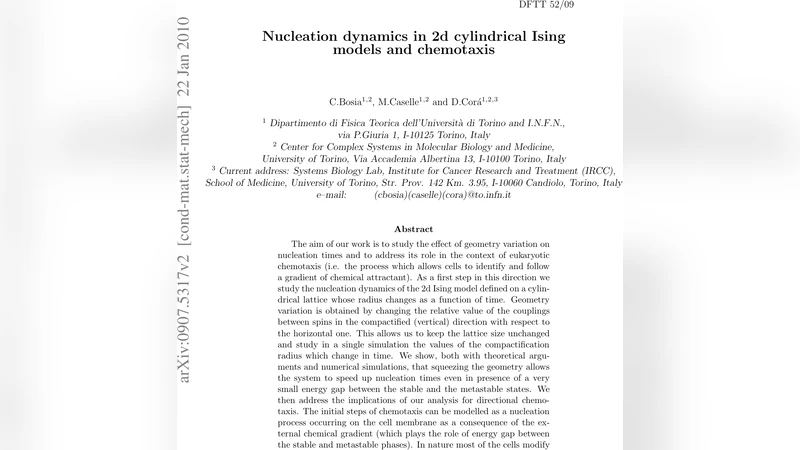
The aim of our work is to study the effect of geometry variation on nucleation times and to address its role in the context of eukaryotic chemotaxis (i.e. the process which allows cells to identify and follow a gradient of chemical attractant). As a first step in this direction we study the nucleation dynamics of the 2d Ising model defined on a cylindrical lattice whose radius changes as a function of time. Geometry variation is obtained by changing the relative value of the couplings between spins in the compactified (vertical) direction with respect to the horizontal one. This allows us to keep the lattice size unchanged and study in a single simulation the values of the compactification radius which change in time. We show, both with theoretical arguments and numerical simulations that squeezing the geometry allows the system to speed up nucleation times even in presence of a very small energy gap between the stable and the metastable states. We then address the implications of our analysis for directional chemotaxis. The initial steps of chemotaxis can be modelled as a nucleation process occurring on the cell membrane as a consequence of the external chemical gradient (which plays the role of energy gap between the stable and metastable phases). In nature most of the cells modify their geometry by extending quasi-onedimensional protrusions (filopodia) so as to enhance their sensitivity to chemoattractant. Our results show that this geometry variation has indeed the effect of greatly decreasing the timescale of the nucleation process even in presence of very small amounts of chemoattractants.
💡 Research Summary
The paper investigates how dynamic changes in geometry affect nucleation times, using a two‑dimensional Ising model defined on a cylindrical lattice whose effective radius varies with time. Instead of physically resizing the lattice, the authors modulate the ratio of the coupling constants in the vertical (compactified) direction, (J_{\perp}), to those in the horizontal direction, (J_{\parallel}). Decreasing (J_{\perp}) weakens interactions along the cylinder axis, which is mathematically equivalent to reducing the cylinder’s circumference while keeping the total number of spins constant. This approach allows a single simulation to explore a whole family of radii without altering the lattice size.
From a theoretical standpoint, nucleation in a metastable Ising system is governed by the free‑energy barrier (\Delta F) associated with forming a critical droplet. For a cylindrical geometry the barrier can be expressed as (\Delta F = 2\pi R\sigma - \pi R^{2}\Delta h), where (R) is the effective radius, (\sigma) the interfacial tension, and (\Delta h) the energy difference per spin between the stable and metastable phases (the analogue of a chemical gradient). When (\Delta h) is small—corresponding to a weak chemoattractant—the first term dominates. Consequently, reducing (R) dramatically lowers (\Delta F) and accelerates the transition.
The authors test these ideas with Metropolis Monte‑Carlo simulations. The system is initialized in the metastable state (all spins –1) and a tiny positive field (\Delta h = 0.01 J/k_{B}) biases the stable state (+1). Temperature is fixed below the critical temperature (e.g., (T = 0.8T_{c})). By varying the ratio (J_{\perp}/J_{\parallel}) from 1.0 (no compression) down to 0.2 (strong compression), they effectively shrink the cylinder’s radius by roughly a factor of five. Nucleation time is measured as the first Monte‑Carlo step at which the global magnetization becomes positive.
Results show a pronounced speed‑up: the average nucleation time drops by more than an order of magnitude when the geometry is compressed, even though the external field remains unchanged. In the most compressed case, nucleation occurs within a few hundred Monte‑Carlo steps, compared with several thousand steps for the uncompressed lattice. The acceleration is attributed not only to the reduced interfacial length but also to altered spin‑spin correlations that facilitate domain growth in the constrained geometry.
The biological relevance is addressed by mapping the Ising spins onto receptors on a cell membrane and interpreting (\Delta h) as the concentration difference of a chemoattractant across the cell. Real eukaryotic cells often extend thin, quasi‑one‑dimensional protrusions (filopodia, lamellipodia) when searching for a gradient. These structures effectively reduce the local curvature radius of the membrane, mirroring the model’s geometric compression. The authors argue that such protrusions can dramatically lower the nucleation barrier for the formation of a polarized receptor cluster, enabling cells to detect and respond to extremely shallow gradients that would otherwise be below the detection threshold.
In the discussion, the authors acknowledge limitations: the model is two‑dimensional, assumes isotropic nearest‑neighbor couplings, and treats the metastable–stable transition as a simple Ising flip. Real membranes exhibit three‑dimensional elasticity, active cytoskeletal forces, and heterogeneous receptor distributions. Moreover, the dynamics of protrusion formation and retraction are not explicitly modeled; they are represented only by a time‑dependent change in (J_{\perp}). Future work is suggested to incorporate continuum elasticity, anisotropic diffusion, and active feedback mechanisms, as well as to compare simulation outcomes with quantitative experimental data on filopodial dynamics and chemotactic response.
Overall, the study provides a clear physical mechanism—geometric compression—that can accelerate nucleation even when the driving field is vanishingly small. By linking this mechanism to cellular protrusions, the paper offers a fresh perspective on how cells might exploit shape changes to enhance sensitivity to weak chemical cues, complementing traditional ideas of receptor up‑regulation or signal amplification.