Deterministic Black-Box Identity Testing $pi$-Ordered Algebraic Branching Programs
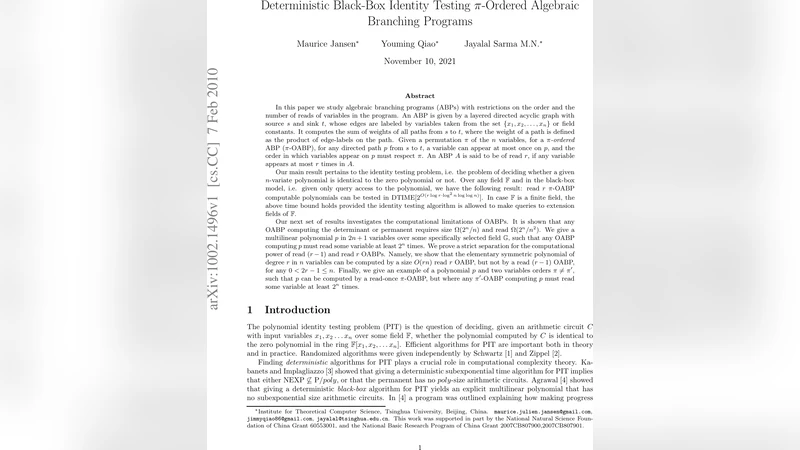
In this paper we study algebraic branching programs (ABPs) with restrictions on the order and the number of reads of variables in the program. Given a permutation $\pi$ of $n$ variables, for a $\pi$-ordered ABP ($\pi$-OABP), for any directed path $p$ from source to sink, a variable can appear at most once on $p$, and the order in which variables appear on $p$ must respect $\pi$. An ABP $A$ is said to be of read $r$, if any variable appears at most $r$ times in $A$. Our main result pertains to the identity testing problem. Over any field $F$ and in the black-box model, i.e. given only query access to the polynomial, we have the following result: read $r$ $\pi$-OABP computable polynomials can be tested in $\DTIME[2^{O(r\log r \cdot \log^2 n \log\log n)}]$. Our next set of results investigates the computational limitations of OABPs. It is shown that any OABP computing the determinant or permanent requires size $\Omega(2^n/n)$ and read $\Omega(2^n/n^2)$. We give a multilinear polynomial $p$ in $2n+1$ variables over some specifically selected field $G$, such that any OABP computing $p$ must read some variable at least $2^n$ times. We show that the elementary symmetric polynomial of degree $r$ in $n$ variables can be computed by a size $O(rn)$ read $r$ OABP, but not by a read $(r-1)$ OABP, for any $0 < 2r-1 \leq n$. Finally, we give an example of a polynomial $p$ and two variables orders $\pi \neq \pi’$, such that $p$ can be computed by a read-once $\pi$-OABP, but where any $\pi’$-OABP computing $p$ must read some variable at least $2^n$
💡 Research Summary
The paper studies algebraic branching programs (ABPs) under two simultaneous restrictions: a fixed variable order π and a bound r on the number of times each variable may appear (read‑r). A π‑ordered ABP (π‑OABP) requires that every source‑to‑sink path respects the permutation π and that each variable occurs at most once on any such path. The authors address two central questions for this model: (1) deterministic black‑box polynomial identity testing (PIT) and (2) lower bounds on the computational power of π‑OABPs.
Deterministic Black‑Box PIT.
The main algorithm works in the black‑box setting, i.e., the tester can only query the unknown polynomial. The key observation is that the order constraint forces a strong structural regularity: variables appear in a fixed sequence along every computation path, which enables a recursive “degree‑compression” technique. Variables are grouped into blocks of size roughly log n; within each block the effective degree of the polynomial contributed by the block can be reduced to O(r log r) by a careful substitution that preserves non‑zeroness (a variant of the Shpilka‑Volkovich generator). The blocks are then merged recursively, each merge incurring an additional factor of log n in the exponent. After O(log n) levels of recursion the total degree of the compressed polynomial is bounded by O(r log r·log² n·log log n). Applying the Schwarz‑Zippel lemma on this low‑degree surrogate yields a deterministic black‑box test that uses at most 2^{O(r log r·log² n·log log n)} field queries and runs in the same time bound. Consequently, for constant or poly‑logarithmic read r the algorithm runs in quasi‑polynomial time, a substantial improvement over the naïve 2^{O(n)} bound for unrestricted ABPs.
Lower Bounds and Structural Limitations.
The second part of the work establishes several strong lower bounds for π‑OABPs, showing that the order and read restrictions do not trivialize the model.
-
Determinant and Permanent.
Any π‑OABP that computes the n × n determinant or permanent must have size at least Ω(2^{n}/n) and must read some variable at least Ω(2^{n}/n²) times. The proof combines a communication‑complexity argument (reducing the computation to a set‑disjointness problem) with the observation that a π‑OABP cannot “reuse” variables across different parts of the matrix without violating the order constraint. -
A Hard Multilinear Polynomial.
Over a suitably chosen field G, the authors construct a multilinear polynomial p in 2n + 1 variables such that any OABP (order‑free) computing p must read at least one variable 2^{n} times. The construction embeds a full binary tree of depth n into the monomial structure, forcing any path that respects the OABP topology to traverse exponentially many distinct variable occurrences. -
Elementary Symmetric Polynomials.
The elementary symmetric polynomial e_{r}(x₁,…,x_n) of degree r can be computed by a read‑r π‑OABP of size O(r n). However, the authors prove that no read‑(r‑1) π‑OABP (for any permutation π) can compute e_{r} when 0 < 2r − 1 ≤ n. The argument uses the rank of the coefficient matrix of e_{r} and shows that a read‑(r‑1) program cannot generate the required r‑wise interactions among variables. -
Order‑Sensitivity Example.
Finally, they exhibit a polynomial p and two permutations π ≠ π′ such that p admits a read‑once π‑OABP, yet any π′‑OABP must read some variable at least 2^{n} times. The construction hinges on arranging the monomials so that the “good” order aligns each variable with a unique layer of the ABP, while the “bad” order forces the program to repeatedly revisit the same variable to respect the order, leading to exponential read. This demonstrates that the computational power of OABPs can vary dramatically with the chosen variable order.
Implications and Future Directions.
The deterministic PIT algorithm shows that the combination of read‑restriction and a fixed order yields enough regularity to break the exponential barrier in the black‑box model. The lower bounds confirm that despite this regularity, π‑OABPs remain weak for classic hard polynomials, and that read‑r is essentially tight for certain natural families (e.g., elementary symmetric polynomials). Moreover, the order‑sensitivity result suggests that optimizing the permutation π could be as crucial as minimizing the read, opening a new line of research on permutation selection for restricted algebraic models.
Overall, the paper contributes a quasi‑polynomial deterministic black‑box PIT for read‑r π‑OABPs, establishes exponential size and read lower bounds for determinant, permanent, and specially crafted polynomials, and clarifies the delicate interplay between variable order and read‑restriction in algebraic branching programs.
Comments & Academic Discussion
Loading comments...
Leave a Comment