Normalities and Commutators
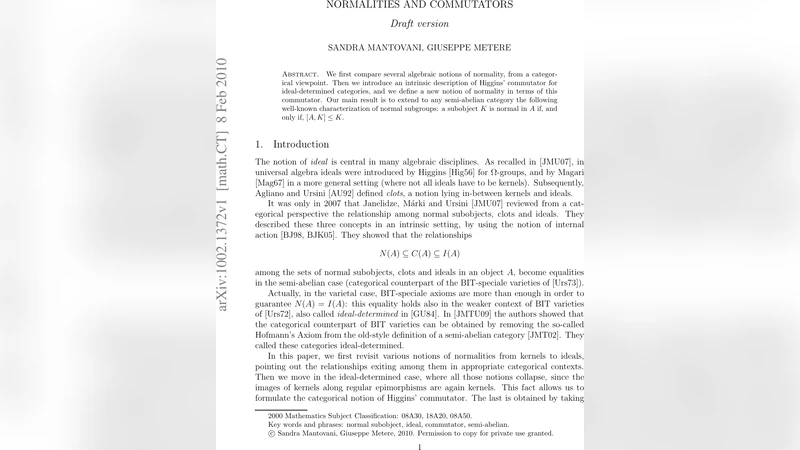
We first compare several algebraic notions of normality, from a categorical viewpoint. Then we introduce an intrinsic description of Higgins’ commutator for ideal-determined categories, and we define a new notion of normality in terms of this commutator. Our main result is to extend to any semi-abelian category the following well-known characterization of normal subgroups: a subobject $K$ is normal in $A$ if, and only if, $[A,K]\leq K$.
💡 Research Summary
The paper “Normalities and Commutators” investigates the notion of normal subobjects from a categorical perspective and establishes a deep connection between normality and Higgins’ commutator in ideal‑determined categories, culminating in a generalization of a classical group‑theoretic characterization of normal subgroups to any semi‑abelian category.
The authors begin by reviewing several algebraic concepts of normality—normal subgroups in groups, normal subobjects in a general category, and ideals in ideal‑determined categories. They introduce the categorical term “normal monomorphism” to unify these notions and prove that, in a semi‑abelian setting, normal monomorphisms coincide with ideal‑generated subobjects. This unification clarifies that the traditional view of normality as “being a kernel” extends naturally to a broad class of algebraic structures beyond groups and rings.
Next, the paper turns to the commutator. Higgins originally defined a commutator of two subobjects as a way of measuring how far they fail to commute. The authors reinterpret this construction in the language of ideal‑determined categories by defining a canonical comparison morphism (
Comments & Academic Discussion
Loading comments...
Leave a Comment