Pure Nash Equilibria: Complete Characterization of Hard and Easy Graphical Games
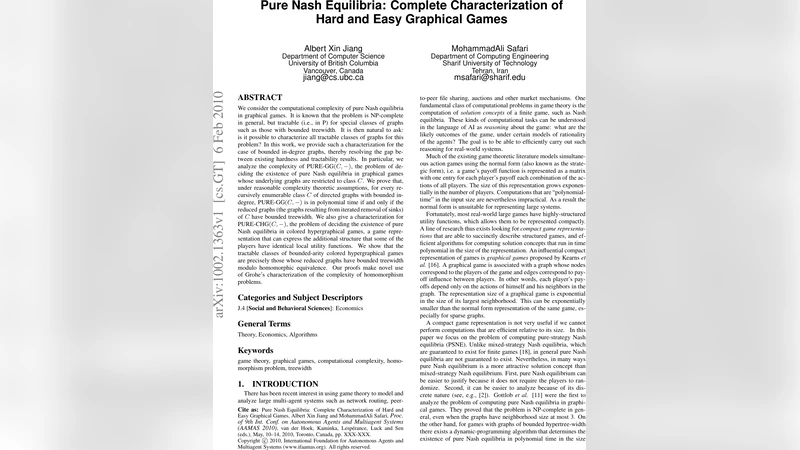
We consider the computational complexity of pure Nash equilibria in graphical games. It is known that the problem is NP-complete in general, but tractable (i.e., in P) for special classes of graphs such as those with bounded treewidth. It is then natural to ask: is it possible to characterize all tractable classes of graphs for this problem? In this work, we provide such a characterization for the case of bounded in-degree graphs, thereby resolving the gap between existing hardness and tractability results. In particular, we analyze the complexity of PUREGG(C, -), the problem of deciding the existence of pure Nash equilibria in graphical games whose underlying graphs are restricted to class C. We prove that, under reasonable complexity theoretic assumptions, for every recursively enumerable class C of directed graphs with bounded in-degree, PUREGG(C, -) is in polynomial time if and only if the reduced graphs (the graphs resulting from iterated removal of sinks) of C have bounded treewidth. We also give a characterization for PURECHG(C,-), the problem of deciding the existence of pure Nash equilibria in colored hypergraphical games, a game representation that can express the additional structure that some of the players have identical local utility functions. We show that the tractable classes of bounded-arity colored hypergraphical games are precisely those whose reduced graphs have bounded treewidth modulo homomorphic equivalence. Our proofs make novel use of Grohe’s characterization of the complexity of homomorphism problems.
💡 Research Summary
The paper delivers a complete structural classification of the computational complexity of finding pure Nash equilibria (PNE) in graphical games when the underlying interaction graph belongs to a restricted class. The authors focus on two representations: the classic graphical game model (PUREGG) and the more expressive colored hypergraphical game model (PURECHG), which captures the situation where several players share identical local utility functions.
Key Concepts and Definitions
- Reduced Graph – For a directed graph G, repeatedly delete sinks (vertices with no outgoing edges) until none remain. The resulting subgraph R(G) is called the reduced graph. This operation isolates the “core” part of the game that can actually affect equilibrium existence, because any strategy profile can be extended arbitrarily on removed sinks.
- Treewidth – A graph‑theoretic measure of how close a graph is to a tree. Bounded treewidth enables dynamic programming on a tree decomposition.
- Bounded In‑Degree – The maximum number of incoming edges per vertex is limited by a constant k. This restriction keeps the size of each player’s local utility table polynomial.
- Colored Hypergraphical Games – Players are vertices of a hypergraph; each hyperedge corresponds to a local interaction, and a color identifies the utility function shared by all hyperedges of that color.
- Homomorphic Equivalence (modulo homomorphism) – Two hypergraphs are equivalent if there exist homomorphisms in both directions. Grohe’s seminal work shows that the H‑homomorphism problem is in P exactly when the core of H has bounded treewidth.
Main Results for PUREGG(C, –)
- Theorem 1 (Tractability): Let C be any recursively enumerable class of directed graphs with a constant in‑degree bound. If every reduced graph of C has treewidth bounded by a constant, then the decision problem PUREGG(C, –) (does a pure Nash equilibrium exist?) can be solved in polynomial time. The algorithm builds a tree decomposition of each reduced graph and runs a standard dynamic‑programming procedure that enumerates consistent local action profiles across the bags. Because the in‑degree is bounded, each bag contains only O(k·tw) variables, keeping the state space polynomial.
- Theorem 2 (Hardness): If C contains reduced graphs of unbounded treewidth, then, assuming P ≠ NP, PUREGG(C, –) is NP‑complete. The proof constructs a reduction from SAT (or planar‑3‑SAT) to a graphical game whose interaction graph belongs to C and whose reduced graph retains the SAT structure. A “sink‑free gadget” ensures that every variable and clause vertex remains in the core, preserving the unbounded treewidth. The reduction respects the in‑degree bound, so the resulting game is a valid instance of PUREGG(C, –). Consequently, the existence of a pure Nash equilibrium is equivalent to the satisfiability of the original formula.
Extension to Colored Hypergraphical Games (PURECHG(C, –))
- Theorem 3 (Tractability): For any recursively enumerable class C of bounded‑arity colored hypergraphs, if the reduced hypergraphs are homomorphically equivalent to hypergraphs whose cores have bounded treewidth, then PURECHG(C, –) lies in P. The authors translate the equilibrium problem into an H‑homomorphism problem where H is the core of the reduced hypergraph. Grohe’s characterization guarantees a polynomial‑time algorithm, which is implemented via tree‑decomposition‑based dynamic programming that respects colors (i.e., shared utility functions).
- Theorem 4 (Hardness): If the above condition fails, PURECHG(C, –) becomes NP‑complete (or harder) under standard complexity assumptions. The reduction again starts from SAT, but now groups variables that share the same utility function into a single color class. The hyperedges encode clauses, and the lack of bounded‑treewidth cores forces the homomorphism problem to be hard, which transfers to the equilibrium decision problem.
Technical Contributions
- Reduced‑Graph Framework – By formalizing sink removal, the authors isolate the essential part of a game that determines equilibrium existence, providing a clean structural lens that was previously missing.
- Dynamic‑Programming on Bounded‑Treewidth Cores – The paper adapts classic CSP techniques to the game‑theoretic setting, handling utility tables that grow with the in‑degree bound rather than the total number of actions.
- Bridging Grohe’s Homomorphism Theory and Game Theory – The work is the first to apply Grohe’s dichotomy for homomorphism problems to the analysis of pure Nash equilibria in colored hypergraphical games, thereby extending the reach of algebraic graph theory into algorithmic game theory.
- General Applicability – Because the results hold for any recursively enumerable class, they immediately cover many natural families such as planar graphs, bounded‑clique‑width graphs, series‑parallel graphs, and various hypergraph families used in network economics and multi‑agent systems.
Implications and Future Directions
- Design Guidance – When constructing multi‑agent systems, ensuring that the interaction graph’s reduced core has bounded treewidth (or that the hypergraph core does) guarantees tractable equilibrium computation.
- Beyond Pure Strategies – The methodology suggests possible extensions to mixed‑strategy equilibria, ε‑Nash equilibria, or to the computation of all equilibria, where similar structural parameters may dictate complexity.
- Alternative Graph Parameters – Investigating whether other measures (clique‑width, rank‑width, modular width) admit analogous dichotomies remains an open line of research.
- Dynamic Environments – Extending the reduced‑graph approach to time‑varying graphs could yield insights into equilibrium tracking in evolving networks.
In summary, the paper settles a long‑standing open question by proving that, for bounded‑in‑degree graphical games, the existence of a pure Nash equilibrium is polynomial‑time decidable exactly when the reduced interaction graphs have bounded treewidth, and that the same structural condition—interpreted through homomorphic equivalence—characterizes tractability for colored hypergraphical games. This bridges graph‑theoretic decomposition techniques, constraint‑satisfaction complexity, and algorithmic game theory into a unified, elegant classification.
Comments & Academic Discussion
Loading comments...
Leave a Comment