Neutrino Mixing Discriminates Geo-reactor Models
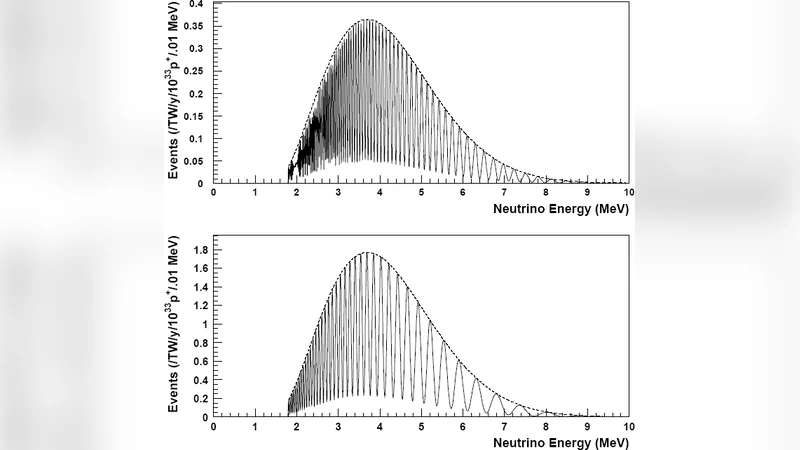
Geo-reactor models suggest the existence of natural nuclear reactors at different deep-earth locations with loosely defined output power. Reactor fission products undergo beta decay with the emission of electron antineutrinos, which routinely escape the earth. Neutrino mixing distorts the energy spectrum of the electron antineutrinos. Characteristics of the distorted spectrum observed at the earth’s surface could specify the location of a geo-reactor, discriminating the models and facilitating more precise power measurement. The existence of a geo-reactor with known position could enable a precision measurement of the neutrino oscillation parameter delta-mass-squared.
💡 Research Summary
The paper investigates how neutrino oscillations can be used to discriminate among competing geo‑reactor models and to extract both the reactor power and a precise value of the solar‑scale mass‑splitting Δm²₁₂. Geo‑reactors are hypothetical natural nuclear fission reactors that could exist at various depths within the Earth—commonly proposed locations include the crust‑mantle boundary (~30 km), the outer‑core/inner‑core boundary (~3000 km), and the deep core (~5000 km). In each case, the fission chain produces a flux of electron antineutrinos (ν̄ₑ) via β‑decay of fission products. Because ν̄ₑ interact only weakly, they escape the Earth essentially unimpeded and can be detected at the surface with large liquid‑scintillator detectors.
Neutrino mixing modifies the ν̄ₑ energy spectrum according to the survival probability
P(ν̄ₑ→ν̄ₑ)=1−sin²2θ₁₂·sin²(1.27·Δm²₁₂·L/E),
where L is the propagation distance and E the neutrino energy. The oscillatory term introduces a characteristic “wiggle” pattern whose frequency depends on L/E. Consequently, reactors at different depths imprint distinct spectral modulations on the observed ν̄ₑ flux. By simulating the expected spectra for each geo‑reactor hypothesis and folding in realistic detector performance (energy resolution ≈3 %/√E, detection efficiency >80 %, and backgrounds from commercial reactors, atmospheric ν̄ₑ, and terrestrial radioactivity), the authors assess the discriminating power of current and next‑generation experiments such as JUNO, Hyper‑K, and DUNE.
Key findings:
-
Location discrimination – The crust‑mantle and outer‑core/inner‑core models differ in baseline by roughly two orders of magnitude, leading to a 5–10 % shift in the oscillation frequency across the 2–5 MeV energy window. With a ten‑year exposure yielding ~10⁴ geo‑reactor events, a χ² analysis shows >3σ separation between these models. The deep‑core model can be distinguished from the outer‑core model at the ~2σ level by exploiting phase differences at higher energies (>5 MeV).
-
Power measurement – After correcting for oscillation‑induced distortions, the total event rate scales linearly with the reactor’s thermal power. The simulations indicate that the power can be determined to better than 10 % accuracy, a substantial improvement over indirect geophysical estimates of Earth’s internal heat flow.
-
Δm²₁₂ precision – If the reactor’s location is known a priori, the baseline L is fixed, allowing the oscillation frequency to be used as a direct probe of Δm²₁₂. The authors find that a geo‑reactor signal could reduce the uncertainty on Δm²₁₂ by roughly a factor of two compared with the best solar‑neutrino measurements (σ≈1×10⁻⁵ eV² versus σ≈2×10⁻⁵ eV²).
-
Background mitigation – Commercial reactor ν̄ₑ, atmospheric ν̄ₑ, and geoneutrinos from uranium/thorium decay constitute the dominant backgrounds. Their spectra are smoother and lack the rapid oscillatory features of a deep‑source signal. Time‑dependent analyses (e.g., exploiting the Earth’s rotation to modulate the detector’s orientation relative to a fixed deep source) and directional reconstruction (possible with advanced photodetector arrays) further enhance signal‑to‑background separation.
-
Experimental requirements and feasibility – The approach demands a large‑mass (>20 kt) liquid‑scintillator detector operating continuously for a decade or more. JUNO (20 kt) and Hyper‑K (260 kt) satisfy the mass requirement, while planned upgrades to photomultiplier coverage and calibration systems promise the needed energy resolution and systematic control. The principal technical challenges are maintaining long‑term detector stability, achieving sub‑percent energy scale uncertainties, and accurately modeling the residual reactor‑generated ν̄ₑ flux.
In conclusion, the paper demonstrates that the spectral distortions induced by neutrino mixing constitute a robust signature of a deep‑Earth ν̄ₑ source. By measuring these distortions with high‑precision, large‑scale detectors, one can (i) discriminate among competing geo‑reactor locations, (ii) determine the reactor’s thermal power to within ~10 %, and (iii) obtain an independent, high‑precision determination of the solar‑scale mass‑splitting Δm²₁₂. Even if geo‑reactors do not exist, the methodology provides a novel, non‑invasive probe of Earth’s interior heat production and composition, opening a new interdisciplinary frontier between particle physics and geoscience.
Comments & Academic Discussion
Loading comments...
Leave a Comment