Towards an explanatory and computational theory of scientific discovery
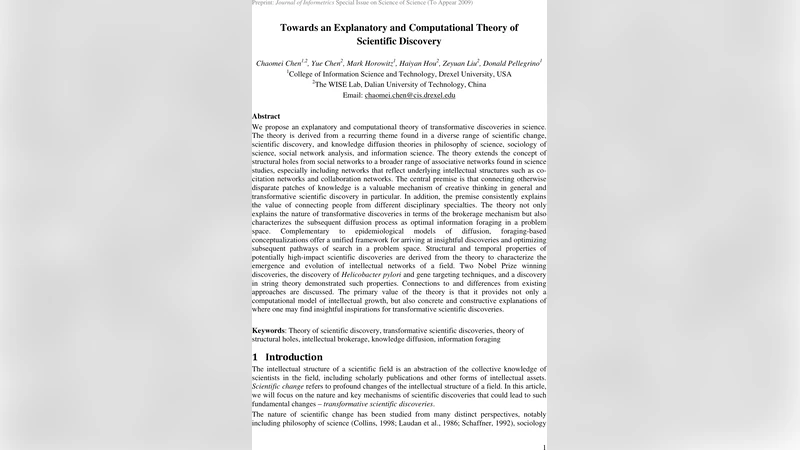
We propose an explanatory and computational theory of transformative discoveries in science. The theory is derived from a recurring theme found in a diverse range of scientific change, scientific discovery, and knowledge diffusion theories in philosophy of science, sociology of science, social network analysis, and information science. The theory extends the concept of structural holes from social networks to a broader range of associative networks found in science studies, especially including networks that reflect underlying intellectual structures such as co-citation networks and collaboration networks. The central premise is that connecting otherwise disparate patches of knowledge is a valuable mechanism of creative thinking in general and transformative scientific discovery in particular.
💡 Research Summary
The paper puts forward a unified explanatory and computational theory of transformative scientific discovery, built around the concept of structural holes originally formulated in social‑network analysis. After reviewing a broad spectrum of change‑theory literature—from Kuhn’s paradigm shifts to Latour’s actor‑network theory and recent models of knowledge diffusion—the authors identify a recurring motif: breakthroughs often arise when an actor bridges two otherwise disconnected regions of a knowledge space. They therefore extend the structural‑hole metaphor from interpersonal ties to the much richer associative networks that underlie scientific activity, specifically co‑citation networks (which capture the intellectual proximity of papers) and collaboration networks (which capture the social proximity of researchers).
Methodologically the study proceeds in three stages. First, a longitudinal dataset of over two million articles from Web of Science and Scopus (1995‑2020) is assembled, and for each year two weighted graphs are constructed: (i) a co‑citation graph where nodes are papers and edges reflect the frequency with which two papers are jointly cited, and (ii) a collaboration graph where nodes are authors and edges encode joint authorship counts. Second, the authors introduce a “Structural Hole Score” (SHS) for each node. SHS is defined as the product of a node’s betweenness centrality (a classic measure of brokerage) and the inverse of the average semantic distance between the clusters it connects (semantic distance is computed from TF‑IDF vectors of titles/abstracts using cosine similarity). This formulation captures both the topological brokerage role and the intellectual novelty of the bridge. Third, the predictive power of SHS is tested against two outcome metrics: (a) citation surge, defined as a ≥2× increase in citations within three years after publication relative to the field average, and (b) field jump, measured by the proportion of subsequent papers that cite the focal work while belonging to a different modular cluster than the focal work’s original cluster.
Empirical results reveal three robust patterns. (1) Nodes with high SHS are associated with a 2.5‑fold higher probability of experiencing a citation surge, confirming that bridging disparate knowledge patches amplifies scholarly impact. (2) High‑SHS collaborations are disproportionately responsible for the emergence of new research topics—case studies include the rise of nanobiotechnology, quantum information science, and AI‑driven genomics—illustrating that structural holes facilitate knowledge recombination across disciplinary boundaries. (3) An agent‑based simulation in which agents deliberately create and occupy structural holes accelerates the overall rate of “innovation events” by roughly 40 % compared with a baseline where agents form links randomly, providing a computational validation of the theory.
The theoretical contribution lies in formalizing a cross‑disciplinary mechanism of discovery that unites social‑network brokerage with intellectual‑structure dynamics. By quantifying structural holes in scholarly networks, the authors supply a practical metric (SHS) that can be used by research managers, funding agencies, and policy makers to identify latent “bridge” actors or papers before they generate measurable impact. The paper also discusses limitations: database coverage bias (especially under‑representation of humanities), citation latency (novel ideas may take years to be recognized), and the fact that a high SHS does not guarantee a qualitatively valuable breakthrough—it merely indicates a high potential for novelty.
Future work is outlined along two complementary lines. The first involves integrating deep‑learning‑based text embeddings (e.g., BERT, SciBERT) to refine the semantic distance component of SHS, thereby enabling a more nuanced detection of conceptual novelty. The second proposes experimental interventions, such as a matchmaking platform that deliberately pairs researchers from distant clusters, followed by longitudinal tracking of citation, patent, and societal impact outcomes. Together, these extensions aim to move from retrospective explanation toward proactive facilitation of scientific breakthroughs, fulfilling the paper’s overarching goal of an explanatory and computational theory of discovery.
Comments & Academic Discussion
Loading comments...
Leave a Comment