We review results from general relativistic axisymmetric magnetohydrodynamic simulations of accretion in Sgr A*. We use general relativistic radiative transfer methods and to produce a broad band (from millimeter to gamma-rays) spectrum. Using a ray tracing scheme we also model images of Sgr A* and compare the size of image to the VLBI observations at 230 GHz. We perform a parameter survey and study radiative properties of the flow models for various black hole spins, ion to electron temperature ratios, and inclinations. We scale our models to reconstruct the flux and the spectral slope around 230 GHz. The combination of Monte Carlo spectral energy distribution calculations and 230 GHz image modeling constrains the parameter space of the numerical models. Our models suggest rather high black hole spin ($a_*\approx 0.9$), electron temperatures close to the ion temperature ($T_i/T_e \sim 3$) and high inclination angles ($i \approx 90 \deg$).
Deep Dive into Numerical Models of Sgr A*.
We review results from general relativistic axisymmetric magnetohydrodynamic simulations of accretion in Sgr A*. We use general relativistic radiative transfer methods and to produce a broad band (from millimeter to gamma-rays) spectrum. Using a ray tracing scheme we also model images of Sgr A* and compare the size of image to the VLBI observations at 230 GHz. We perform a parameter survey and study radiative properties of the flow models for various black hole spins, ion to electron temperature ratios, and inclinations. We scale our models to reconstruct the flux and the spectral slope around 230 GHz. The combination of Monte Carlo spectral energy distribution calculations and 230 GHz image modeling constrains the parameter space of the numerical models. Our models suggest rather high black hole spin ($a_*\approx 0.9$), electron temperatures close to the ion temperature ($T_i/T_e \sim 3$) and high inclination angles ($i \approx 90 \deg$).
Observations of the Galactic Center provide strong evidence for the existence of a supermassive black hole in Sgr A* (which hereafter refers to the black hole, the accretion flow, and the radio source). Sgr A*'s proximity allows us to perform observations with higher angular resolution than other galactic nuclei. Estimates of Sgr A*'s mass M = 4.5±0.4×10 6 M ⊙ and distance D = 8.4±0.4 kpc (Ghez et al. 2008, Gillessen et al. 2009) indicate that it has the largest angular size of any known black hole (GM/(c 2 D) ≃ 5.3µas).
Recent 230 GHz VLBI constrains the structure of Sgr A* on angular scales comparable to the size of the black hole horizon (Doeleman et al. 2008, see also Doeleman contribution to this conference proceeding). Using a two-parameter, symmetric Gaussian brightness distribution model VLBI infers a full width at half maximum FWHM = 37 +16 -10 µas. This is smaller than the apparent diameter of the black hole: ≈ 2 √ 27GM/(c 2 D) ≃ 55µas (this depends only weakly on black hole spin). Sgr A* radio -submm emission is usually modeled as synchrotron emission, with the turnover at ∼ 230 GHz indicating transition from optically thick to optically thin emission. The model of accretion and its geometry is still under debate because Sgr A* is dim at shorter wavelengths (in NIR and X-ray band) or completely obscured (UV and optical light). Moreover in 2 Mościbrodzka, Gammie, Dolence, Shiokawa, Leung the NIR and X-ray the source is not resolved and we only have upper limits for its quiescent luminosity.
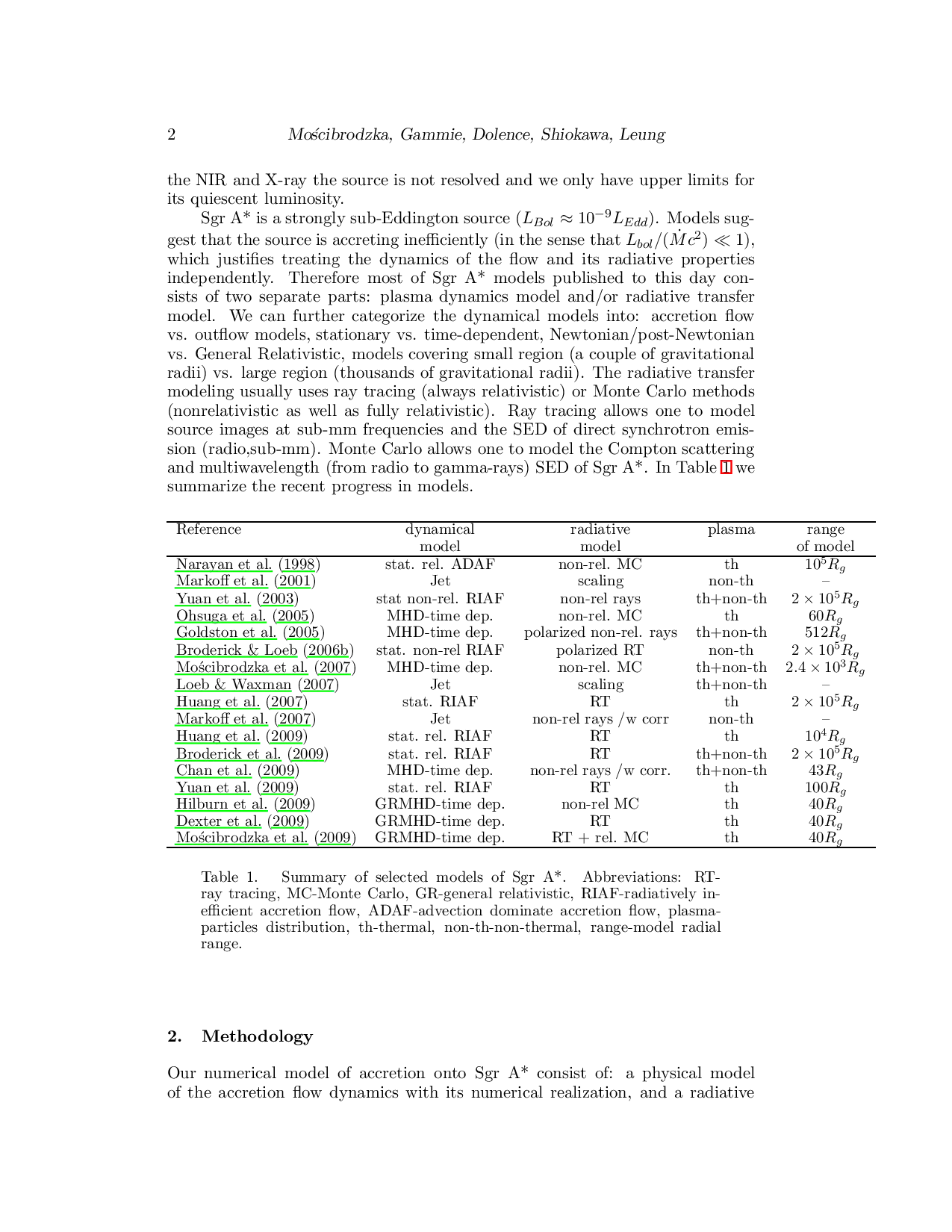
Sgr A* is a strongly sub-Eddington source (L Bol ≈ 10 -9 L Edd ). Models suggest that the source is accreting inefficiently (in the sense that L bol /( Ṁ c 2 ) ≪ 1), which justifies treating the dynamics of the flow and its radiative properties independently. Therefore most of Sgr A* models published to this day consists of two separate parts: plasma dynamics model and/or radiative transfer model. We can further categorize the dynamical models into: accretion flow vs. outflow models, stationary vs. time-dependent, Newtonian/post-Newtonian vs. General Relativistic, models covering small region (a couple of gravitational radii) vs. large region (thousands of gravitational radii). The radiative transfer modeling usually uses ray tracing (always relativistic) or Monte Carlo methods (nonrelativistic as well as fully relativistic). Ray tracing allows one to model source images at sub-mm frequencies and the SED of direct synchrotron emission (radio,sub-mm). Monte Carlo allows one to model the Compton scattering and multiwavelength (from radio to gamma-rays) SED of Sgr A*. In Table 1 we summarize the recent progress in models.
Our numerical model of accretion onto Sgr A* consist of: a physical model of the accretion flow dynamics with its numerical realization, and a radiative transfer model. We assume that the accreting plasma is geometrically thick, optically thin, turbulent and it accretes onto a spinning black hole. The spin angular momentum J of the black hole, whose magnitude is parameterized by a * = Jc/(GM 2 ), is assumed to be aligned with the angular momentum of the accretion flow. The accretion flow in Sgr A* is collisionless. We assume that ions and electrons have thermal distributions, possibly with different temperatures. In our model we allow the electron temperature T e to differ from the ion temperature T i , but we fix the ratio (T i /T e = const). The plasma equation of state is described by the P = e(γ -1) relation with γ = 13/9 (non-relativistic ions and relativistic electrons). A more physical model would evolve T e and T i independently with a model for dissipation and energy exchange between the electrons and ions, but this would complicate the model and introduce a host of new parameters.
We realize the physical model using an axisymmetric version of the GRMHD code harm (Gammie et al. 2003). As initial conditions we adopt an analytical model of a thick disk (a torus) in hydrostatic equilibrium (Fishbone & Moncrief 1976). Since the code is not designed to evolve MHD equations in vacuum, we surround the equilibrium torus with a hot, low density plasma which does not influence the torus evolution. We seed the torus with a poloidal, concentric loops of weak magnetic field. Small perturbations are added to the internal energy which allows to for magnetorotational instability and turbulence development. We solve the GRMHD evolution equations of evolution until a quasi-equilibrium accretion flow is established (meaning that the flow is not evolving on the dynamical timescale). The details of torus initial setup and discussion of the flow evolution is presented in McKinney & Gammie (2004).
Our numerical domain extends from the black hole event horizon to 40GM/c 2 = 1.8 AU or 210µas, but is only in equilibrium to ∼ 15GM/c 2 = 0.7AU or 80µas. Since low frequency emission from Sgr A* is believed to arise at larger radius, we are unable to model the low frequency (radio, mm) portion of spectral energy
…(Full text truncated)…
This content is AI-processed based on ArXiv data.