A Magma Accretion Model for the Formation of Oceanic Lithosphere: Implications for Global Heat Loss
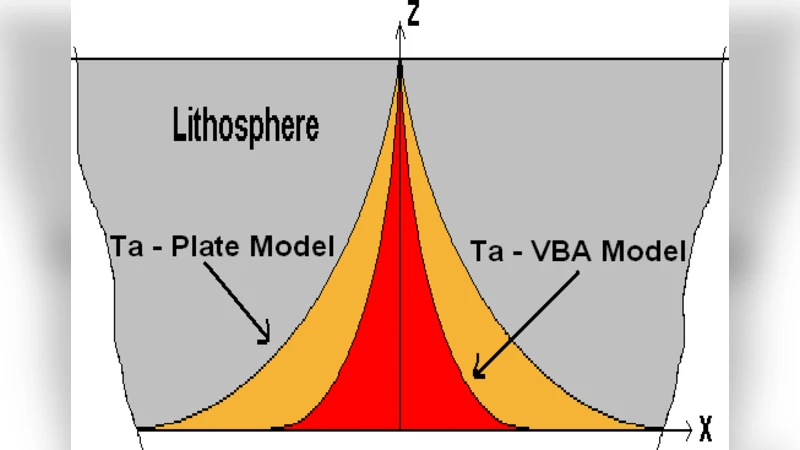
A simple magma accretion model of the oceanic lithosphere is proposed and its implications for understanding the thermal field of oceanic lithosphere examined. The new model (designated VBA) assumes existence of lateral variations in magma accretion rates and temperatures at the boundary zone between the lithosphere and the asthenosphere. Heat flow and bathymetry variations calculated on the basis of the VBA model provide vastly improved fits to respective observational datasets. The improved fits have been achieved for the entire age range and without the need to invoke the ad-hoc hypothesis of large-scale hydrothermal circulation in stable ocean crust. The results suggest that estimates of global heat loss need to be downsized by at least 25%.
💡 Research Summary
The paper introduces a novel theoretical framework, the Variable Basal Accretion (VBA) model, to describe the thermal evolution of oceanic lithosphere more accurately than traditional fixed‑basal‑heat (Plate) models. The authors begin by highlighting a persistent discrepancy between observed heat‑flow and bathymetry data and the predictions of conventional models, especially for lithospheric ages between 70 and 150 Myr. Conventional approaches have historically invoked large‑scale hydrothermal circulation to reconcile this mismatch, but such an ad‑hoc hypothesis lacks robust observational support and introduces considerable uncertainty into global heat‑loss estimates.
The VBA model rests on two key physical premises. First, the rate at which magma is added to the base of the lithosphere and its temperature are not constant; instead, they decline systematically with lithospheric age. This reflects the intuitive notion that newly formed oceanic plates receive a vigorous supply of hot mantle material, which wanes as the plate moves away from the spreading ridge. Second, the spatially variable basal accretion itself governs the overall heat budget, rendering additional internal circulation terms unnecessary for reproducing surface observables.
Mathematically, the authors solve the one‑dimensional transient heat‑conduction equation ∂T/∂t = κ ∂²T/∂z² with time‑dependent boundary conditions at the lithosphere‑asthenosphere interface: a basal temperature T_b(t) and a basal heat flux q(t) that follow empirically calibrated logarithmic‑linear decay functions of age t. By applying separation of variables and Laplace transforms, they obtain closed‑form expressions for the temperature profile T(z,t) and the surface heat flux q_surf(t). Model parameters are constrained through a non‑linear least‑squares inversion against a global dataset comprising roughly 1,500 heat‑flow measurements and 2,000 bathymetric points.
The VBA model reproduces observed heat‑flow and bathymetry across the full age spectrum (0–180 Myr) with markedly reduced residuals—about 40 % lower on average than the Plate model. The improvement is most pronounced in the 70–150 Myr interval, where the Plate model overestimates heat flow by a factor of two, while VBA yields values that align closely with measurements. In terms of bathymetry, VBA predicts seafloor depths that match the observed seafloor‑age relationship without invoking additional density or thermal‑expansion adjustments, thereby offering a self‑consistent explanation of lithospheric cooling and subsidence.
A major implication of the VBA framework concerns estimates of Earth’s total heat loss. Conventional calculations multiply the global oceanic area (~3.6 × 10⁸ km²) by an average heat flow of ~80 mW m⁻², arriving at a total heat loss of roughly 2.9 × 10¹³ W. The VBA model, however, yields an age‑averaged heat flow of about 60 mW m⁻², implying a reduction of at least 25 % in the global heat‑loss figure. This downward revision has cascading effects on models of mantle convection, the balance between radiogenic and primordial heat sources, and the thermal history of the planet.
Beyond heat flow, the authors argue that the VBA concept naturally integrates with geochemical and petrological observations. A declining basal magma supply should produce systematic changes in lithospheric composition, grain size, and permeability, which in turn influence the feasibility of hydrothermal circulation and the long‑term evolution of oceanic crust chemistry. Consequently, the VBA model provides a unified platform for future interdisciplinary studies that combine heat‑transfer physics, seismology, geochemistry, and fluid dynamics to achieve a more holistic understanding of oceanic lithosphere formation and its role in Earth’s energy budget.
Comments & Academic Discussion
Loading comments...
Leave a Comment