Springers theorem for tame quadratic forms over Henselian fields
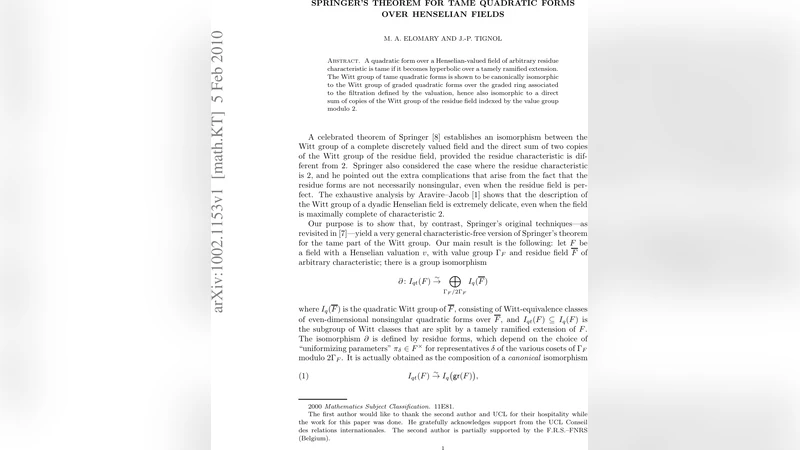
A quadratic form over a Henselian-valued field of arbitrary residue characteristic is tame if it becomes hyperbolic over a tamely ramified extension. The Witt group of tame quadratic forms is shown to be canonically isomorphic to the Witt group of graded quadratic forms over the graded ring associated to the filtration defined by the valuation, hence also isomorphic to a direct sum of copies of the Witt group of the residue field indexed by the value group modulo 2.
💡 Research Summary
The paper investigates quadratic forms over a field equipped with a Henselian valuation, introducing the notion of “tame” quadratic forms. A quadratic form is called tame if it becomes hyperbolic after passing to a tamely ramified extension of the base field. This definition is deliberately broad enough to include the case where the residue characteristic is two, a situation where classical tame‑ramification theory does not directly apply.
The authors first construct the filtration of the valued field by the valuation ideals ({\mathfrak{p}^{\gamma}}{\gamma\in\Gamma}) and form the associated graded ring (\operatorname{gr}(K)=\bigoplus{\gamma\in\Gamma}\mathfrak{p}^{\gamma}/\mathfrak{p}^{>\gamma}). On this graded ring they define graded quadratic forms, i.e. quadratic forms whose homogeneous components lie in a fixed degree (\gamma). The Witt group of these graded forms, denoted (W_{\mathrm{gr}}(K)), is the primary algebraic object used to bridge the valuation‑theoretic and residue‑field perspectives.
The central theorem establishes a canonical isomorphism \
Comments & Academic Discussion
Loading comments...
Leave a Comment