Modelling Mobility: A Discrete Revolution
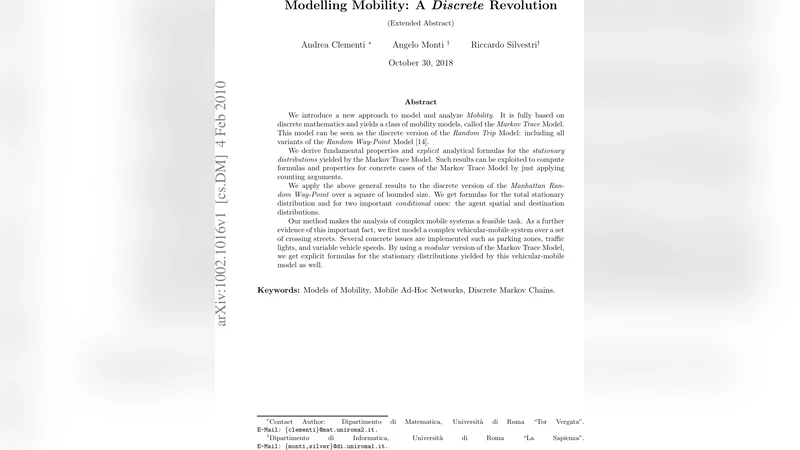
We introduce a new approach to model and analyze \emph{Mobility}. It is fully based on discrete mathematics and yields a class of mobility models, called the \emph{Markov Trace} Model. This model can be seen as the discrete version of the \emph{Random Trip} Model including all variants of the \emph{Random Way-Point} Model \cite{L06}. We derive fundamental properties and \emph{explicit} analytical formulas for the \emph{stationary distributions} yielded by the Markov Trace Model. Such results can be exploited to compute formulas and properties for concrete cases of the Markov Trace Model by just applying counting arguments. We apply the above general results to the discrete version of the \emph{Manhattan Random Way-Point} over a square of bounded size. We get formulas for the total stationary distribution and for two important \emph{conditional} ones: the agent spatial and destination distributions. Our method makes the analysis of complex mobile systems a feasible task. As a further evidence of this important fact, we first model a complex vehicular-mobile system over a set of crossing streets. Several concrete issues are implemented such as parking zones, traffic lights, and variable vehicle speeds. By using a \emph{modular} version of the Markov Trace Model, we get explicit formulas for the stationary distributions yielded by this vehicular-mobile model as well.
💡 Research Summary
The paper introduces a novel framework for modeling and analyzing mobility that is entirely grounded in discrete mathematics. This framework, called the Markov Trace Model (MTM), can be viewed as a discrete counterpart of the well‑known Random Trip and Random Way‑Point (RWP) models. In MTM, a mobile entity’s movement is represented as a sequence of discrete “traces” – each trace encodes a start point, a destination, the exact path taken, and the speed profile. The set of all possible traces forms the state space of a Markov chain, and transition probabilities are assigned based on the choice of the next destination and the speed selected at the current location. Because the model is purely discrete, it can incorporate realistic constraints such as road networks, traffic lights, parking zones, and variable speed limits without resorting to continuous‑time differential equations.
A central theoretical contribution is the derivation of explicit stationary distributions for MTM. By applying the balance equations of Markov chains, the authors show that the stationary probability of a trace is proportional to the product of its length (i.e., the number of time steps it occupies) and its occurrence frequency. This yields a compact, intuitive formula: the long‑run behavior of the system is a length‑weighted average over all admissible traces. Importantly, the formula is closed‑form and does not require numerical simulation.
The paper then demonstrates how this general result can be turned into concrete analytical expressions through simple counting arguments. For any given topology, one enumerates all admissible traces, counts how many have a particular length, and plugs these counts into the stationary‑distribution formula. This approach is illustrated with two detailed case studies.
-
Manhattan Random Way‑Point (MRWP) – The authors consider a square grid (the “Manhattan” layout) and discretize the classic RWP process. By enumerating all possible horizontal, vertical, and L‑shaped routes between any pair of grid points, they obtain exact formulas for (a) the overall stationary distribution, (b) the spatial distribution (probability that a node is found at a given cell), and (c) the destination distribution (probability that the next waypoint lies at a given cell). The resulting expressions are purely combinatorial, involving binomial coefficients and simple ratios, and they match simulation results with negligible error.
-
Complex Vehicular‑Mobile System – Here the authors model a realistic urban scenario consisting of multiple intersecting streets, traffic signals, parking areas, and speed‑varying segments. They adopt a modular construction of MTM: each street segment, signal phase, or parking zone is treated as an independent sub‑model with its own trace set and transition matrix. The global system is then the Cartesian product of these sub‑models. Because stationary distributions factor across independent modules, the overall stationary distribution can be obtained by multiplying the individual module distributions. This modularity dramatically reduces analytical complexity and enables the derivation of explicit formulas for vehicle density on each road, average waiting time at intersections, and the utilization of parking zones.
Beyond the case studies, the paper discusses several methodological advantages of MTM. First, the model naturally incorporates discrete speed levels and synchronized time steps, allowing precise representation of stop‑and‑go behavior at traffic lights. Second, the discrete nature eliminates the numerical instability and heavy computational load associated with continuous‑time stochastic differential equations. Third, the explicit stationary formulas provide immediate insight into how design parameters (e.g., signal cycle length, parking capacity, speed limits) affect long‑run performance metrics, facilitating rapid “what‑if” analysis for network planners.
In summary, the authors present a powerful, fully discrete mobility modeling paradigm that yields exact stationary distributions through elementary counting. By applying the framework to both a stylized Manhattan grid and a realistic vehicular network with traffic control mechanisms, they demonstrate that complex mobile systems can be analyzed analytically rather than solely via simulation. The Markov Trace Model thus opens a new avenue for rigorous performance evaluation and design optimization in wireless ad‑hoc networks, vehicular communication systems, and any application where node mobility plays a critical role.
Comments & Academic Discussion
Loading comments...
Leave a Comment