Mean-field theory of a plastic network of integrate-and-fire neurons
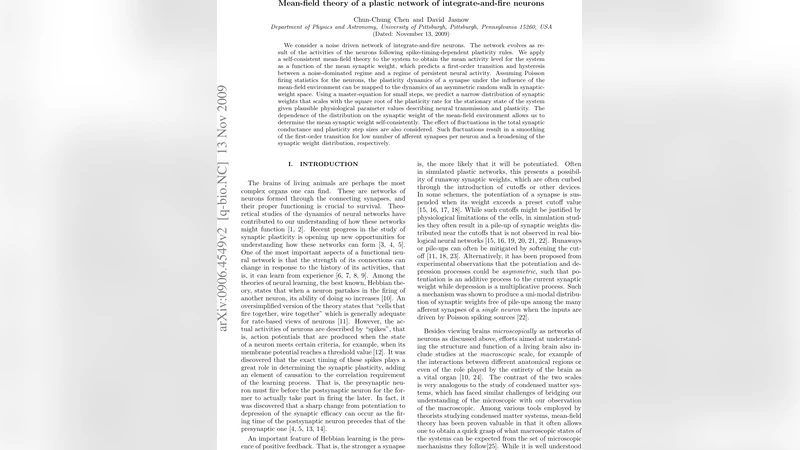
We consider a noise driven network of integrate-and-fire neurons. The network evolves as result of the activities of the neurons following spike-timing-dependent plasticity rules. We apply a self-consistent mean-field theory to the system to obtain the mean activity level for the system as a function of the mean synaptic weight, which predicts a first-order transition and hysteresis between a noise-dominated regime and a regime of persistent neural activity. Assuming Poisson firing statistics for the neurons, the plasticity dynamics of a synapse under the influence of the mean-field environment can be mapped to the dynamics of an asymmetric random walk in synaptic-weight space. Using a master-equation for small steps, we predict a narrow distribution of synaptic weights that scales with the square root of the plasticity rate for the stationary state of the system given plausible physiological parameter values describing neural transmission and plasticity. The dependence of the distribution on the synaptic weight of the mean-field environment allows us to determine the mean synaptic weight self-consistently. The effect of fluctuations in the total synaptic conductance and plasticity step sizes are also considered. Such fluctuations result in a smoothing of the first-order transition for low number of afferent synapses per neuron and a broadening of the synaptic weight distribution, respectively.
💡 Research Summary
The paper investigates a network of integrate‑and‑fire (IF) neurons driven by stochastic input and whose synaptic strengths evolve according to spike‑timing‑dependent plasticity (STDP). The authors develop a self‑consistent mean‑field theory in which the collective effect of all afferent synapses on a neuron is replaced by an average synaptic weight (\bar w) and an associated average conductance (\bar g = N_{\text{in}}\bar w). Under this approximation the firing rate (\nu) of a typical neuron becomes a deterministic function (\nu = F(\bar w)). Conversely, given a firing rate, the average weight changes at a rate dictated by the STDP rule, yielding (\dot{\bar w}=G(\nu)). Solving the coupled equations (\nu = F(\bar w)) and (\bar w = G(\nu)) self‑consistently reveals an S‑shaped curve: for a range of parameters there are three fixed points (two stable, one unstable). This structure signals a first‑order phase transition between a low‑activity, noise‑dominated regime and a high‑activity, self‑sustained regime, together with hysteresis depending on the direction of parameter sweep.
To capture the microscopic dynamics of individual synapses, the authors assume that each neuron fires as a Poisson process with rate (\nu). Each pre‑post spike pair triggers a weight increment (\Delta w^+) with probability proportional to (\nu) and a decrement (\Delta w^-) with a different probability, reflecting the asymmetric STDP learning windows. The evolution of a single synaptic weight can therefore be mapped onto an asymmetric random walk in weight space. By taking the limit of small step sizes, they derive a master equation of the Fokker‑Planck type: \
Comments & Academic Discussion
Loading comments...
Leave a Comment