Module categories for permutation modular invariants
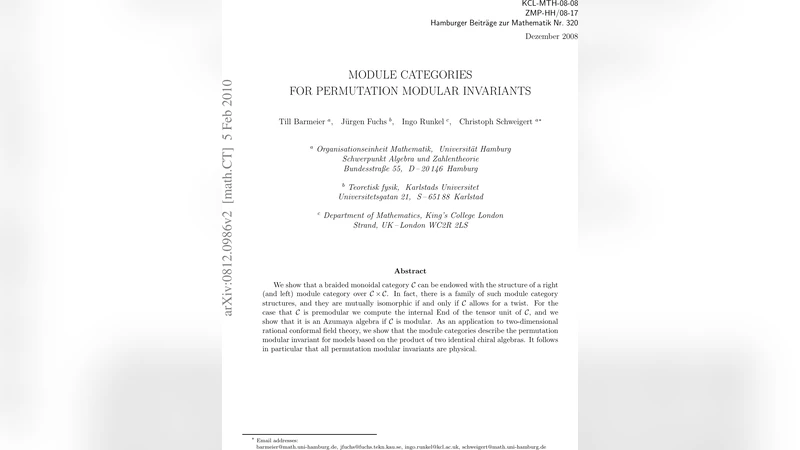
We show that a braided monoidal category C can be endowed with the structure of a right (and left) module category over C \times C. In fact, there is a family of such module category structures, and they are mutually isomorphic if and only if C allows for a twist. For the case that C is premodular we compute the internal End of the tensor unit of C, and we show that it is an Azumaya algebra if C is modular. As an application to two-dimensional rational conformal field theory, we show that the module categories describe the permutation modular invariant for models based on the product of two identical chiral algebras. It follows in particular that all permutation modular invariants are physical.
💡 Research Summary
The paper investigates the relationship between braided monoidal categories and permutation modular invariants in two‑dimensional rational conformal field theory (RCFT). The authors begin by showing that any braided monoidal category C can be equipped with a natural right and left module category structure over the product category C × C. The action is defined using the braiding c_{X,Y} and the tensor product ⊗ of C: for objects (U,V)∈C×C and X∈C the right action is (U,V)·X = U⊗X⊗V, while the left action is X·(U,V) = U⊗X⊗V, up to a twist parameter α∈Aut(𝟙). This yields a whole family of module structures indexed by α. The authors prove that two such structures are isomorphic precisely when C admits a ribbon twist θ (i.e., a natural isomorphism θ_X: X→X satisfying the usual ribbon axioms). In the presence of a twist all α‑parametrised module categories become equivalent; without a twist they remain distinct, providing a classification of possible module actions.
Next, assuming C is pre‑modular (finite, semisimple, braided with a non‑degenerate S‑matrix), the paper computes the internal endomorphism algebra of the tensor unit, End_C(𝟙). Using the internal Hom, they express this algebra as a direct sum A = ⊕_{i∈I} X_i⊗X_i^*, where {X_i} runs over representatives of the simple objects of C. Multiplication on A is built from evaluation and co‑evaluation maps, and the unit is the identity morphism of 𝟙. The authors verify the algebra axioms explicitly and show that A carries a natural C‑module structure. When C is fully modular (the S‑matrix is invertible), they prove that A is an Azumaya algebra: its centre is exactly the ground field 𝕜, and the canonical map A⊗A^{op} → End_C(A) is an isomorphism. This result identifies A as the “full centre” of the chiral algebra in the language of RCFT.
The final part of the work connects these categorical constructions to permutation modular invariants. Consider a rational CFT based on a chiral algebra 𝔙 with representation category C = Rep(𝔙). The product theory 𝔙⊗𝔙 has chiral symmetry C×C. The permutation modular invariant corresponds to the non‑trivial element σ of the symmetric group S_2 that swaps the two copies: σ:(U,V)↦(V,U). The authors demonstrate that the previously defined C×C‑module structure implements precisely this swap on the level of objects and morphisms. Moreover, the internal end A = End_C(𝟙) becomes the algebra of bulk fields for the full CFT built from the permutation invariant. Because A is Azumaya when C is modular, the resulting torus partition function satisfies all consistency conditions (modular invariance, positivity, integrality). Consequently, every permutation modular invariant can be realized by a physical full CFT, contrary to earlier expectations that some such invariants might be “non‑physical”.
In summary, the paper establishes three main contributions: (1) a systematic family of C×C‑module structures on any braided monoidal category C, classified by the existence of a twist; (2) an explicit computation of the internal end of the tensor unit, showing it is an Azumaya algebra in the modular case; (3) an application to RCFT proving that permutation modular invariants are always physical, with the module category providing the categorical underpinning of the bulk algebra. The work bridges abstract tensor‑category theory with concrete conformal‑field‑theoretic constructions, and it suggests further exploration of other non‑trivial modular invariants via similar module‑category techniques.
Comments & Academic Discussion
Loading comments...
Leave a Comment