On admissible rank one local systems
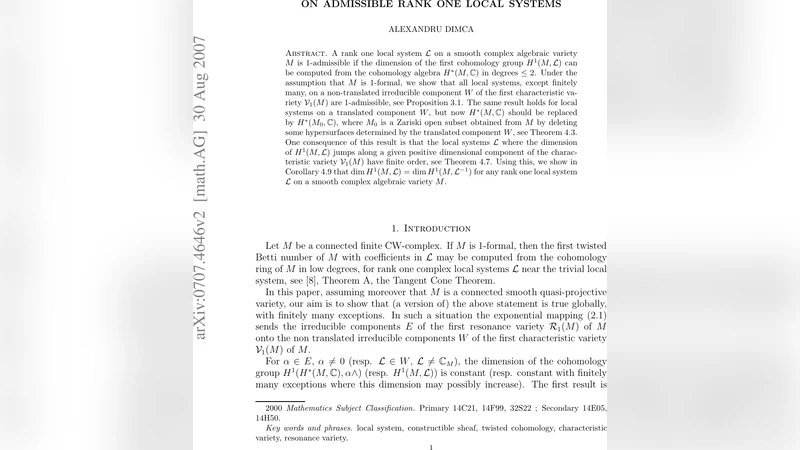
A rank one local system $\LL$ on a smooth complex algebraic variety $M$ is 1-admissible if the dimension of the first cohomology group $H^1(M,\LL)$ can be computed from the cohomology algebra $H^(M,\C)$ in degrees $\leq 2$. Under the assumption that $M$ is 1-formal, we show that all local systems, except finitely many, on a non-translated irreducible component $W$ of the first characteristic variety $\V_1(M)$ are 1-admissible, see Proposition 3.1. The same result holds for local systems on a translated component $W$, but now $H^(M,\C)$ should be replaced by $H^*(M_0,\C)$, where $M_0$ is a Zariski open subset obtained from $M$ by deleting some hypersurfaces determined by the translated component $W$, see Theorem 4.3.
💡 Research Summary
The paper investigates rank‑one local systems on a smooth complex algebraic variety M and introduces the notion of 1‑admissibility. A rank‑one local system ℒ is called 1‑admissible if the dimension of its first cohomology group can be computed solely from the cohomology algebra H⁎(M,ℂ) using only the degree‑≤ 2 part. Concretely, if α∈H¹(M,ℂ) corresponds to ℒ via the exponential map exp : H¹(M,ℂ)→𝕋(M) (the character torus), then ℒ is 1‑admissible precisely when
dim H¹(M,ℒ) = dim H¹(H⁎(M,ℂ), α∧),
where the right‑hand side is the first cohomology of the complex (H⁎(M,ℂ), α∧) obtained by wedging with α. This definition reduces the problem of computing twisted cohomology to a purely algebraic calculation inside the ordinary cohomology ring.
The main results are proved under the hypothesis that M is 1‑formal in the sense of Sullivan–Morgan: the minimal model of M is determined by its cohomology in degree 1 and the cup‑product map H¹∧H¹→H². For 1‑formal spaces the tangent cone theorem holds: the tangent cone at the identity of the first characteristic variety V₁(M) coincides with the first resonance variety R₁(M). Consequently, for any α lying in a generic point of R₁(M), the equality above automatically holds.
Proposition 3.1 deals with non‑translated (i.e. containing the identity) irreducible components W of V₁(M). It shows that for all ℒ∈W belonging to the smooth part of the character torus, ℒ is 1‑admissible, with at most finitely many exceptions. These exceptional points are torsion characters where the cohomology jumps beyond the generic value; they correspond to intersections of different components or higher‑order singularities of V₁(M). Thus, on each non‑translated component, “almost all’’ local systems are 1‑admissible.
Theorem 4.3 treats translated components, i.e. components of the form W = ρ·W₀ with ρ≠1 a torsion character and W₀ a non‑translated component. Direct application of the tangent cone theorem fails because the identity is not contained in W. The authors circumvent this by deleting from M the hypersurfaces that support the translation character ρ, obtaining an open subset
M₀ = M \ ⋃_{i} H_i.
On M₀ the translated component becomes non‑translated, and the cohomology algebra H⁎(M₀,ℂ) replaces H⁎(M,ℂ) in the definition of 1‑admissibility. The theorem proves that, again up to finitely many torsion points, every ℒ∈W is 1‑admissible with respect to H⁎(M₀,ℂ). In other words, after removing the appropriate hypersurfaces, the same algebraic computation of dim H¹(M,ℒ) works for translated components.
The paper also discusses several consequences and examples. For hyperplane arrangement complements, which are known to be 1‑formal, the results give a concrete method to compute the dimensions of twisted cohomology groups for almost all characters on each component of V₁. Similar applications are presented for quasi‑projective varieties and for varieties with known resonance varieties.
Finally, the authors outline possible extensions. One direction is to drop the 1‑formality assumption and investigate whether a modified notion of admissibility can still be related to higher‑order characteristic varieties V_k(M) (k≥2). Another is to explore the relationship between 1‑admissibility and the structure of the full cohomology jump loci, potentially leading to new insights into the interplay between topology, algebraic geometry, and representation theory of fundamental groups.
In summary, the work establishes that for 1‑formal varieties, the vast majority of rank‑one local systems on any irreducible component of the first characteristic variety are 1‑admissible; the dimension of their twisted first cohomology is completely determined by the ordinary cohomology algebra (or by the algebra of a suitable Zariski open subset in the translated case). This bridges the gap between the geometric description of characteristic varieties and the purely algebraic resonance varieties, providing a powerful computational tool for researchers studying cohomology jump loci.
Comments & Academic Discussion
Loading comments...
Leave a Comment