The Cut-off Covering Spectrum
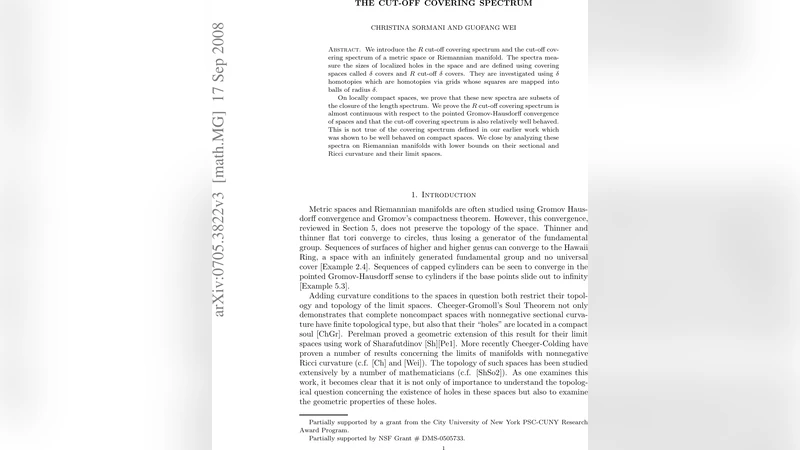
We introduce the $R$ cut-off covering spectrum and the cut-off covering spectrum of a complete length space or Riemannian manifold. The spectra measure the sizes of localized holes in the space and are defined using covering spaces called $\delta$ covers and $R$ cut-off $\delta$ covers. They are investigated using $\delta$ homotopies which are homotopies via grids whose squares are mapped into balls of radius $\delta$. On locally compact spaces, we prove that these new spectra are subsets of the closure of the length spectrum. We prove the $R$ cut-off covering spectrum is almost continuous with respect to the pointed Gromov-Hausdorff convergence of spaces and that the cut-off covering spectrum is also relatively well behaved. This is not true of the covering spectrum defined in our earlier work which was shown to be well behaved on compact spaces. We close by analyzing these spectra on Riemannian manifolds with lower bounds on their sectional and Ricci curvature and their limit spaces.
💡 Research Summary
The paper introduces two new spectral invariants for complete length spaces and Riemannian manifolds: the R‑cut‑off covering spectrum and the cut‑off covering spectrum. These invariants are designed to measure the sizes of localized “holes” in spaces that may be non‑compact, overcoming limitations of the earlier covering spectrum which behaved well only on compact spaces.
The construction begins with the notion of a δ‑cover: for a given δ>0, a δ‑cover is the smallest normal covering space in which every loop can be homotoped into a ball of radius δ. To compare loops in this setting the authors introduce δ‑homotopies, homotopies built from a grid of squares each of which maps into a ball of radius δ. This combinatorial control allows one to decide whether two loops become trivial in a δ‑cover.
To isolate local topology, the authors define an R‑cut‑off δ‑cover. Fix a base point p and a radius R>0; inside the ball B(p,R) the δ‑cover condition is enforced, while outside this ball the covering is allowed to be arbitrary. The set of critical δ‑values for which the R‑cut‑off δ‑cover changes yields the R‑cut‑off covering spectrum. Dropping the dependence on R altogether gives the cut‑off covering spectrum, which records the limiting behavior as R→∞ but still ignores “far‑away” large holes.
The first major theorem shows that, under a local compactness assumption, both new spectra are subsets of the closure of the length spectrum (the set of lengths of closed geodesics). This establishes a direct link between the newly defined topological invariants and classical metric data: any value appearing in the cut‑off spectra can be approximated by lengths of closed loops.
The second major contribution concerns stability under pointed Gromov–Hausdorff convergence. If a sequence of pointed spaces (X_i ,p_i) converges to (X ,p) in the pointed Gromov–Hausdorff sense, then for any fixed R the R‑cut‑off covering spectra of X_i converge in the Hausdorff sense to that of X, up to an arbitrarily small error for sufficiently large i. This “almost continuity” is a significant improvement over the original covering spectrum, which can jump discontinuously in non‑compact limits. The cut‑off covering spectrum (without a fixed R) also enjoys a weaker but still useful continuity property.
The authors then explore curvature constraints. For complete Riemannian manifolds with a sectional curvature lower bound K≥k>0, comparison geometry (Bishop–Gromov and Rauch comparison) forces the R‑cut‑off covering spectrum to lie within a bounded interval, essentially
Comments & Academic Discussion
Loading comments...
Leave a Comment