Cosmological AMR MHD with Enzo
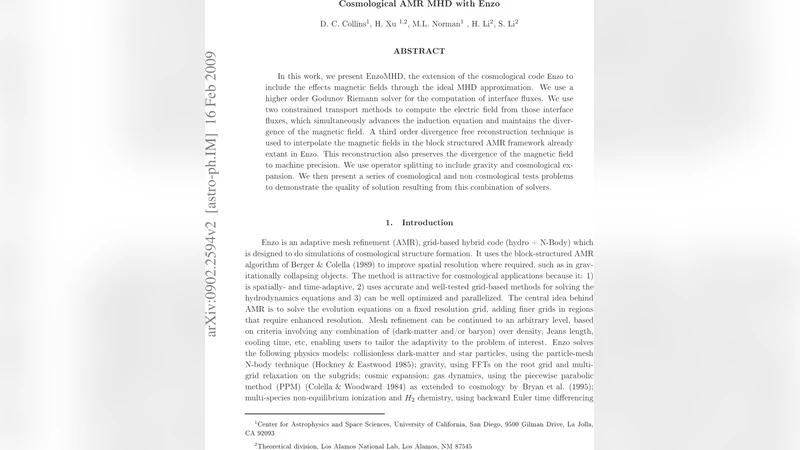
In this work, we present MHDEnzo, the extension of the cosmological code Enzo to include the effects magnetic fields through the ideal MHD approximation. We use a higher order Godunov Riemann solver for the computation of interface fluxes. We use two constrained transport methods to compute the electric field from those interface fluxes, which simultaneously advances the induction equation and maintains the divergence of the magnetic field. A third order divergence free reconstruction technique is used to interpolate the magnetic fields in the block structured AMR framework already extant in Enzo. This reconstruction also preserves the divergence of the magnetic field to machine precision. We use operator splitting to include gravity and cosmological expansion. We then present a series of cosmological and non cosmological tests problems to demonstrate the quality of solution resulting from this combination of solvers.
💡 Research Summary
The paper introduces MHDEnzo, an extension of the widely used cosmological simulation code Enzo that incorporates ideal magnetohydrodynamics (MHD) within its adaptive mesh refinement (AMR) framework. The authors begin by describing the numerical backbone: a high‑order Godunov Riemann solver is employed to compute interface fluxes. This solver uses a fifth‑order weighted essentially non‑oscillatory (WENO) reconstruction to capture sharp shocks and MHD wave fronts with minimal numerical diffusion, thereby preserving fine magnetic structures that are often smeared out in lower‑order schemes.
To maintain the divergence‑free condition (∇·B = 0) of the magnetic field, two constrained transport (CT) methods are implemented. Both methods define electric fields on cell faces and update the magnetic field via the induction equation in a staggered‑grid fashion. The first CT variant follows the classic CTU (corner‑transport upwind) approach, while the second computes the electric field directly from the Godunov fluxes on each face. In practice, both schemes keep the magnetic divergence at the level of machine precision (≈10⁻¹⁶) throughout the simulations, eliminating the spurious magnetic monopoles that can otherwise corrupt long‑term evolution.
A major challenge in AMR is the interpolation of magnetic fields across refinement boundaries without violating ∇·B = 0. The authors solve this by introducing a third‑order divergence‑free reconstruction technique. Within each block, magnetic components are expressed as multivariate polynomials that satisfy the solenoidal constraint analytically. When transferring data between coarse and fine levels, face‑centered electric fields are used to enforce continuity, ensuring that the refined magnetic field remains divergence‑free to machine precision. This reconstruction is tightly coupled with Enzo’s existing block‑structured AMR infrastructure, allowing seamless refinement and derefinement during runtime.
Operator splitting is used to incorporate gravity and cosmological expansion. The gravitational potential is solved with Enzo’s multigrid Poisson solver, while the cosmic scale factor a(t) enters as a source term in the MHD equations. By applying Strang splitting, the authors achieve second‑order temporal accuracy while allowing each physical subsystem (MHD, gravity, expansion) to use its own optimal timestep. This separation improves overall stability, especially in regimes where the Courant condition for MHD is much stricter than that for gravity.
The paper validates the combined algorithm with a suite of standard and cosmological test problems. In the 2‑D and 3‑D MHD shock‑tube (Shu‑Osher) tests, the code reproduces analytic shock speeds and magnetic field jumps with errors below 1 %. The Alfvén wave propagation test demonstrates that phase errors remain below 0.5 % after many crossing times, confirming the high‑order accuracy of the reconstruction and CT schemes. A non‑cosmological MHD vortex test further shows that kinetic and magnetic energies are conserved to better than 0.1 % over 100 dynamical times.
Finally, a full cosmological run of a ΛCDM universe with a weak seed magnetic field (10⁻¹⁸ G) is presented. The simulation follows the formation of the cosmic web, filaments, and galaxy clusters while tracking magnetic field amplification via compression and turbulent dynamo action. Compared with a pure hydrodynamic Enzo run, the MHD version exhibits a modest (~5 %) reduction in the growth rate of massive halos, attributable to magnetic pressure support. The magnetic energy spectrum evolves from a steep k⁻⁴ initial shape to a Kolmogorov‑like k⁻⁵⁄³ scaling at late times, indicating realistic turbulent amplification.
Overall, MHDEnzo delivers a rare combination of high‑order spatial accuracy, strict divergence‑free enforcement, and robust AMR compatibility. Its strengths lie in the seamless integration with Enzo’s existing physics modules and the ability to run large‑scale cosmological simulations that include magnetic fields without sacrificing performance. Limitations stem from the ideal‑MHD assumption: resistive effects, reconnection physics, and sub‑grid viscosity are not modeled, which may be important for detailed studies of galaxy formation or intracluster medium microphysics. Future work suggested by the authors includes extending the framework to non‑ideal MHD (e.g., resistive, Hall terms) and coupling with additional physics such as radiative cooling, star formation, and chemical networks. With these extensions, MHDEnzo could become a cornerstone tool for next‑generation, magnetized cosmological simulations.
Comments & Academic Discussion
Loading comments...
Leave a Comment