What Can Heterogeneity Add to the Scientometric Map? Steps towards algorithmic historiography
The Actor Network represents heterogeneous entities as actants (Callon et al., 1983; 1986). Although computer programs for the visualization of social networks increasingly allow us to represent heterogeneity in a network using different shapes and colors for the visualization, hitherto this possibility has scarcely been exploited (Mogoutov et al., 2008). In this contribution to the Festschrift, I study the question of what heterogeneity can add specifically to the visualization of a network. How does an integrated network improve on the one-dimensional ones (such as co-word and co-author maps)? The oeuvre of Michel Callon is used as the case materials, that is, his 65 papers which can be retrieved from the (Social) Science Citation Index since 1975.
💡 Research Summary
The paper investigates how incorporating heterogeneity—different types of entities—enhances the informational richness of scientometric maps. Using Michel Callon’s oeuvre as a case study, the author extracts 65 papers indexed in the Social Science Citation Index from 1975 to 2009. From these documents three distinct variable sets are derived: 48 unique co‑authors, 27 title words that appear at least twice, and 26 journals in which the papers were published. These 101 variables are arranged in a 65 × 101 occurrence matrix, which is then normalized using the cosine similarity measure. The resulting similarity matrix is visualized with the Kamada‑Kawai spring‑layout algorithm in Pajek; node sizes are proportional to the logarithm of each variable’s frequency.
Figure 1 presents the integrated map that simultaneously displays authors (circles), words (triangles) and journals (diamonds). The visualization reveals several dense clusters. Two clusters at the upper left are anchored around the journal Research Policy: one reflects co‑authored editorials, the other consists of evaluative studies of the journal itself. A small isolated cluster on the upper right corresponds to a single medical imaging paper, showing that not all entities are tightly linked. In the centre, words form a dense core that connects the two larger author‑journal clusters. One author cluster revolves around Jean‑Pierre Courtial, linking Scientometrics and Social Science Information with a strong semantic component (network analysis, co‑word studies). Another cluster, centred on Volonola Rabeharisoa and John Law, highlights research on patient associations and medical technologies, a theme that would be more pronounced if a French database were used.
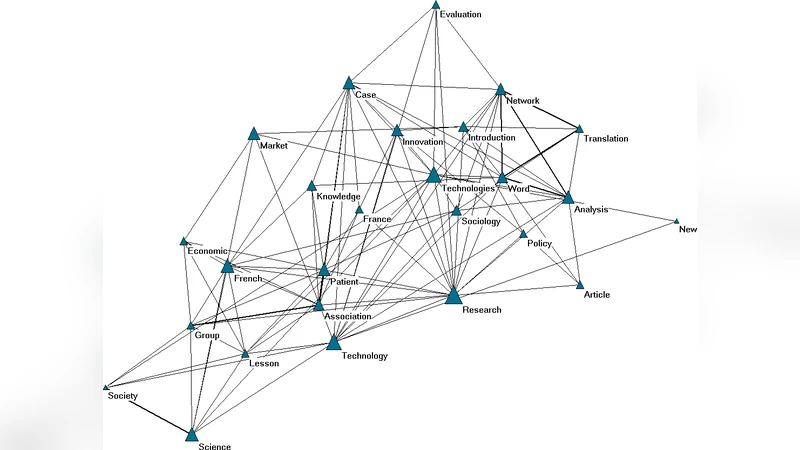
For comparison, Figure 2 shows a pure co‑author map (no threshold). It captures the social structure but obscures the cognitive dimensions; the same clusters appear, but the semantic richness is lost. Figure 3 displays a co‑word map based solely on title words. Because co‑words are less codified than citations, the structure is weaker and explains only 31 % of the variance. Factor analysis identifies three main thematic factors (network analysis, patient associations, technology & society) but the map alone does not make these clear.
Temporal dynamics are explored by splitting the integrated map into six five‑year intervals (Figure 4) and a detailed view of 2005‑2009 (Figure 5). Early periods (1975‑1990) are dominated by Scientometrics and Research Policy collaborations. After 1995, the entry of Rabeharisoa introduces a medical‑technology and patient‑association focus, visible as a new cluster of words and journals. In the most recent period, the “technology & society” theme becomes more prominent, yet co‑authorship ties are sparser, indicating a shift toward more solo or loosely connected work.
The author concludes that heterogeneity is essential for a meaningful scientometric representation. Author names, lexical items, and journal venues each contribute distinct layers of meaning: social relations, cognitive structures, and institutional contexts. By integrating them, the map simultaneously reveals who collaborates, what concepts are being exchanged, and where the discourse is published. This multidimensional approach aligns with Callon’s actor‑network theory, where actors (including texts and journals) are actants that co‑construct meaning. The paper argues that such integrated visualizations pave the way for “algorithmic historiography,” a systematic, computational reconstruction of the intellectual history of science and technology studies.
Comments & Academic Discussion
Loading comments...
Leave a Comment