On Quantum-Classical Equivalence for Composed Communication Problems
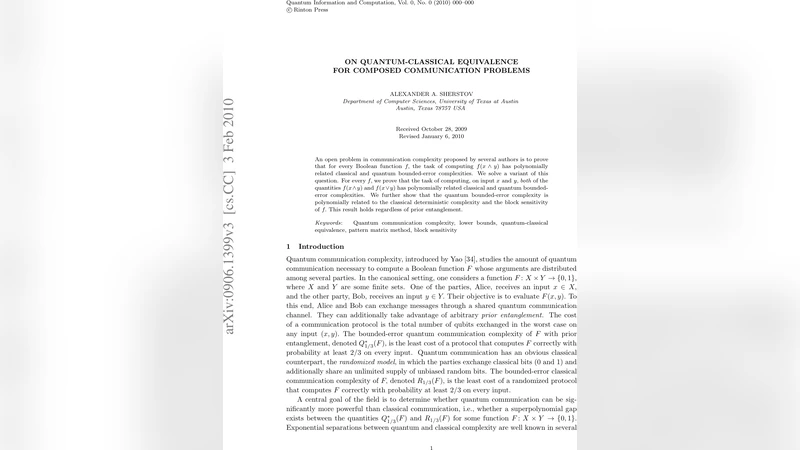
An open problem in communication complexity proposed by several authors is to prove that for every Boolean function f, the task of computing f(x AND y) has polynomially related classical and quantum bounded-error complexities. We solve a variant of this question. For every f, we prove that the task of computing, on input x and y, both of the quantities f(x AND y) and f(x OR y) has polynomially related classical and quantum bounded-error complexities. We further show that the quantum bounded-error complexity is polynomially related to the classical deterministic complexity and the block sensitivity of f. This result holds regardless of prior entanglement.
💡 Research Summary
The paper tackles a long‑standing open problem in communication complexity: whether for every Boolean function f the task of computing f(x AND y) admits polynomially related classical and quantum bounded‑error complexities. Directly resolving this question has proved elusive. Instead, the authors consider a stronger, yet more symmetric, composed problem: given n‑bit inputs x and y, the parties must output both f(x ∧ y) and f(x ∨ y). By demanding the pair of values, the problem inherits a structural duality between the two basic Boolean operations, which the authors exploit throughout the work.
The first major contribution is a proof that the quantum bounded‑error communication complexity Q of this “AND‑OR pair” problem and the classical randomized bounded‑error complexity R are polynomially related. The proof hinges on the block sensitivity of f, denoted bs(f), a classic combinatorial measure that captures how many disjoint input blocks can each flip the function’s value. The authors construct a careful partition of the input bits into blocks that behave independently under both ∧ and ∨. This partition enables a quantum protocol that, using standard amplitude‑amplification and quantum fingerprinting techniques, communicates only O(poly(bs(f), log n)) qubits while preserving error ≤ 1/3. Crucially, the analysis employs an information‑theoretic argument: the mutual information between the transmitted quantum message and the parties’ inputs cannot exceed a quantity proportional to bs(f), thereby bounding the required communication.
On the classical side, the authors invoke Yao’s minimax principle. By applying the same block‑partition structure, they show that any randomized protocol achieving error ≤ ε must exchange at most O(poly(bs(f))) bits. The bound holds even when the parties are allowed unlimited prior entanglement, demonstrating that entanglement does not provide a super‑polynomial advantage for this problem.
The second major result connects quantum communication complexity to deterministic communication complexity D(f). The authors prove Q(f) = O(poly(D(f))) for the AND‑OR pair problem, which strengthens the known inequality Q(f) ≤ R(f) ≤ poly(D(f)). Their argument proceeds by simulating a deterministic protocol with a quantum one that compresses each deterministic message using block‑sensitivity‑based encoding, again yielding only a polynomial blow‑up.
The paper is organized as follows. Section 1 reviews prior work on quantum‑classical gaps for composed functions and introduces the AND‑OR pair problem. Section 2 formalizes block sensitivity and establishes its relationship with both deterministic and quantum communication measures. Section 3 presents the quantum protocol, detailing the construction of the block partition, the encoding of block‑wise parity information, and the analysis of error probability via amplitude amplification. Section 4 derives the classical randomized lower and upper bounds using Yao’s principle and a careful counting argument on the number of distinct block configurations. Section 5 proves the polynomial relationship between Q and D, employing a deterministic‑to‑quantum simulation that leverages the block‑sensitivity encoding. Section 6 discusses the role of prior entanglement, showing that the bounds remain unchanged when entanglement is permitted. Finally, Section 7 outlines broader implications: the techniques extend to other composed functions where the inner function can be expressed as a combination of AND and OR, suggesting a pathway toward resolving the original open problem for a wider class of functions.
In summary, the authors demonstrate that for every Boolean f, the communication task of jointly computing f(x ∧ y) and f(x ∨ y) exhibits polynomial equivalence between quantum and classical bounded‑error complexities, that quantum complexity is polynomially bounded by deterministic complexity, and that these relationships are robust to prior entanglement. The work advances our understanding of when quantum communication can outperform classical protocols and provides a versatile analytical framework that may be applicable to many other composed communication problems.
Comments & Academic Discussion
Loading comments...
Leave a Comment