What makes a phase transition? Analysis of the random satisfiability problem
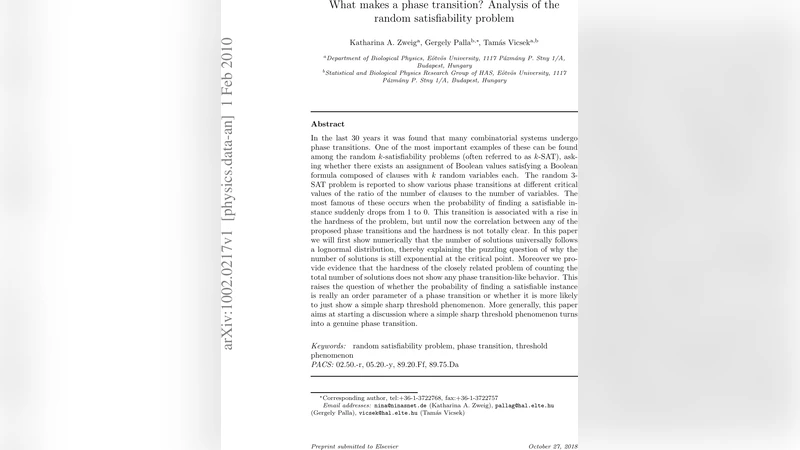
In the last 30 years it was found that many combinatorial systems undergo phase transitions. One of the most important examples of these can be found among the random k-satisfiability problems (often referred to as k-SAT), asking whether there exists an assignment of Boolean values satisfying a Boolean formula composed of clauses with k random variables each. The random 3-SAT problem is reported to show various phase transitions at different critical values of the ratio of the number of clauses to the number of variables. The most famous of these occurs when the probability of finding a satisfiable instance suddenly drops from 1 to 0. This transition is associated with a rise in the hardness of the problem, but until now the correlation between any of the proposed phase transitions and the hardness is not totally clear. In this paper we will first show numerically that the number of solutions universally follows a lognormal distribution, thereby explaining the puzzling question of why the number of solutions is still exponential at the critical point. Moreover we provide evidence that the hardness of the closely related problem of counting the total number of solutions does not show any phase transition-like behavior. This raises the question of whether the probability of finding a satisfiable instance is really an order parameter of a phase transition or whether it is more likely to just show a simple sharp threshold phenomenon. More generally, this paper aims at starting a discussion where a simple sharp threshold phenomenon turns into a genuine phase transition.
💡 Research Summary
The paper revisits the notion of phase transitions in the context of random k‑satisfiability (k‑SAT), focusing on the extensively studied random 3‑SAT problem. Over the past three decades, many combinatorial systems have been reported to exhibit phase‑transition‑like behavior, most famously a sudden drop in the probability that a random instance is satisfiable when the clause‑to‑variable ratio (α) crosses a critical value near 4.26. The authors ask whether this sharp change truly constitutes a physical phase transition or whether it is merely a “sharp threshold” phenomenon familiar from probabilistic combinatorics.
First, they perform massive numerical experiments on millions of random 3‑SAT instances, using exact counting algorithms to determine the total number of satisfying assignments for each instance. The distribution of solution counts is found to be log‑normal across the entire range of α, including the critical region. A log‑normal distribution implies that while the mean number of solutions grows exponentially with the number of variables, the variance also grows dramatically, producing a mixture of instances with very few solutions and others with an astronomically large number of solutions. This statistical picture explains why the solution space remains exponentially large at the critical point, contrary to the naive expectation that solutions vanish.
Second, the authors scrutinize the traditional order parameter – the satisfiability probability (the fraction of instances that are satisfiable). In statistical physics, a phase transition is associated with non‑analytic behavior of a thermodynamic potential, not merely a rapid change in a binary probability. The paper argues that the observed abrupt drop is better interpreted as a sharp threshold, a well‑known phenomenon where a monotone property of a random structure switches from almost surely true to almost surely false over a narrow parameter window.
Third, to test the link between the alleged phase transition and computational hardness, the study measures two distinct hardness metrics. The first is the runtime of SAT solvers (e.g., WalkSAT, Survey Propagation) on decision instances; this metric indeed peaks near the critical α, reflecting the empirically observed “hard‑SAT” region. The second metric is the runtime of exact #SAT solvers that count all satisfying assignments. Contrary to expectations for a genuine phase transition, the #SAT runtime grows smoothly with α and shows no pronounced peak at the critical point. This divergence suggests that the difficulty spike observed for decision SAT does not extend to the counting problem, weakening the claim that the satisfiability probability is a genuine thermodynamic order parameter.
Finally, the paper offers a statistical‑mechanical explanation for the emergence of the log‑normal distribution. Random clause generation involves independent choices of variables and their polarities; the multiplicative effect of these independent random factors leads, via the multiplicative central limit theorem, to a log‑normal distribution of the product of clause‑satisfaction probabilities. This explains both the exponential scaling of the mean number of solutions and the large fluctuations observed.
In conclusion, the authors contend that the sharp decline of satisfiability probability at α≈4.26 should be regarded as a combinatorial sharp threshold rather than a bona‑fide phase transition. The lack of a corresponding singularity in the counting‑problem hardness further supports this view. They call for a more careful distinction between genuine phase‑transition phenomena—characterized by non‑analytic changes in macroscopic observables—and simple threshold effects when analyzing random combinatorial problems. This nuanced perspective aims to guide future research toward identifying truly physical order parameters in random SAT and related models.
Comments & Academic Discussion
Loading comments...
Leave a Comment