Carbon isotope measurements in the Solar System
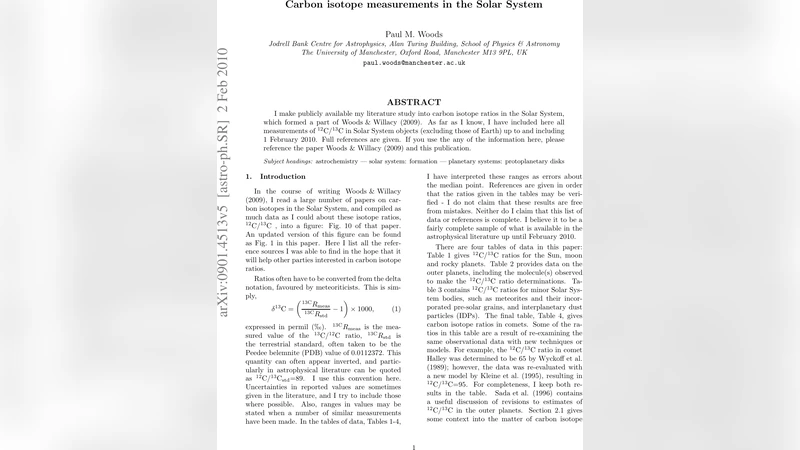
I make publicly available my literature study into carbon isotope ratios in the Solar System, which formed a part of Woods & Willacy (2009). As far as I know, I have included here all measurements of 12C/13C in Solar System objects (excluding those of Earth) up to and including 1 February 2010. Full references are given. If you use the any of the information here, please reference the paper Woods & Willacy (2009) and this publication.
💡 Research Summary
The paper presents a comprehensive literature compilation of carbon‑isotope ratios (¹²C/¹³C) measured in Solar System bodies other than Earth, covering all published values up to 1 February 2010. It is an ancillary product of Woods & Willacy (2009) and is intended as a publicly available reference database for researchers studying isotopic composition across the Solar System.
Data sources span a wide range of environments: planetary atmospheres (Mercury through Neptune), major moons (e.g., Titan, Europa), small bodies such as asteroids and comets, and solar wind or solar photospheric measurements. For each entry the authors list the original reference, the measurement technique (mass spectrometry of returned samples, remote infrared or UV spectroscopy, in‑situ probe analysis), the instrument used, and the reported uncertainty. By preserving these methodological details, the compilation allows users to assess systematic biases and to combine data in a statistically robust manner.
The compiled values reveal a generally narrow band for the giant planets (¹²C/¹³C ≈ 89–95), closely matching the solar photospheric ratio (~ 89). Terrestrial planets show slightly higher ratios (Mars ≈ 92), while small bodies display a broader spread (80–100). Notable outliers include Titan (≈ 79 ± 4) and comet 67P/Churyumov‑Gerasimenko (≈ 84 ± 3), suggesting localized fractionation processes such as photochemical enrichment, thermal processing, or heterogeneous accretion of carbon‑bearing ices.
The authors discuss the limitations inherent in the dataset. Because the compilation stops at early 2010, it does not incorporate more recent high‑precision measurements from facilities such as ALMA, the James Webb Space Telescope, or the Rosetta mission’s final analyses. Consequently, the database should be viewed as a baseline against which newer observations can be compared to track temporal or methodological improvements.
Beyond presenting raw numbers, the paper highlights scientific implications. The relatively uniform ¹²C/¹³C ratio among the gas giants supports the view that the bulk solar nebula was isotopically homogeneous at the time of their formation. In contrast, the variability among comets and asteroids points to either radial gradients in the proto‑solar disk or later processing that altered the original isotopic signature. These patterns can be used to test models of disk mixing, radial transport of icy grains, and the timing of volatile delivery to the inner Solar System.
Finally, the authors call for continued expansion of the database. Future work should (1) incorporate post‑2010 measurements, (2) standardize reporting of uncertainties and calibration procedures, and (3) integrate isotopic data with dynamical models of Solar System evolution. By making the dataset openly accessible, the paper aims to facilitate interdisciplinary studies that combine isotopic chemistry, planetary science, and astrophysical modeling, ultimately improving our understanding of how carbon—and its isotopic fingerprints—was distributed and processed from the solar nebula to the present‑day planetary bodies.
Comments & Academic Discussion
Loading comments...
Leave a Comment