Bethe Ansatz, Inverse Scattering Transform and Tropical Riemann Theta Function in a Periodic Soliton Cellular Automaton for A^{(1)}_n
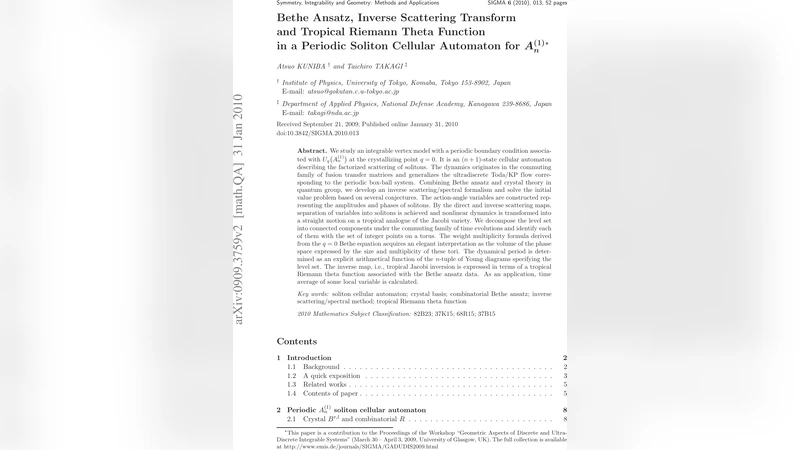
We study an integrable vertex model with a periodic boundary condition associated with U_q(A_n^{(1)}) at the crystallizing point q=0. It is an (n+1)-state cellular automaton describing the factorized scattering of solitons. The dynamics originates in the commuting family of fusion transfer matrices and generalizes the ultradiscrete Toda/KP flow corresponding to the periodic box-ball system. Combining Bethe ansatz and crystal theory in quantum group, we develop an inverse scattering/spectral formalism and solve the initial value problem based on several conjectures. The action-angle variables are constructed representing the amplitudes and phases of solitons. By the direct and inverse scattering maps, separation of variables into solitons is achieved and nonlinear dynamics is transformed into a straight motion on a tropical analogue of the Jacobi variety. We decompose the level set into connected components under the commuting family of time evolutions and identify each of them with the set of integer points on a torus. The weight multiplicity formula derived from the q=0 Bethe equation acquires an elegant interpretation as the volume of the phase space expressed by the size and multiplicity of these tori. The dynamical period is determined as an explicit arithmetical function of the n-tuple of Young diagrams specifying the level set. The inverse map, i.e., tropical Jacobi inversion is expressed in terms of a tropical Riemann theta function associated with the Bethe ansatz data. As an application, time average of some local variable is calculated.
💡 Research Summary
The paper investigates a periodic soliton cellular automaton (PSCA) that arises from the quantum affine algebra U_q(A_n^{(1)}) in the crystallizing limit q → 0. In this limit the R‑matrix becomes a deterministic map, and its fusion produces a family of commuting transfer matrices T_ℓ (ℓ = 1,…,n). The automaton therefore has (n + 1) internal states at each lattice site and exhibits factorised soliton scattering: solitons of different amplitudes (or “colours”) move ballistically and interact through completely elastic collisions.
The authors combine the Bethe ansatz at q = 0 with crystal‑basis theory to construct a full inverse‑scattering formalism. The zero‑temperature Bethe equations reduce to a set of integer equations whose solutions are encoded by an n‑tuple of Young diagrams Y^{(a)} (a = 1,…,n) together with multiplicities m_i^{(a)}. These data, called the Bethe data, play the role of action‑angle variables: the “action” part records the amplitudes (lengths) of the solitons, while the “angle” part records their phases (positions).
Two maps are introduced. The direct scattering map Φ takes an initial cellular configuration and extracts the Bethe data. This is achieved by interpreting the configuration as an element of a tensor product of crystal bases, then reading off the integer eigenvalues of the fused transfer matrices. The inverse scattering map Ψ reconstructs the configuration from the Bethe data. The reconstruction is expressed through a tropical Riemann theta function Θ_Γ(z), where Γ is a lattice determined by the Bethe data and z is a linear function of the angles and the discrete times t_ℓ. In this way the nonlinear time evolution of the PSCA is linearised: under Ψ the dynamics becomes a straight‑line motion on the tropical analogue of a Jacobian variety (a real torus ℝ^g/Γ).
The paper proceeds to analyse the geometry of the level sets – the sets of configurations sharing the same Bethe data. Each level set decomposes into connected components that are in bijection with the integer points of a torus T(Y). The number of such points coincides with the weight multiplicity given by the q = 0 Bethe equations, providing a striking interpretation of the multiplicity formula as the volume (in the counting sense) of the phase space.
A central result is an explicit arithmetical formula for the dynamical period. For a given n‑tuple of Young diagrams the minimal common period P(Y) of all commuting flows T_ℓ is the least common multiple of certain integers p_i^{(a)} that depend only on the sizes of the rows of the diagrams. This yields a closed‑form expression for the recurrence time of any configuration.
Finally, the authors apply the tropical theta‑function representation to compute time‑averaged values of local observables (e.g., the occupation probability of a particular site). By averaging over the straight‑line motion on the torus, the average reduces to an integral of the tropical theta function, which can be evaluated explicitly.
In summary, the work establishes a comprehensive integrable structure for the periodic A_n^{(1)} soliton cellular automaton. It identifies action‑angle variables via the zero‑temperature Bethe ansatz, linearises the dynamics on a tropical Jacobian, decomposes the phase space into integer‑lattice tori whose volumes reproduce Bethe multiplicities, and provides explicit formulas for periods and observable averages. The synthesis of quantum‑group Bethe ansatz, crystal theory, and tropical geometry offers a powerful framework that extends the ultradiscrete Toda/KP correspondence to multi‑colour soliton systems and deepens the connection between integrable quantum models and tropical algebraic geometry.
Comments & Academic Discussion
Loading comments...
Leave a Comment