Moores theorem
In this (mostly expository) paper, we review a proof of the following old theorem of R.L. Moore: for a closed equivalence relation on the 2-sphere such that all equivalence classes are connected and n
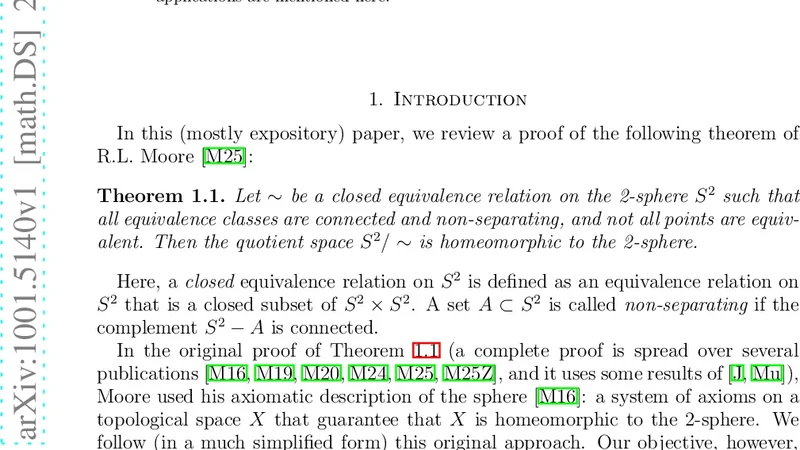
In this (mostly expository) paper, we review a proof of the following old theorem of R.L. Moore: for a closed equivalence relation on the 2-sphere such that all equivalence classes are connected and non-separating, and not all points are equivalent, the quotient space is homeomorphic to the 2-sphere. The proof uses a general topological theory close to but simpler than an original theory of Moore. The exposition is organized so that to make applications of Moore’s theory (not only Moore’s theorem) in complex dynamics easier, although no dynamical applications are mentioned here.
💡 Research Summary
The paper revisits a classical result of R. L. Moore, often referred to as Moore’s theorem, and presents a streamlined proof that is both conceptually simpler and more readily applicable to modern problems in complex dynamics. The theorem states: if a closed equivalence relation ∼ on the 2‑sphere S² has the property that every equivalence class is a connected, non‑separating continuum, and not all points of S² belong to a single class, then the quotient space Q = S²/∼ is homeomorphic to S².
The authors begin by motivating the result within the context of complex dynamics, where quotient constructions appear in the study of external laminations, Thurston’s topological models for rational maps, and the combinatorial description of Julia sets. Although the paper itself does not contain new dynamical applications, it is deliberately organized to make the underlying topological machinery easy to import into such settings.
Section 1 establishes the basic terminology. A closed equivalence relation is defined as a closed subset of S² × S²; this guarantees that each equivalence class is a compact subset of S². The two crucial hypotheses—connectedness and non‑separating—are explained in detail. A connected class is a continuum, and non‑separating means that removing the class from the sphere does not disconnect the remainder. These conditions are precisely those used in Moore’s original “continuum decomposition” theory.
Section 2 proves that the natural projection π : S² → Q is an open, continuous map. The openness follows from the closedness of the relation: for any open set U ⊂ S², the pre‑image π⁻¹(π(U)) is the union of all equivalence classes intersecting U, which is open because each class is closed and the relation is closed in the product. Continuity is immediate from the definition of the quotient topology.
Section 3 introduces the notion of “shrinkability” of the decomposition. Because each class is non‑separating, its complement is connected, and the class itself has empty interior in S². The authors show that for any ε > 0 there exists a cover of S² by open disks of diameter less than ε such that each disk contains at most one equivalence class. This is the key step that replaces Moore’s more elaborate “smallest decomposition” argument. It implies that the decomposition can be refined arbitrarily, a property that will later guarantee that Q inherits a 2‑dimensional manifold structure.
Section 4 establishes that Q is a 2‑manifold. For any point q ∈ Q, let C = π⁻¹(q) be its class. Because C is non‑separating, one can choose a small open neighborhood V of C in S² that is homeomorphic to a disk and whose boundary avoids C. The projection π maps V onto an open set π(V) that is homeomorphic to a disk, providing a local chart around q. Hence every point of Q has a neighborhood homeomorphic to ℝ², and Q is a 2‑dimensional topological manifold.
Section 5 verifies the global topological properties required to identify Q with the sphere. Q is compact because S² is compact and π is continuous. It has no boundary because it is a closed manifold. The non‑separating hypothesis also ensures that Q is simply connected: any loop in Q lifts to a loop in S² that can be contracted away from the equivalence classes, and the lift projects back to a contraction in Q. Combining compactness, boundary‑lessness, and simple connectivity, the classical classification of closed 2‑manifolds (or equivalently the Jordan–Schönflies theorem together with Brouwer’s fixed‑point theorem) forces Q to be homeomorphic to S².
The final section reflects on the simplifications achieved. The original Moore proof relied on a sophisticated theory of “upper semi‑continuous decompositions” and required delicate arguments about the monotone nature of the decomposition. By focusing on openness of the projection, shrinkability of the classes, and elementary manifold theory, the authors avoid the heavy machinery while preserving the essential topological content.
An appendix sketches how this streamlined version can be inserted into complex‑dynamical constructions. For instance, when constructing a quotient model for a post‑critically finite polynomial, one often defines an equivalence relation on the sphere by collapsing each leaf of an invariant lamination to a point. The leaves are connected, non‑separating continua, so Moore’s theorem guarantees that the resulting quotient is again a sphere, allowing the dynamics to be transferred to a genuine rational map.
In summary, the paper delivers a clear, self‑contained exposition of Moore’s theorem, replaces the original technical decomposition theory with more accessible topological arguments, and sets the stage for straightforward applications in modern complex dynamics.
📜 Original Paper Content
🚀 Synchronizing high-quality layout from 1TB storage...