Analytical calculation of the minimum wind speed required to sustain wind-blown sand on Earth and Mars
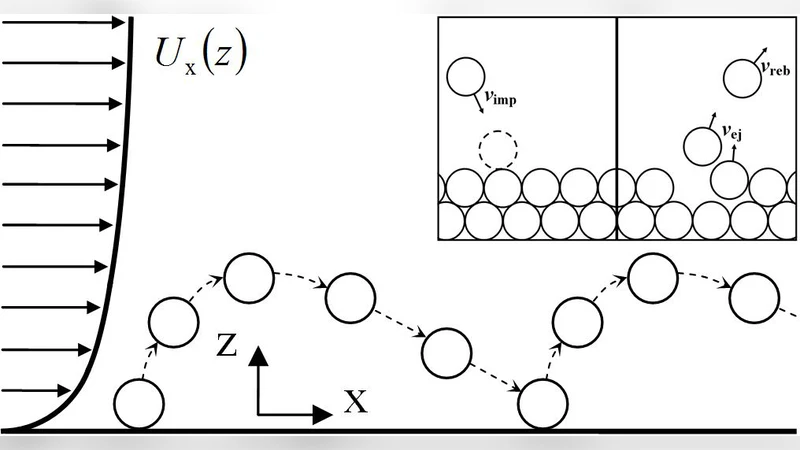
The wind-driven hopping motion of sand grains, known as saltation, forms dunes and ripples and ejects fine dust particles into the atmosphere on both Earth and Mars. While the wind speed at which saltation is initiated, the fluid threshold, has been studied extensively, the wind speed at which it is halted, the impact threshold, has been poorly quantified for Mars conditions. We present an analytical model of the impact threshold, which we show to be in agreement with measurements and recent numerical simulations for Earth conditions. For Mars conditions, we find that the impact threshold is approximately an order of magnitude below the fluid threshold, in agreement with previous studies. Saltation on Mars can thus be sustained at wind speeds an order of magnitude less than required to initiate it, leading to the occurrence of hysteresis. These results confirm earlier simulations with a detailed numerical saltation model, and have important implications for the formation of sand dunes, ripples, and dust storms on Mars.
💡 Research Summary
The paper presents a comprehensive analytical framework for determining the impact threshold—the minimum wind shear velocity required to sustain saltation—on both Earth and Mars. Saltation, the wind‑driven hopping of sand grains, is the primary mechanism behind dune and ripple formation, wind erosion, and dust emission on both planets. While the fluid threshold (the wind speed needed to initiate saltation) has been extensively studied, the wind speed at which saltation ceases—the impact threshold—has received far less attention, especially under Martian conditions.
The authors construct a steady‑state model that treats a typical saltating grain as moving under gravity and aerodynamic drag alone, neglecting secondary forces such as particle spin, electrostatics, turbulence, and inter‑particle collisions. By enforcing a constant particle concentration, they require that the average horizontal momentum gained from the wind during a hop exactly balances the momentum lost to the bed. This condition yields Equation (1), linking the horizontal momentum gain to the drag force, particle mass, and hop duration.
Drag is expressed through a Reynolds‑number‑dependent drag coefficient (Eq. 4) and an average relative velocity between grain and wind (Eq. 3). The wind profile at the impact threshold is assumed to be unperturbed, allowing the use of the logarithmic “law of the wall” (Eq. 7) to relate wind speed at a characteristic height to the shear velocity u*. Substituting these relations into the momentum balance gives an explicit expression for the impact shear velocity u*₍imp₎ (Eq. 8), which depends on several averaged quantities: impact speed v_imp, lift‑off speed v₀ₓ, hop time, hop height, and mean horizontal grain speed.
The average impact speed is derived from the balance between splashed particles (N_spl) and particles lost to the bed (N_loss). Assuming an exponential distribution of impact speeds (supported by numerical simulations) leads to a closed‑form solution (Eq. 14) that shows v_imp is essentially independent of shear velocity and depends mainly on grain size, gravity, and atmospheric density. The lift‑off speed combines contributions from splash ejecta and rebounding grains (Eqs. 15‑19), using experimentally calibrated parameters for restitution and splash fractions.
Vertical motion is solved analytically (Eqs. 20‑23) to obtain average hop time and height, while horizontal motion is integrated (Eqs. 24‑26) to give the mean horizontal grain speed. All these expressions are then iteratively solved together with Eq. 8 to compute the impact threshold for given planetary conditions.
Validation on Earth shows the model reproduces laboratory measurements (Bagnold 1937; Iversen & Rasmussen 1994) and the results of the COMSALT numerical saltation model, yielding an impact threshold ≈ 0.82 × the fluid threshold, consistent with classic observations. For Mars, using typical Martian atmospheric pressure (≈ 600 Pa), temperature (≈ 210 K), gravity (3.71 m s⁻²), and grain sizes of 100–1000 µm, the model predicts an impact threshold roughly an order of magnitude lower than the fluid threshold (≈ 0.1 × fluid). This aligns with prior scaling studies (Claudin & Andreotti 2006; Almeida et al. 2008) and recent COMSALT simulations (Kok 2010).
A practical approximation (Eq. 27) is offered, allowing researchers to estimate the impact threshold from pressure, temperature, and grain diameter with 1–10 % error across a broad Martian parameter space.
The key insight is the existence of a pronounced hysteresis between initiation and maintenance of saltation, especially on Mars where the impact threshold is dramatically lower. Consequently, once a wind event exceeds the fluid threshold and initiates saltation, subsequent winds well below that value can still sustain grain motion, explaining observed active sand transport despite the rarity of super‑threshold winds in Martian atmospheric models. This hysteresis has profound implications for dune and ripple evolution, dust storm initiation, and the long‑term modification of the Martian surface.
In conclusion, the paper delivers a robust analytical tool for quantifying the impact threshold on Earth and Mars, validates it against empirical and numerical data, and highlights the critical role of hysteresis in planetary aeolian processes. The results provide a foundation for incorporating realistic saltation dynamics into climate, atmospheric, and geomorphological models of both planets.
Comments & Academic Discussion
Loading comments...
Leave a Comment