The Eddington Limit in Cosmic Rays: An Explanation for the Observed Lack of Low-Mass Radio-Loud Quasars and the M_{BH}-M_{Bulge} Relation
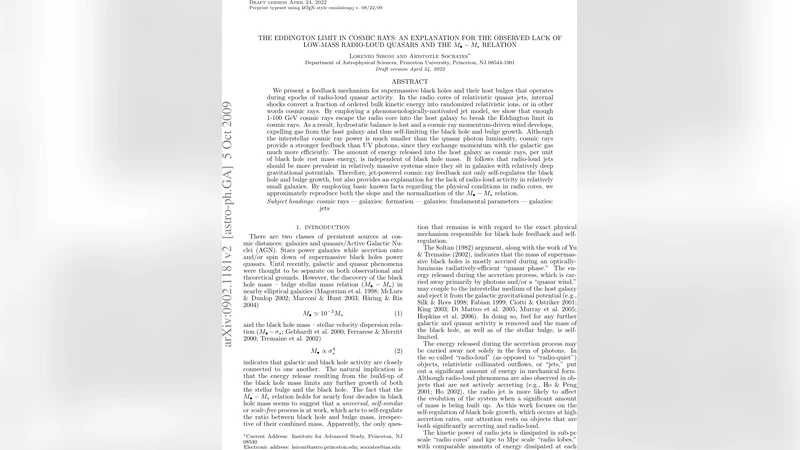
We present a feedback mechanism for supermassive black holes and their host bulges that operates during epochs of radio-loud quasar activity. In the radio cores of relativistic quasar jets, internal shocks convert a fraction of ordered bulk kinetic energy into randomized relativistic ions, or in other words cosmic rays. By employing a phenomenologically-motivated jet model, we show that enough 1-100 GeV cosmic rays escape the radio core into the host galaxy to break the Eddington limit in cosmic rays. As a result, hydrostatic balance is lost and a cosmic ray momentum-driven wind develops, expelling gas from the host galaxy and thus self-limiting the black hole and bulge growth. Although the interstellar cosmic ray power is much smaller than the quasar photon luminosity, cosmic rays provide a stronger feedback than UV photons, since they exchange momentum with the galactic gas much more efficiently. The amount of energy released into the host galaxy as cosmic rays, per unit of black hole rest mass energy, is independent of black hole mass. It follows that radio-loud jets should be more prevalent in relatively massive systems since they sit in galaxies with relatively deep gravitational potentials. Therefore, jet-powered cosmic ray feedback not only self-regulates the black hole and bulge growth, but also provides an explanation for the lack of radio-loud activity in relatively small galaxies. By employing basic known facts regarding the physical conditions in radio cores, we approximately reproduce both the slope and the normalization of the M_{BH}-M_{Bulge} relation.
💡 Research Summary
The paper proposes a novel feedback mechanism that operates during the radio‑loud phase of quasars, in which relativistic jets convert a fraction of their bulk kinetic energy into high‑energy cosmic rays (CRs) via internal shocks. By adopting a phenomenological jet model calibrated to observed jet powers, core sizes, magnetic field strengths, and bulk Lorentz factors, the authors estimate that roughly 5–10 % of the jet’s kinetic luminosity is transferred into 1–100 GeV protons and nuclei. These CRs escape the compact radio core and propagate into the host galaxy’s interstellar medium (ISM).
Once in the ISM, a modest fraction (≈10 %) of the CRs interact with the gas through Coulomb collisions and hadronic processes, depositing momentum much more efficiently than photons. The authors define a “cosmic‑ray Eddington limit” as the condition where the CR‑driven momentum flux, (P_{\rm CR}=L_{\rm CR}/(4\pi r^{2}c)), exceeds the gravitational binding force of the galactic bulge. When this limit is surpassed, hydrostatic equilibrium is lost and a CR‑driven, momentum‑dominated wind is launched, expelling gas from the bulge and halting further accretion onto the central supermassive black hole (SMBH).
A key result is that the CR energy injected into the host per unit SMBH rest‑mass energy is essentially independent of SMBH mass. Consequently, the CR feedback strength scales with the depth of the galactic potential well rather than with the absolute jet power. In massive galaxies (bulge masses ≳10¹¹ M⊙, SMBH masses ≳10⁸ M⊙) the gravitational binding is strong enough that the CR pressure can reach the Eddington limit, producing a powerful outflow that self‑regulates both SMBH growth and bulge star formation. In contrast, low‑mass systems have shallow potentials; the CR pressure never reaches the critical value, so the jet cannot sustain a long‑lived radio‑loud phase. This naturally explains the observed paucity of low‑mass radio‑loud quasars.
The model also reproduces the observed (M_{\rm BH})–(M_{\rm Bulge}) relation. Because the CR energy per unit SMBH mass is roughly constant (≈10⁻³ c²), the total momentum imparted to the bulge scales linearly with SMBH mass, yielding (M_{\rm BH}\propto M_{\rm Bulge}) with a normalization that matches empirical data. The authors argue that CR feedback is more efficient than photon‑driven (UV or X‑ray) feedback because CRs couple to the dense ISM over kiloparsec scales without being limited by radiative transfer effects such as dust opacity or photon trapping.
The paper discusses several caveats. The treatment of CR transport (diffusion versus streaming), magnetic field geometry in the jet and host galaxy, and the multi‑phase structure of the ISM are simplified. Future work will require full magneto‑hydrodynamic simulations that self‑consistently follow CR acceleration, propagation, and interaction with realistic galactic environments. Nevertheless, the presented analytic framework offers a compelling explanation for three long‑standing observations: (1) the scarcity of radio‑loud quasars in low‑mass galaxies, (2) the tight linear correlation between SMBH mass and bulge mass, and (3) the apparent dominance of kinetic (jet) feedback over radiative feedback in massive, radio‑loud systems. The study highlights cosmic rays as a potent, yet often overlooked, agent of galaxy‑scale feedback in the co‑evolution of black holes and their host galaxies.
Comments & Academic Discussion
Loading comments...
Leave a Comment