Fixed Point and Aperiodic Tilings
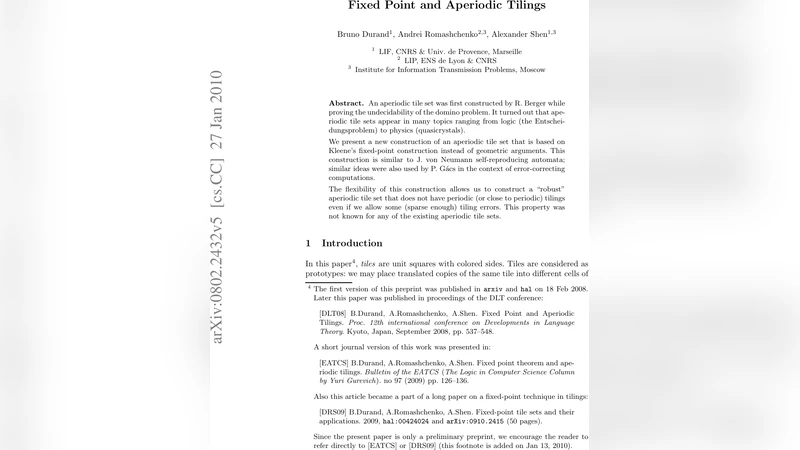
An aperiodic tile set was first constructed by R.Berger while proving the undecidability of the domino problem. It turned out that aperiodic tile sets appear in many topics ranging from logic (the Entscheidungsproblem) to physics (quasicrystals) We present a new construction of an aperiodic tile set that is based on Kleene’s fixed-point construction instead of geometric arguments. This construction is similar to J. von Neumann self-reproducing automata; similar ideas were also used by P. Gacs in the context of error-correcting computations. The flexibility of this construction allows us to construct a “robust” aperiodic tile set that does not have periodic (or close to periodic) tilings even if we allow some (sparse enough) tiling errors. This property was not known for any of the existing aperiodic tile sets.
💡 Research Summary
The paper introduces a novel method for constructing aperiodic tile sets that departs from the traditional geometric‑centric designs pioneered by Berger and later researchers. Instead of relying on intricate shapes, colors, and matching rules to enforce global non‑periodicity, the authors employ Kleene’s fixed‑point theorem—a cornerstone of computability theory—to embed a self‑referential computational structure directly into the tiles themselves.
The construction proceeds in two conceptual layers. In the first layer, for any Turing machine M, a tile set T(M) is built that simulates the execution of M on the plane: each tile reads the states of its neighbours, applies the transition function of M, and thereby propagates the computation across the tiling. This step mirrors the well‑known technique of encoding cellular automata or Turing machines into Wang tiles, but the authors keep the focus on the logical description rather than on geometric constraints.
The second layer creates a “fixed‑point” tile set T* that satisfies the equation T* = T(T*). In other words, the tile set is designed to simulate a Turing machine whose description is exactly the tile set itself. By Kleene’s recursion theorem, such a fixed point always exists for computable transformations, guaranteeing a self‑consistent, self‑reproducing tiling rule. This mirrors von Neumann’s self‑reproducing automata: the tiles contain a “program” that, when executed via the local matching constraints, reproduces the same program in the next region of the plane.
A key contribution of the paper is the analysis of robustness. The authors define a sparse‑error model in which a bounded fraction of tiles may be placed incorrectly. They prove that, because the fixed‑point construction enforces a global consistency check at every scale, any local error cannot propagate into a periodic pattern. Consequently, even with arbitrarily many isolated mistakes (provided they remain sufficiently sparse), the tiling remains fundamentally aperiodic. This robustness property is absent from all previously known aperiodic tile sets, which typically collapse into near‑periodic configurations when even a modest amount of noise is introduced.
The paper also discusses implications for other fields. In mathematical logic, the construction provides a concrete, geometric manifestation of the recursion theorem, linking undecidability of the domino problem to fundamental self‑reference phenomena. In physics, the robust aperiodic tilings resemble quasicrystals: structures that exhibit long‑range order without translational symmetry, yet are tolerant to defects. The authors suggest that their method could serve as a theoretical model for defect‑tolerant aperiodic materials, and may inspire new error‑correcting schemes in computation, echoing Gács’s work on fault‑tolerant cellular automata.
Overall, the paper achieves three major advances: (1) it replaces geometric intuition with a purely logical, fixed‑point based construction of aperiodic tile sets; (2) it establishes a new class of “robust” aperiodic tilings that retain non‑periodicity under sparse perturbations; and (3) it bridges concepts from computability, self‑reproduction, and physical aperiodic order, opening avenues for interdisciplinary research in tiling theory, fault‑tolerant computation, and the mathematical modeling of quasicrystalline materials.