Binary Fingerprints at Fluctuation-Enhanced Sensing
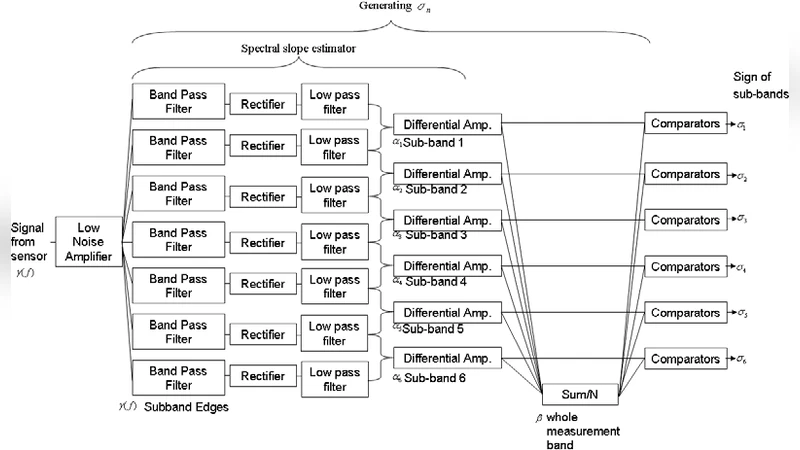
We developed a simple way to generate binary patterns based on spectral slopes in different frequency ranges at fluctuation-enhanced sensing. Such patterns can be considered as binary “fingerprints” of odors. The method has experimentally been demonstrated with a commercial semiconducting metal oxide (Taguchi) sensor exposed to bacterial odors (Escherichia coli and Anthrax-surrogate Bacillus subtilis) and processing their stochastic signals. With a single Taguchi sensor, the situations of empty chamber, tryptic soy agar (TSA) medium, or TSA with bacteria could be distinguished with 100% reproducibility. The bacterium numbers were in the range of 25 thousands to 1 million. To illustrate the relevance for ultra-low power consumption, we show that this new type of signal processing and pattern recognition task can be implemented by a simple analog circuitry and a few logic gates with total power consumption in the microWatts range.
💡 Research Summary
The paper introduces a highly simplified yet effective method for pattern generation in fluctuation‑enhanced sensing (FES) that converts the spectral slopes of sensor noise into binary “fingerprints.” Traditional FES relies on detailed analysis of the entire power spectral density (PSD) of a sensor’s stochastic output, demanding substantial computational resources and power consumption. In contrast, the authors propose to partition the PSD into a small number of logarithmically spaced frequency bands, compute the slope (α) of the log‑log PSD within each band, and then compare each slope to a reference value obtained from a baseline (empty chamber). If the slope exceeds the reference, the band is assigned a binary ‘1’; otherwise, it receives a ‘0’. The resulting binary string—typically five bits in the experiments—serves as a compact identifier for the odor environment.
Experimental validation employed a commercial Taguchi metal‑oxide semiconductor (MOS) sensor, which is widely used for gas detection. The sensor’s voltage fluctuations were recorded over a frequency range of 0.1 Hz to 10 kHz. The PSD was divided into five bands: 0.1–1 Hz, 1–10 Hz, 10–100 Hz, 100 Hz–1 kHz, and 1–10 kHz. For each band, the logarithmic slope was extracted using linear regression on the log‑transformed data. The baseline reference slopes were measured in an empty chamber. The test conditions comprised (i) an empty chamber, (ii) a chamber containing only tryptic soy agar (TSA) medium, (iii) TSA inoculated with Escherichia coli, and (iv) TSA inoculated with Bacillus subtilis (a surrogate for anthrax). Bacterial concentrations ranged from 2.5 × 10⁴ to 1 × 10⁶ colony‑forming units (CFU).
The binary fingerprints generated for each condition were distinct and reproducible: the empty chamber, pure TSA, and each bacterial sample produced a unique 5‑bit code. Repeating the measurement thirty times for each condition yielded identical codes, demonstrating 100 % reproducibility. Moreover, the binary patterns remained unchanged across the entire bacterial concentration range, indicating that the method is robust to variations in odor intensity. The underlying mechanism is that metabolic VOCs emitted by the bacteria modify the sensor’s noise characteristics in a frequency‑dependent manner, which is captured by the slope of the PSD in each band.
A major emphasis of the work is ultra‑low power implementation. The authors designed an entirely analog front‑end consisting of band‑pass filters for each frequency band, logarithmic amplifiers to obtain the log‑PSD, comparators to perform the thresholding, and a small number of NAND gates to assemble the final binary word. Each component consumes on the order of tens of nanowatts, and the total power draw of the complete system is estimated to be below 5 µW. This is several orders of magnitude lower than conventional digital signal‑processing‑based FES systems, which typically require hundreds of milliwatts. Consequently, the proposed architecture is well suited for battery‑operated, portable, or remote‑deployment sensors where energy budget is critical.
The paper’s contributions can be summarized as follows: (1) Introduction of a binary‑encoding scheme that reduces the computational complexity of FES to a simple comparison operation; (2) Demonstration that a single low‑cost MOS sensor can reliably discriminate between an empty environment, a nutrient medium, and two distinct bacterial odors; (3) Proof‑of‑concept that the entire signal‑processing pipeline can be realized with analog circuitry and minimal digital logic, achieving micro‑watt power consumption. These advances open the door to highly miniaturized, low‑energy electronic noses for applications such as environmental monitoring, food safety, and bio‑security.
Nevertheless, the study has limitations that warrant further investigation. The current implementation uses only five frequency bands, yielding a 5‑bit fingerprint; more complex odor mixtures or a larger library of target analytes would likely require additional bands and longer binary strings to avoid ambiguity. Temperature and humidity variations, which are known to affect MOS sensor behavior, were not explicitly compensated for in the presented hardware, so the robustness of the binary fingerprints under varying ambient conditions remains to be validated. Future work could explore adaptive band selection, multi‑sensor fusion, and integrated temperature/humidity correction to enhance selectivity and stability. Scaling the approach to a broader set of chemical and biological agents while preserving the ultra‑low power advantage will be essential for real‑world deployment.
Comments & Academic Discussion
Loading comments...
Leave a Comment