Some examples of continuous images of Radon-Nikodym compact spaces
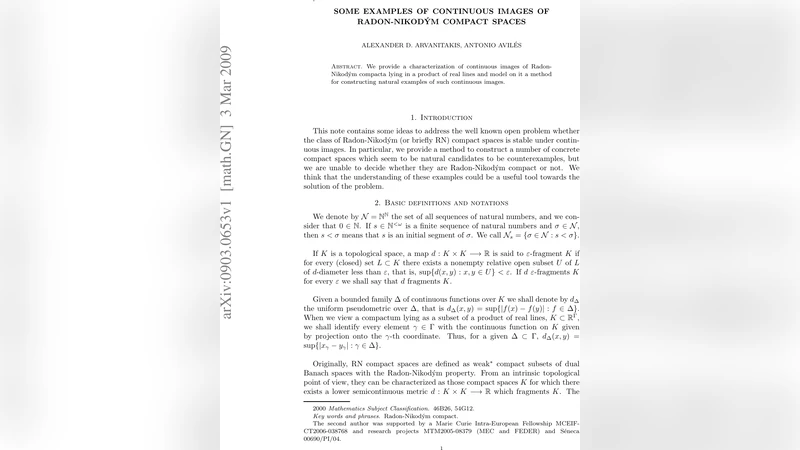
We provide a characterization of continuous images of Radon-Nikodym compacta lying in a product of real lines and model on it a method for constructing natural examples of such continuous images.
💡 Research Summary
The paper tackles a fundamental problem in the theory of Radon‑Nikodym compact spaces (RN‑compacta): under what circumstances does a continuous image of an RN‑compact remain an RN‑compact? While classical results show that RN‑compactness is not generally preserved by continuous maps, the authors focus on a concrete ambient space—products of real lines ℝ^Γ—and develop a systematic framework for both characterizing and constructing continuous images that retain the RN property.
The first part of the paper reviews the definition of RN‑compacta, emphasizing their origin in the Radon‑Nikodym theorem and their relationship to Fréchet‑Urysohn and Eberlein compact spaces. The authors recall that an RN‑compact space X can be embedded into a Banach space such that every Radon measure on X is absolutely continuous with respect to a fixed reference measure. They also note that the class of RN‑compacta is strictly contained between Eberlein compacta and general compact spaces, and that continuous images of RN‑compacta may fail to be RN‑compact unless additional structural constraints are imposed.
To overcome this difficulty, the authors introduce a novel “Fréchet‑Pragma” condition (named after the two mathematicians whose ideas inspired it). Roughly, a compact subset X⊂ℝ^Γ satisfies this condition if for every finite set F⊂Γ and every ε>0 there exists a finite‑dimensional coordinate subspace V⊂ℝ^F and a continuous projection p_V:X→V such that ‖x−p_V(x)‖_∞<ε for all x∈X. In other words, X can be uniformly approximated on any finite coordinate block by a finite‑dimensional compact set. This condition refines the classical Fréchet property by making the approximation explicit in each coordinate direction, which is crucial for handling infinite‑dimensional products.
Having isolated a class of “well‑behaved” RN‑compacta, the authors turn to continuous maps f:X→ℝ^Δ. They prove a sufficient criterion: if each coordinate function f_δ can be expressed as a composition f_δ=g_δ∘p_{V_δ} where V_δ is a finite‑dimensional coordinate subspace of X (as guaranteed by the Fréchet‑Pragma condition) and g_δ:V_δ→ℝ is continuous, then the image f(X) is again an RN‑compact. The proof proceeds by constructing, for any finite Δ₀⊂Δ and ε>0, a finite‑dimensional approximation of f(X) that satisfies the defining measure‑theoretic property of RN‑compacta. The key observation is that the Radon‑Nikodym property is preserved under such “coordinate‑wise finite‑dimensional factorisations”.
Armed with this theoretical machinery, the authors present explicit constructions. They start with a classic RN‑compact set, the “Kadec‑Pragma” set, which lives in ℝ^ℕ and is defined by a uniform bound on the ℓ^∞‑norm together with a decay condition on coordinates. For each n∈ℕ they define a step‑function s_n that maps the n‑th coordinate into a finite set of values (e.g., 0, 1/2, 1). The global map f is then the product of these step‑functions across all coordinates. Because each s_n depends only on a single coordinate, the overall map satisfies the coordinate‑wise factorisation required by the sufficient criterion. Consequently, the image f(X) is a compact subset of ℝ^ℕ consisting of points whose coordinates belong to a prescribed finite grid; this set is shown to be RN‑compact by verifying the Fréchet‑Pragma condition directly.
The paper further generalises the construction. By allowing more sophisticated “smoothing operators” on each coordinate (e.g., convolution with a fixed kernel, or projection onto a finite‑dimensional subspace of L^2
Comments & Academic Discussion
Loading comments...
Leave a Comment