A New Class of TAST Codes With A Simplified Tree Structure
We consider in this paper the design of full diversity and high rate space-time codes with moderate decoding complexity for arbitrary number of transmit and receive antennas and arbitrary input alphabets. We focus our attention to codes from the threaded algebraic space-time (TAST) framework since the latter includes most known full diversity space-time codes. We propose a new construction of the component single-input single-output (SISO) encoders such that the equivalent code matrix has an upper triangular form. We accomplish this task by designing each SISO encoder to create an ISI-channel in each thread. This, in turn, greatly simplifies the QR-decomposition of the composite channel and code matrix, which is essential for optimal or near-optimal tree search algorithms, such as the sequential decoder.
💡 Research Summary
This paper addresses the long‑standing challenge of designing space‑time codes that simultaneously offer full diversity, high spectral efficiency, and moderate decoding complexity for arbitrary numbers of transmit and receive antennas. The authors focus on the Threaded Algebraic Space‑Time (TAST) framework, which already encompasses many known full‑diversity codes such as orthogonal designs and cyclic division algebra codes. The key contribution is a novel construction of the component single‑input single‑output (SISO) encoders that forces the equivalent code matrix to be upper‑triangular.
The construction proceeds as follows. Start with a full‑rate, full‑diversity M×M TAST code S (e.g., the Golden code). For a chosen integer L ≥ 0, define the transmission block length T = 2M + L − 1 and the number of QAM information symbols K = M(M + L). The new M×T code matrix T(u) is built by concatenating columns of S in a cyclic fashion: the first M columns are successive columns of S with new symbols injected, then L “middle” columns are added to increase the rate, and finally M − 1 termination columns are appended where no new symbols enter. Crucially, each information symbol appears exactly M times, all within a single thread (i.e., a specific permutation of antenna‑time slots). This guarantees that any non‑zero symbol occupies an M×M sub‑matrix that is a column‑permuted copy of S, thereby inheriting S’s full‑diversity property. The authors formalize this in Theorem 1 and provide a constructive proof.
Because the resulting equivalent code matrix M is upper‑triangular, the QR decomposition of the composite matrix (I_T ⊗ H) M simplifies dramatically. Only the QR decomposition of the channel matrix H (size N × M) is required; the triangular structure automatically yields the QR factors of the whole product. This reduces the preprocessing complexity from O((NT)³) to roughly O(NM²), and with Givens rotations the flop count per decoded symbol becomes linear in the block length K, as opposed to quadratic for conventional TAST codes.
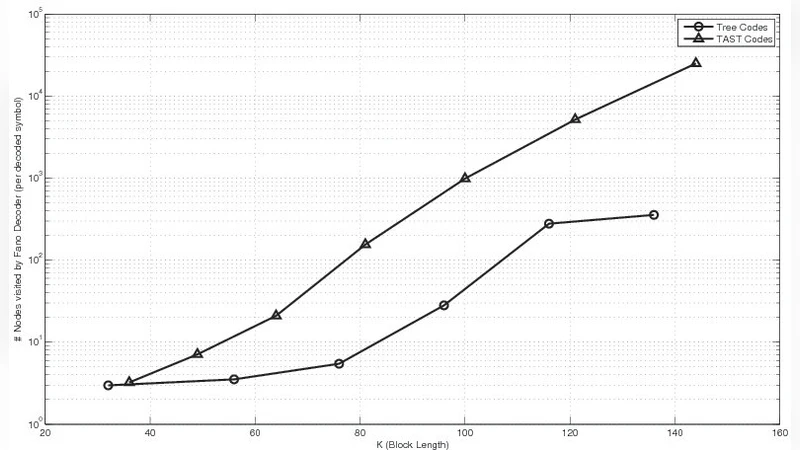
The authors evaluate the proposed codes via simulations using BPSK modulation and the Fano sequential decoder. Results show a substantial reduction in the number of visited nodes (tree‑search complexity) and in the number of floating‑point operations required for QR decomposition, especially for large block lengths and low SNR regimes. The complexity gain stems from the sparsity introduced by the upper‑triangular structure, which the decoder can exploit efficiently.
Rate analysis reveals a trade‑off: the new codes achieve a rate
\
Comments & Academic Discussion
Loading comments...
Leave a Comment