Termination Detection of Local Computations
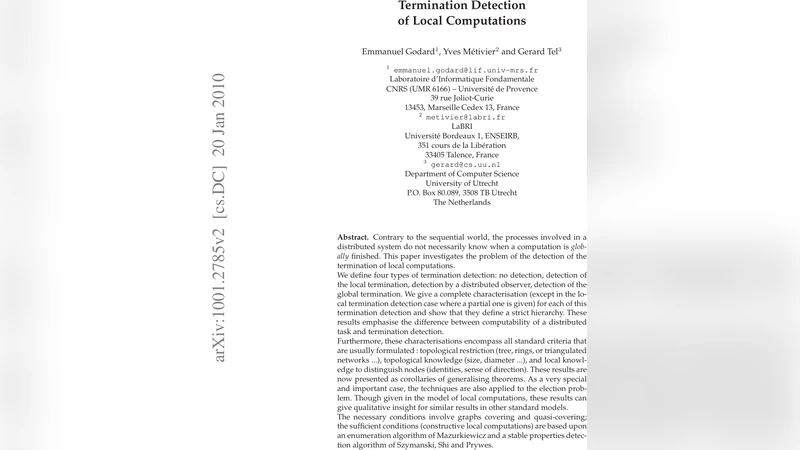
Contrary to the sequential world, the processes involved in a distributed system do not necessarily know when a computation is globally finished. This paper investigates the problem of the detection of the termination of local computations. We define four types of termination detection: no detection, detection of the local termination, detection by a distributed observer, detection of the global termination. We give a complete characterisation (except in the local termination detection case where a partial one is given) for each of this termination detection and show that they define a strict hierarchy. These results emphasise the difference between computability of a distributed task and termination detection. Furthermore, these characterisations encompass all standard criteria that are usually formulated : topological restriction (tree, rings, or triangu- lated networks …), topological knowledge (size, diameter …), and local knowledge to distinguish nodes (identities, sense of direction). These results are now presented as corollaries of generalising theorems. As a very special and important case, the techniques are also applied to the election problem. Though given in the model of local computations, these results can give qualitative insight for similar results in other standard models. The necessary conditions involve graphs covering and quasi-covering; the sufficient conditions (constructive local computations) are based upon an enumeration algorithm of Mazurkiewicz and a stable properties detection algorithm of Szymanski, Shi and Prywes.
💡 Research Summary
This paper addresses the fundamental problem of termination detection in distributed systems, focusing on the model of local computations. The authors first define four distinct levels of termination detection: (1) no detection, where processes never become aware that the computation has finished; (2) local termination detection, where each process can recognize that its own local computation has reached a normal form; (3) observed termination detection, in which a distinguished observer node (or a set of observers) can determine that the whole system has terminated; and (4) global termination detection, where every node simultaneously knows that the computation has ended.
The core technical contribution lies in characterising the necessary and sufficient conditions for each of these detection levels using graph‑theoretic notions of coverings and quasi‑coverings. A covering is a structure‑preserving mapping from one labelled graph to another; it captures the idea that two different network topologies can appear identical from a local point of view, thus preventing nodes from distinguishing their environments. A quasi‑covering relaxes this notion by requiring the covering property only within a bounded radius r; if arbitrarily large radii are allowed, the quasi‑covering essentially becomes a full covering.
The authors prove that termination detection of any kind is possible only when the family of admissible networks F satisfies two properties: (i) it is closed under covering‑lifting (i.e., any covering of a graph in F is also in F), and (ii) there exists a recursive function r such that no strict quasi‑covering of radius greater than r exists from any graph H to a graph in F. These two abstract conditions subsume all previously known sufficient conditions—unique leader, tree topology, known diameter, and distinct identifiers—showing that they are merely special instances of a single, more general criterion.
To turn these existential characterisations into constructive algorithms, the paper combines two classic tools. Mazurkiewicz’s enumeration algorithm assigns unique identifiers to all vertices using only local relabelling steps; it works precisely when the covering‑lifting condition holds. The Szymanski‑Shi‑Prywes (SSP) stable‑property detection algorithm can recognise when a global predicate (e.g., “all nodes have obtained their identifiers and no further relabelling is possible”) has become stable across the whole network. By integrating Mazurkiewicz’s enumeration with SSP, the authors obtain a universal local computation that not only solves the underlying distributed task but also explicitly detects its termination according to the desired level (local, observed, or global).
The paper also applies the same framework to the classic election problem. Election—selecting a unique leader—is essentially a task that requires global termination detection. Using the covering‑based characterisation, the authors delineate exactly which families of graphs admit an election algorithm. For instance, complete graphs and rooted trees satisfy the covering‑restriction and therefore support election, whereas anonymous rings or any family that admits unbounded quasi‑coverings cannot elect a unique leader.
A hierarchy among the four detection levels is rigorously established: global detection strictly implies observed detection, which strictly implies local detection, which in turn strictly implies no detection. Each step in the hierarchy demands strictly stronger structural knowledge (e.g., identifiers, sense of direction, knowledge of size or diameter) that eliminates larger classes of quasi‑coverings.
In conclusion, the paper separates the notions of computability and termination detection in distributed computing, providing a unified graph‑theoretic lens to understand when explicit termination can be achieved. The results are model‑independent in spirit; although proved in the local‑computation framework, the same impossibility arguments extend to weaker models such as asynchronous message‑passing. The work opens avenues for future research on termination detection under faults, dynamic topologies, and in other computational models, while offering a practical guideline: to guarantee a certain level of termination awareness, a system designer must ensure that the network’s structural properties preclude the existence of large‑radius quasi‑coverings.
Comments & Academic Discussion
Loading comments...
Leave a Comment