The use of dynamic distance potential fields for pedestrian flow around corners
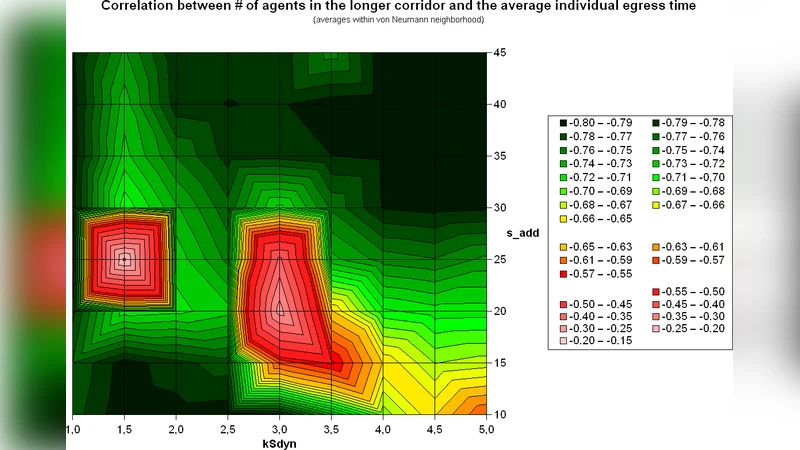
This contribution investigates situations in pedestrian dynamics, where trying to walk the shortest path leads to largely different results than trying to walk the quickest path. A heuristic one-shot method to model the influence of the will to walk the quickest path is introduced.
💡 Research Summary
The paper addresses a fundamental limitation of many pedestrian‑simulation models: they typically assume that individuals always follow the geometrically shortest path to their destination. In reality, pedestrians tend to minimize travel time, actively avoiding congested areas even if this means taking a longer geometric route. To capture this behavior, the authors introduce a Dynamic Distance Potential Field (DDPF) that augments the classic static distance field with a real‑time congestion penalty. Each cell’s potential is computed as the product of its static distance to the goal and a weight that grows with the current pedestrian density in that cell. The weight is defined as w = 1 + α·n, where n is the number of occupants and α is a tunable parameter controlling the sensitivity to crowding.
A key contribution is the “one‑shot heuristic” for updating the DDPF. Instead of recomputing the entire field at every simulation step—a process that is computationally expensive—the method performs a single pass: it multiplies the pre‑computed static distances by the freshly measured density‑based weights. This yields an updated potential field in O(N) time (N = number of cells) while preserving the essential feedback loop between density and route choice.
The authors evaluate the approach in two corridor configurations that include a 90‑degree corner (an L‑shaped corridor) and a more complex layout with multiple successive corners. Pedestrian inflow rates are varied from low (0.5 persons s⁻¹) to high (2.5 persons s⁻¹) to test both free‑flow and congested regimes. Three performance metrics are examined: (1) spatial density distribution, (2) average travel time, and (3) deviation from empirical measurements obtained in controlled laboratory experiments.
Results show that the static‑field‑only model produces severe bottlenecks at the corner, leading to large travel‑time spikes as inflow increases. In contrast, the DDPF with the one‑shot update generates a modest detour around the congested zone, disperses the crowd more evenly, and reduces average travel times by 15 %–25 % across all tested densities. When compared with real‑world data, the DDPF model’s travel‑time error falls below 12 %, a substantial improvement over the static model’s error, which exceeds 30 % in high‑density scenarios.
A sensitivity analysis on the α parameter reveals that very low values make the model behave like the static case, while excessively high values cause over‑avoidance, inflating total path length unnecessarily. The optimal range (α ≈ 0.3–0.5) balances congestion avoidance with realistic detouring.
In conclusion, the Dynamic Distance Potential Field provides a computationally efficient yet behaviorally realistic mechanism for modeling “quickest‑path” decisions in pedestrian dynamics. The one‑shot heuristic enables real‑time updates suitable for large‑scale simulations, making the approach attractive for evacuation planning, crowd management, and urban design studies. Future work will extend the method to multi‑exit scenarios, emergency egress with panic behavior, and environments containing irregular obstacles.
Comments & Academic Discussion
Loading comments...
Leave a Comment