We study the homology of the dual de Rham complex as functors on the category of abelian groups. We give a description of homology of the dual de Rham complex up to degree 7 for free abelian groups and present a corrected version of the proof of Jean's computations of the zeroth homology group.
Deep Dive into On the homology of the dual de Rham complex.
We study the homology of the dual de Rham complex as functors on the category of abelian groups. We give a description of homology of the dual de Rham complex up to degree 7 for free abelian groups and present a corrected version of the proof of Jean’s computations of the zeroth homology group.
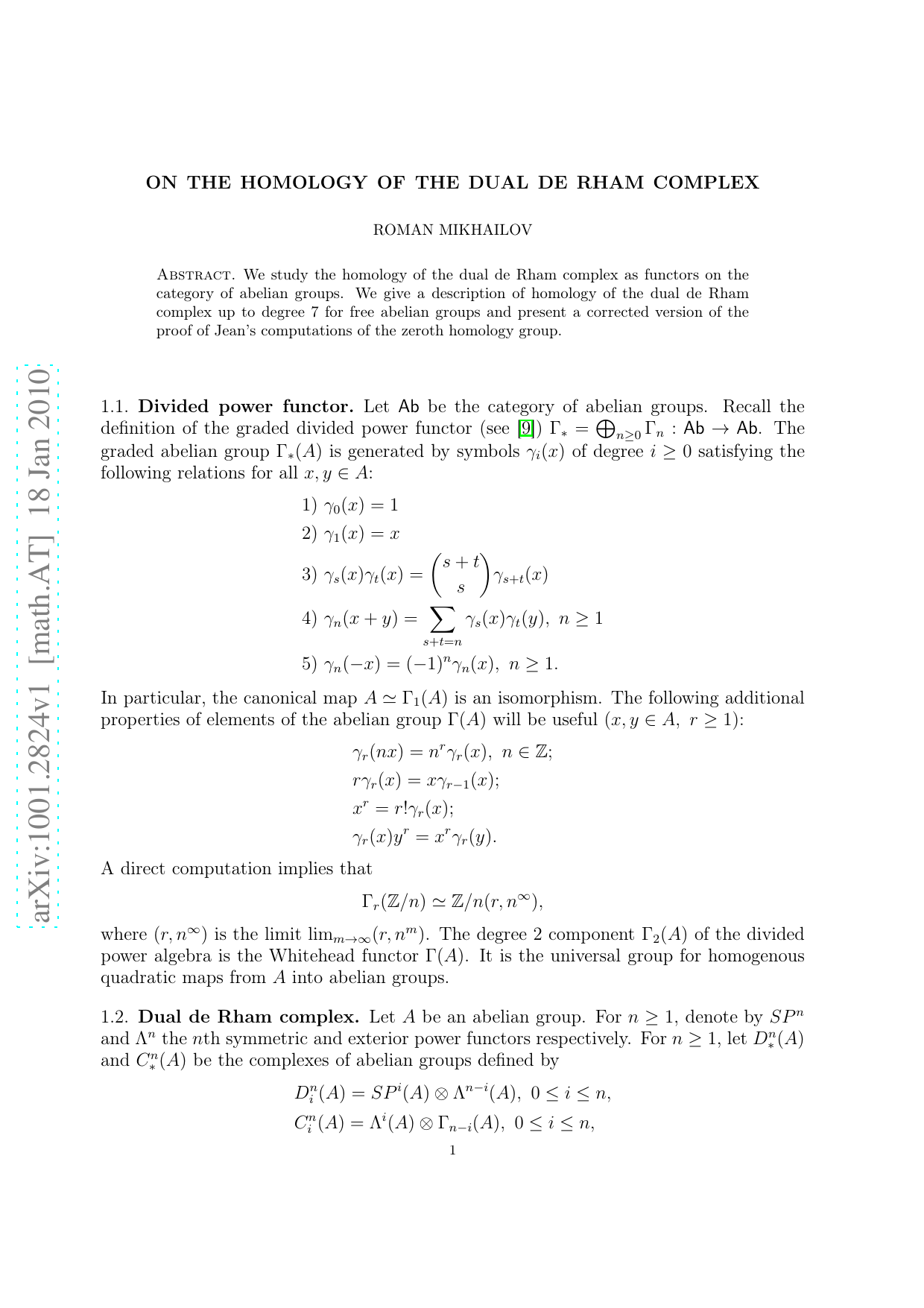
1.1. Divided power functor. Let Ab be the category of abelian groups. Recall the definition of the graded divided power functor (see [9]) Γ * = n≥0 Γ n : Ab → Ab. The graded abelian group Γ * (A) is generated by symbols γ i (x) of degree i ≥ 0 satisfying the following relations for all x, y ∈ A:
- γ n (x + y) = s+t=n γ s (x)γ t (y), n ≥ 1 5) γ n (-x) = (-1) n γ n (x), n ≥ 1.
In particular, the canonical map A ≃ Γ 1 (A) is an isomorphism. The following additional properties of elements of the abelian group Γ(A) will be useful (x, y ∈ A, r ≥ 1):
γ r (nx) = n r γ r (x), n ∈ Z;
rγ r (x) = xγ r-1 (x);
x r = r!γ r (x); γ r (x)y r = x r γ r (y).
A direct computation implies that
where (r, n ∞ ) is the limit lim m→∞ (r, n m ). The degree 2 component Γ 2 (A) of the divided power algebra is the Whitehead functor Γ(A). It is the universal group for homogenous quadratic maps from A into abelian groups.
1.2. Dual de Rham complex. Let A be an abelian group. For n ≥ 1, denote by SP n and Λ n the nth symmetric and exterior power functors respectively. For n ≥ 1, let D n * (A) and C n * (A) be the complexes of abelian groups defined by
where the differentials d i : D n i (A) → D n i-1 (A) and d i : C n i (A) → C n i-1 (A) are:
for any X ∈ Γ n-i (A). The complex D n (A) is the degree n component of the classical de Rham complex, first introduced in the present context of polynomial functors in [4] and denoted Ω n in [5]. The dual complexes C n (A) were considered in [6]. We will call them the dual de Rham complexes.
The dual de Rham complexes appear naturally in the theory of homology of Eilenberg-Mac Lane spaces. Let A be a free abelian group. There are well-known natural isomorphisms (see, for example, [1]):
Consider the path-fibration:
and the homology spectral sequence
The dual de Rham complexes can be recognized as natural parts of the E 3 -term of this spectral sequence. For example, we have the following natural diagrams:
9,0
/ / E 3 3,5
We will now give a functorial description of certain homology groups of these complexes C n (A). Some applications of these results in the theory of derived functors one can find in [2].
Proposition 1.1. Let A be a free abelian. Then (1) [5] For any prime number p, H 0 C p (A) = A ⊗ Z/p, and H i C p (A) = 0, for all i > 0;
(2) [6] There is a natural isomorphism
We will make use of the following fact from number theory (see [7] corollary 2):
Lemma 1.1. Let n and k be a pair positive integers and p is a prime number, then
where r is the largest power of p dividing pnk(n -k).
Proof of Proposition 1.1 (2). Let n ≥ 2 and define the map
by setting:
If (i 1 , . . . , i t ) = 1, then we set q n (γ i 1 (a 1 ) . . . γ it (a t )) = 0, where a k ∈ A for all k.
Let us check that the map q n is well-defined. For that we have to show that q n (γ j 1 (x)γ j 2 (x) . . . γ jt (x t )) = q n ( j 1 + j 2 j 1 γ j 1 +j 2 (x) . . . γ jt (x t )) (1.1)
q n (γ j 1 (-x 1 ) . . . γ jt (x t )) = (-1) j 1 q n (γ j 1 (x 1 ) . . . γ jt (x t ))
Verification of (1.1). First suppose that p|j 1 + j 2 , p ∤ j 1 . Since for every pair of numbers
we have
Hence
The equality (1.5) implies that
where r is the largest power of p, dividing (j 1 + j 2 )j 1 j 2 /p 2 . Since p|j 1 , p|j 2 , we have
and the property (1.1) follows.
Verification of (1.2). We have
Verification of (1.3). We have
)) = 0 (we separately check the cases p = 2 and p = 2).
We now know that the map q n is well-defined. It induces a map
Let n = p s i i be the prime decomposition of n. Then
It follows from definition of the map qn , that qn :
is an isomorphism. For free abelian groups A and B, one has a natural isomorphism of complexes
This implies that the cross-effect1 C n (A|B) of the functor C n (A) is described by
and its homology
A|B) can be described with the help of Künneth formulas:
Hence we have the following simple description of the cross-effect of H 0 C n (A):
From the other hand, we have the following decomposition of the cross-effect of the functor Γp n/p (A) := Γ n/p (A ⊗ Z/p):
We must now show that the maps qn preserve the decompositions (1.6) and (1.7). This is equivalent to the commutativity of the following diagram:
The map ε ′ • (q i ⊗ qj ) is defined via the natural map
and the commutativity of the diagram (1.8) follows. This proves that the natural map
induced by qn on cross-effects is an isomorphism, and it follows from this that qn is an isomorphism for all free abelian groups A.
1.3. Derived functors and homology. Let A be an abelian group, and F an endofunctor on the category of abelian groups. Recall that for every n ≥ 0 the derived functor of F in the sense of Dold-Puppe [3] are defined by
where P * → A is a projective resolution of A, and K is the Dold-Kan transform, inverse to the Moore normalization functor
from simplicial abelian groups to chain complexes. Recall the description of the highest derived functors of the tensor power functor due to Mac Lance [8]. The group Tor [n]
…(Full text truncated)…
This content is AI-processed based on ArXiv data.