Scaling, Self-similarity and Superposition
A novel procedure for the nonlinear superposition of two self-similar solutions of the heat conduction equation with power-law nonlinearity is introduced. It is shown how the boundary conditions of the superposed state conflicts with self-similarity,…
Authors: K.Y. Eksi
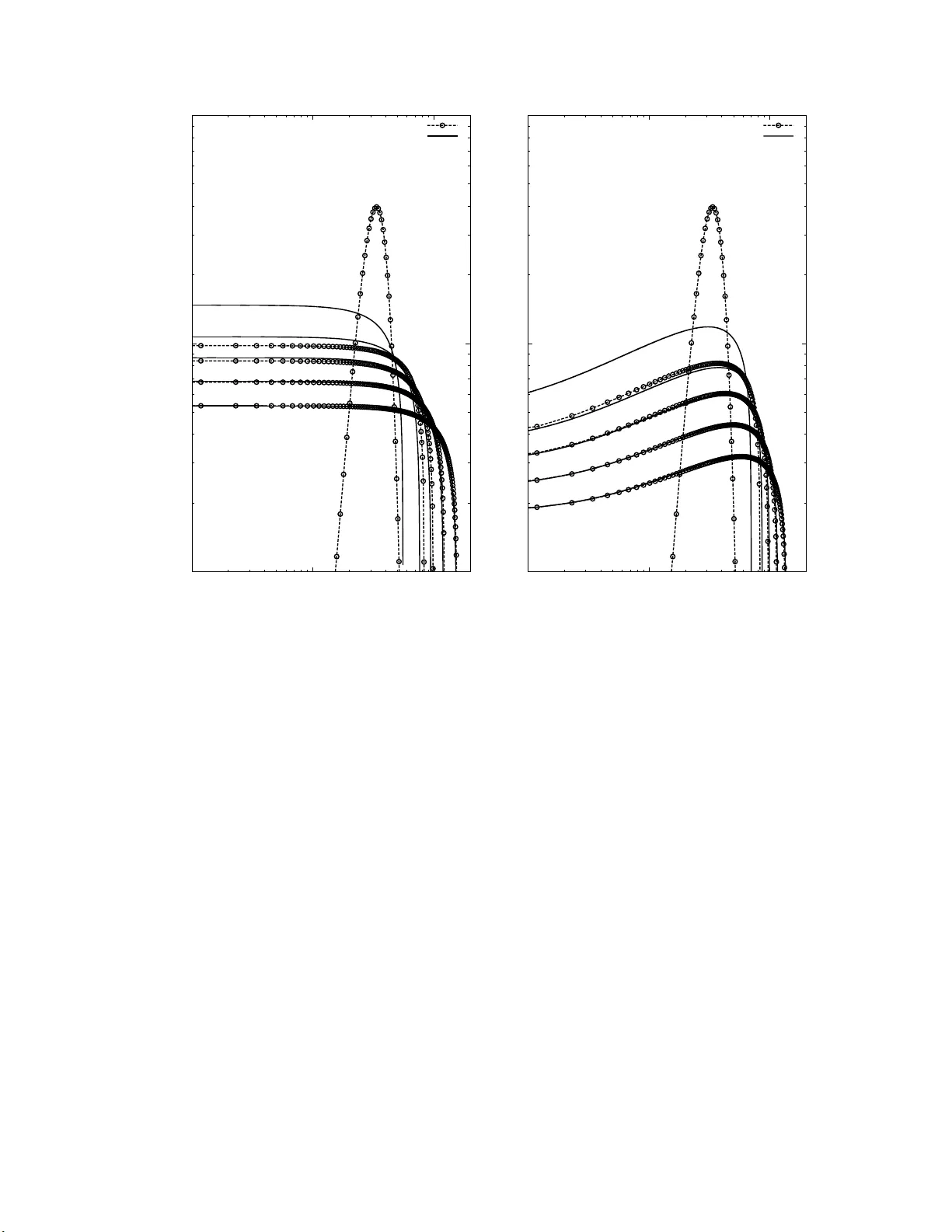
Scaling, Self-similarit y and Sup erp osition Kazım Y a vuz Ek ¸ si ∗ Istanbul T e chnic al University, F aculty of Scienc e and L etters, Dept. of Physics Engine ering , Maslak 3 4469, Istanbul, TURKEY (Dated: September 8, 20 21) Abstract A no v el pr ocedure for the nonlin ear su p erp osit ion of t w o self-similar solutions of the heat conduc- tion equation with p o w er-la w nonlinearit y is introdu ce d. It is sho wn ho w the b oundary conditions of the sup erp osed state conflicts with self-similarit y , ren d ering the nonlinearly sup erp osed state to b e a n on-exa ct solution. It is argued that the nonlinearit y couples with the presence of th e scale so that the sup erp osition in the linear case can giv e an exact solution. P ACS num bers: 02.30.Jr, 02 .30.Ik, 4 4.05.+e, 44.1 0.+i, 4 7.56.+r, 51.2 0 .+d, 89.75.Da Keywords: Self-similar it y , In tegrability , Porous Medium Equation, Nonlinear diffusion ∗ Electronic address: eksi@itu.edu.tr 1 I. INTR ODUCTION Phenomena exhibiting self-similarity at differen t time and/or spatial scales are ubiquitous in nature [1]. Self-similarity tec hniques exploit suc h symmetries fo r reducing t he num b er of v ariables for describing the system. This also is the underlying idea in dimensional analysis [2, 3]. Suc h tec hniques had m uc h b een explored in fluid phenomena [4] and, mor e recen tly , in o ptics [5]. Self-similar solutions can only b e constructed in the absence o f scales ha ving the dimensions of indep enden t v ariables. As a result they are alw ays endo w ed with extreme b oundary conditions (BCs) represen ting the in termediate asymptotic b eha vior [1] of a sys tem a w a y from the initial conditions and b oundaries. A PDE may ha v e more tha n one self-similar solution eac h corr esp onding t o a sp ecific BC. If the underlying equation is linear, its self-similar solutions can b e sup erp osed to obtain a solution satisfying a realistic b oundary condition. Sup erposition o f the solutions in the nonlinear case is not p ossible, but as is show n here, there is still an approximate symmetry to b e exploited, leading to a pro cedure for nonlinear sup erposition o f self-similar solutions. I I. HEA T E QUA TION AND SELF-SIMILAR SO LUTIONS As an example for illustrating the pro cedure, consider the nonlinear diffusion equation ∂ θ ∂ τ = ∂ 2 θ n +1 ∂ ξ 2 (1) whic h is the dimensionless form of the heat conduction equation with p ow er-law nonlinearit y [6]. This equation is also know n as the p orous medium equation [7] describing the flo w of an isen tropic gas through a p orous medium. The equation is no nlinear for n 6 = 0 and we call n the nonlinearit y parameter. This equation ha s tw o well-kno wn self-similar solutions [8–10]. The first solution, θ ( ξ , τ ) = τ − 1 n +1 h ξ τ − 1 2( n +1) i 1 n +1 1 − k n ξ τ − 1 2( n +1) n +2 n +1 1 /n , (2) satisfies the Diric hlet BC θ (0 , τ ) = 0, and the second solution, θ ( ξ , τ ) = τ − 1 n +2 1 − k n ξ τ − 1 n +2 2 1 /n , (3) satisfies the Neumann BC θ ′ (0 , τ ) = 0 where θ ′ ≡ d θ/dξ . In b oth these solutions k n = n 2( n + 1)( n + 2) . (4) 2 The equation (1) can equiv alen tly b e replaced b y tw o equations in conserv ative form. The first one is ∂ θ ∂ τ + ∂ Φ ∂ ξ = 0 (5) where Φ( ξ , τ ) = − ∂ θ n +1 ∂ ξ (6) is the F ic k’s la w in dimensionless form, and the second one is ∂ ( θ ξ ) ∂ τ + ∂ Γ ∂ ξ = 0 (7) where Γ( ξ , τ ) = Φ( ξ , τ ) ξ + θ n +1 (8) It is clear from the Eqns.(5) a nd (7 ) that, in the steady state, Φ and Γ a re the integration constan ts and solving equation (8) for θ giv es θ ( ξ ) = (Γ − Φ ξ ) 1 n +1 , (9) whic h is the g eneral solution in terms of Φ and Γ. Ho w do the time-dep enden t solutions giv en in Eqns . (2) and (3) lo ok when written in terms of Γ( τ ) ≡ − Γ(0 , τ ) and Φ( τ ) ≡ − Φ(0 , τ ) corresp onding to the time dep enden t case? Here the negativ e sign is t o make the flux lea ving the system from the left b oundary p ositiv e. Using the div ergence theorem fo r equation (5), it is p ossible to see from the first solution giv en in equation (2 ) t ha t Φ( τ ) = d dτ Z ∞ 0 θ dξ (10) declines as a p o w er-la w Φ( τ ) = − τ − α where α = 1 + 1 2( n + 1) (11) while Γ( τ ) = d dτ Z ∞ 0 ξ θ dξ (12) v anishes (Γ( τ ) = 0). Similarly , it is p ossible to see from the second solution, giv en in equation (3), that Γ( τ ) = τ − β where β = 1 − 1 n + 2 (13) while Φ( τ ) = 0. 3 I I I. THE SOL UTIONS I N TERMS OF FLUXES W e write the first solution give n in equation (2) in terms of Φ( τ ) as θ = [ − ξ Φ( τ )] 1 n +1 1 − k n ξ 2 τ [ − ξ Φ( τ )] 1 n +1 − 1 1 /n . (14) It is p ossible to show that this satisfies equation (1) ev en if Φ( τ ) is mu ltiplied with a constant Φ 0 so that Φ( τ ) = − Φ 0 τ − α . (15) The second solution give n in equation (3), can b e written in terms of Γ( τ ) as θ = [Γ( τ )] 1 n +1 1 − k n ξ 2 τ [Γ( τ )] 1 n +1 − 1 1 /n (16) and it is p ossible to sho w that this satisfies equation (1 ) ev en if Γ( τ ) is defined as Γ( τ ) = Γ 0 τ − β (17) where Γ 0 is a constan t. Note that there is a “duality ” Γ ↔ − ξ Φ b et wee n the tw o solutions (14) and (16). The solutions for the linear case ( n = 0) , using lim n → 0 (1 + An ) 1 /n = e A , can b e written, in terms o f Γ and Φ, as θ ( ξ , τ ) = − ξ Φ( τ ) e − ξ 2 / 4 τ (18) where Φ = − Φ 0 τ − 3 / 2 and θ ( ξ , τ ) = Γ( τ ) e − ξ 2 / 4 τ (19) where Γ = Γ 0 τ − 1 / 2 , resp ectiv ely . As the diffusion equation (1) is linear fo r n = 0, these t w o can b e sup erp osed to give θ ( ξ , τ ) = [Γ( τ ) − ξ Φ( τ )] e − ξ 2 / 4 τ , (20) and this satisfies the b oundary conditio n θ (0 , τ ) = Γ( τ ). Note that the steady state solution giv en in Eqn.(9 ) for the linear case ( n = 0 ) b ecomes θ ( ξ ) = Γ − ξ Φ. The t erm in the square brac k ets in Eqn.(20) carries a form similar to the steady state solution but Γ and Φ are time-dep enden t in the former case. In the linear case m ultiplying a solution with an y constan t can b e absorb ed into the constan ts Φ 0 or Γ 0 . In the nonlinear case m ultiplying the solution with a constan t do es not 4 giv e a solution, but it is p ossible to gauge Φ 0 or Γ 0 to obtain the similar effect. In other w ords, multiply ing the flux with a constan t in the general case reduces to m ultiplying the solution with a constant. IV. NONLINEAR SUPERPOSITI ON The self-similar solutions given b y equations (14) and (16) corresp ond to extreme b ound- ary condito ns: According to the former, t here is a sink at ξ = 0, suc h tha t all the heat carried to this b oundary is totally absorb ed. The latter solution describes the case in whic h there is a p erfect insulator a t ξ = 0 suc h that heat cannot lea v e the system fro m this b ound- ary . In the steady state, the solution of whic h is giv en in equation(9), any ratio b et ween the inte gration constan ts Γ and Φ is p o ss ible allo wing fo r intermediate BCs. This is not the case with the self-similar solutions whic h can only b e constructed in the absence of a scale: If θ and θ ′ are b oth finite at the b oundary , then l ∼ θ /θ ′ is a length scale associated with the system. It is the a im of this pap er to find the time dep enden t v ersion of the general steady state solution g iv en in equation (9) eve n though it ma y not b e an exact solution. The self-similar solutio ns giv en in eq uations (14) and (16) app ear to b e the time- dep ende n t v ersions of the steady state solution given in equation (9) with Γ = 0 and Φ = 0, resp ec tiv ely . W e ha v e written the solutions g iv en b y equations (14) and (16) in a “dual” form suggesting a “nonlinear sup erp o sition” in whic h w e add up not the solutions themselv es but Γ( τ ) a nd − ξ Φ( τ ) terms in separate corresp onding parts of the solutions. This pro cedure giv es θ ( ξ , τ ) = [Γ( τ ) − ξ Φ( τ )] 1 n +1 1 − k n ξ 2 τ [Γ( τ ) − ξ Φ( τ )] 1 n +1 − 1 1 /n (21) whic h reduces t o equations (1 4) and (16) for Γ 0 = 0 and Φ 0 = 0, resp ectiv ely . This expression is endo w ed with the BC θ (0 , τ ) = [Γ( τ )] 1 / ( n +1) whic h can describ e cases in whic h a f r action of the heat is absorb ed at the b oundary . The expression given in equation (21) cannot satisfy the diffusion equation (1) for a general v alue o f n but is alw a ys a g oo d appro ximate solution. In F igure 1 w e compare the self-similar solutions with the n umerical solution o f the diffusion equation (1) for t w o differen t BCs. In b oth cases w e ha v e ta ken n = 7 / 3 and initiated the n umerical solution from a Gaussian t emp erature distribution. The analytical solutions are time shifted as τ → τ + 1 exploiting the symm etry of the diffusion equation (1) under this transformation. This allo ws 5 0.1 1 10 0.1 1 10 θ ξ τ =0 τ =0 τ =3 τ =9 τ =27 τ =81 numerical analytical 0.1 1 10 0.1 1 10 θ ξ τ =0 τ =0 τ =3 τ =9 τ =27 τ =81 numerical analytical FIG. 1: Ev olution of a Gaussian heat distribution on a semi infinite bar describ ed b y th e diffu sion equation (1), w ith snapshots tak en at τ = 0, τ = 3, τ = 9, τ = 27 and τ = 81 where τ is time in units of diffusive time scale. Solid lines sho w the analytical solutions and dash ed lines with data p oin ts (corresp onding to the n umerical grid s ) sho w th e n umerical solutions. Left panel corresp onds to the case where we emplo y ed the Neum ann b oundary condition θ ′ (0 , τ ) = 0 and is compared with the exact solution give n in equation (16) with τ → τ + 1. Righ t panel corresp onds to the case θ (0 , τ ) = [Γ( τ )] 1 / ( n +1) and is compared with the appro ximate solution given in equation (21 ). us t o ev aluate the analytical expression at t = 0. The left panel sho ws the case with θ ′ (0 , τ ) = 0 where the exact solution giv en in equation (16) is compared with the n umerical solution. It is seen that it tak es a bout ∼ 10 diffusiv e time scales for the n umerical solution to forget its initial configurat io n and to settle on to the self-similar solution. The right panel sho ws a similar comparison fo r the a ppro ximate analytical solution giv en in equation (2 1 ) for Γ 0 = 0 . 1, Φ 0 = 1 . 0. W e see that the approx imate solution is a lso remark ably accurate after ∼ 10 diffusiv e time scales. The analytical approx imate solution is ev en more success ful if n < 1. 6 V. DISCUSSION W e hav e constructed an approximate solution of the nonlinear heat equation with p ow er- la w no nlinearity satisfying a more general BC, b y using a “nonlinear sup erp osition” o f t w o self-similar solutions endow ed with D iric hlet and Neumann BCs. W e can not expect to find an exact solution for suc h a g eneral BC in tro duces a length scale in to the pro blem, th us, destro ying the v ery condition for self-similarit y . Requiring equation (21) b e a solution of equation (1) reduces to the requiremen t that τ ˙ Φ Φ + α ! ξ 2 Φ 2 + τ ˙ Γ Γ + τ ˙ Φ Φ + 2 ! ξ ΓΦ + τ ˙ Γ Γ + β ! Γ 2 (22) v anishes. The first and the third terms v anish b y equations (15) and (17), respectiv ely . The second term, noting that 2 − α − β = k n , do es not v a nish but simplify to k n ξ ΓΦ. This v anishes for either Γ 0 = 0 or Φ 0 = 0 corresp onding to the w ell kno wn self-similar solutio ns giv en in Eqns.(14) and (16). It also v anishes for the linear case, n = 0, as k 0 = 0. The expression giv en in equation(21) do es not satisfy the diffusion equation (1) in general, but it is a v ery a ccu rate appro ximate self-similar solution of it. The pro cedure can b e a pplied to other second order nonlinear PDEs as long as they hav e t w o self-similar solutions and the equation can b e written in terms of t w o PDEs in conser- v ativ e f o rm. The application of this pro cedure to the viscous ev olution of a thin accretion disk in the gravitational field of a cen tr a l star, a ubiquitous phenomena in astrophysic s [11], will b e published elsewhere later. Equation (22) v anishes when the nonlinearity parameter, n , v anishes (no te that k 0 = 0). As the “no nlinear sup erp osition” tec hnique we emplo y ed here reduces to ordinary summation for n = 0, this giv es a w ay o f seeing wh y summing up t w o solutions in the linear case yields a solution ev en when a scale is presen t: the nonlinearit y term n couples with the finite scale in the pro blem and v anishing of either yields a solution. It is in teresting to see that sup erposing t w o solutions by addition is a sp ecial case of a mo r e general pro cedure emplo y ed in reac hing equation(2 1) from t he solutions given by equations (14) and (16) although this general pro cedure do es not necessarily giv e an exact solution. 7 Ac kno w ledgmen ts KYE a ckno wledges Ay ¸ se Erzan, Sa v a¸ s Arap o˘ glu, ¨ Omer ˙ Ilda y , Ahmet T. Giz and ¨ Omer G ¨ u rdo˘ gan for useful discussions and suggestions. [1] Barenblatt, G.I. Sc aling, Self-Similarity, and Intermadiate Asymptotics (Cam bridge Univ. Press, C am brid ge , 1996) . [2] L ord Ra yleigh, The pr inciple of s imilit ude. Natur e 95 , 66–68 (191 5). [3] Bu c kingham, E. The p rinciple of similitude. Nature 96 , 396-397 (1915) . [4] Barenblatt, G.I. & Zel’do vic h, Y. Self-Similar Solutions as Int ermediate Asymptotics. Annu. R ev. Fluid Me ch. 4 , 285–3 12 (1972). [5] Du dley , J.M., Finot, C., Richardson, D.J. and Millot, G. Self-similarit y in u ltrafast nonlinear optics. Natur e , 3 , 597-603 (2007 ). [6] Z el’do vic h Y a. B. & Raizer, Y u.P . Physics of Sho c k Waves and High T emp er atur e P heno mena (Do ver Publications, 2002 ). [7] V´ azquez, J.L. Por ous Me dium Equation (Oxf ord Science Pu b lica tions, 2006). [8] Barenblatt, G.I. On some un s te ady motions of a liquid or a gas in a p orous mediu m. Prikl. Mat. i M ekh. , 16 67-78 (1952). [9] Barenblatt, G.I. & Zel’do vic h, Y a.B. On the dip ole t yp e solution in problems of unsteady gas filtration in the p olytropic regime Prikl. Mat. i Mekh. , 21 , 718-720, 1957. [10] Zel’dovic h Y a.B. & Komp anee ts A.S. On the propagation of heat for nonlinear heat conduction, in Col le ction de dic ate d to the sev entieth Birthday of A c ademician A.F. Ioffe (P .I. L u kirskii, ed.) Izdat. Acad. Nauk S SSR, Mosk o w (1959). [11] F rank , J., King A. and Raine, D. A c cr etion Power in Astr ophysics (Cam bridge Univ ersit y Press, 2002). 8
Original Paper
Loading high-quality paper...
Comments & Academic Discussion
Loading comments...
Leave a Comment