A Possible Supernova Remnant high above the Galactic Disk
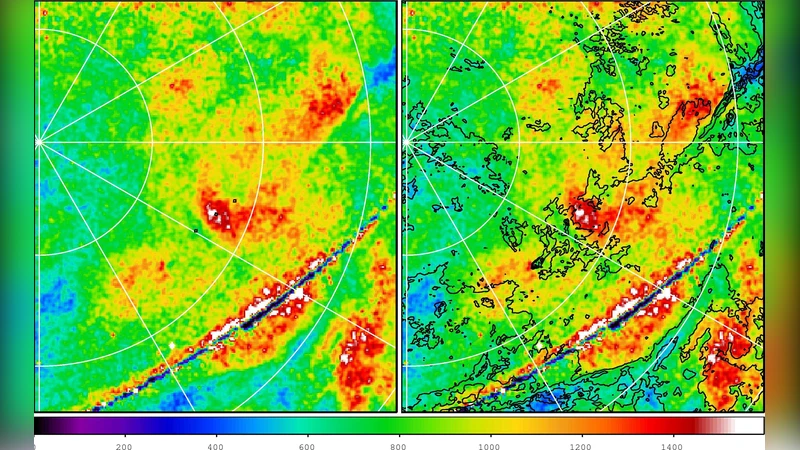
We present the analysis of three Suzaku observations of a bright arc in the ROSAT All-Sky Survey 1/4 keV maps at $l \approx 247\degr$, $b \approx -64\degr$. In particular, we have tested the hypothesis that the arc is the edge of a bubble blown by an extraplanar supernova. One pointing direction is near the brightest part of the arc, one is toward the interior of the hypothesized bubble, and one is toward the bubble exterior. We fit spectral models generated from 1-D hydrodynamical simulations of extraplanar supernova remnants (SNRs) to the spectra. The spectra and the size of the arc ($\mathrm{radius} \approx 5\degr$) are reasonably well explained by a model in which the arc is the bright edge of a $\sim$100,000-yr old SNR located $\sim$1–2 kpc above the disk. The agreement between the model and the observations can be improved if the metallicity of the X-ray–emitting gas is $\sim$1/3 solar, which is plausible, as the dust which sequesters some metals is unlikely to have been destroyed in the lifetime of the SNR. The width of the arc is larger than that predicted by our SNR model; this discrepancy is also seen with the Vela SNR, and may be due to the 1-D nature of our simulations. If the arc is indeed the edge of an extraplanar SNR, this work supports the idea that extraplanar supernovae contribute to the heating of the $\sim$million-degree gas in the halo.
💡 Research Summary
The authors investigate a prominent X‑ray arc seen in the ROSAT All‑Sky Survey at Galactic coordinates l ≈ 247°, b ≈ –64°, proposing that it represents the bright rim of an extraplanar supernova remnant (SNR). To test this hypothesis they obtained three Suzaku XIS pointings: one aimed at the brightest segment of the arc, one toward the interior of the putative bubble, and one outside the bubble. The spectra from these pointings were jointly fitted with models derived from one‑dimensional hydrodynamic simulations of SNR evolution in a low‑density, high‑altitude Galactic environment.
The observed spectra consist of a soft foreground component (∼0.1 keV) attributed to the Local Hot Bubble and a hotter component (∼0.2–0.3 keV) that dominates the arc emission. The surface brightness of the hot component peaks at the arc’s edge and declines toward the interior, consistent with a thin, shell‑like structure. By varying the explosion energy (E), ambient density (n), age (t), and metallicity (Z) in the simulations, the authors identified a best‑fit model with E ≈ 10⁵¹ erg, n ≈ 0.01 cm⁻³, age t ≈ 1 × 10⁵ yr, and a metallicity of roughly one‑third solar. This model reproduces the arc’s angular radius (≈ 5°), the temperature, the absolute X‑ray surface brightness, and the relative strengths of O VII and O VIII lines observed by Suzaku.
A notable refinement of the fit is achieved by lowering the metal abundance to ∼0.3 Z⊙. The authors argue that, at the high Galactic latitude of the remnant, dust grains that lock up metals are unlikely to have been fully destroyed over the SNR’s lifetime, thereby justifying a sub‑solar gas‑phase metallicity. However, the simulated shell is narrower than the observed arc. The authors attribute this discrepancy to the limitations of one‑dimensional modeling, which cannot capture three‑dimensional effects such as Rayleigh‑Taylor instabilities, magnetic field geometry, or ambient density inhomogeneities. A similar mismatch has been reported for the Vela SNR, reinforcing the need for multi‑dimensional simulations.
The paper’s conclusions have two major implications. First, it provides observational support for the existence of SNRs at heights of 1–2 kpc above the Galactic plane, demonstrating that such remnants can survive for ∼10⁵ yr and still emit detectable soft X‑rays. Second, it reinforces the idea that extraplanar supernovae are a significant heating source for the million‑degree plasma that permeates the Galactic halo. By contributing mechanical energy and hot gas at large distances from the disk, these events help maintain the thermal balance of the halo and may influence the circulation of matter between the disk and halo.
The authors suggest that future high‑resolution X‑ray missions (e.g., XRISM, Athena) could resolve finer spectral variations across the arc, allowing more stringent tests of the SNR scenario. Coupling such data with two‑ or three‑dimensional hydrodynamic simulations would enable a more accurate assessment of shell thickness, asymmetries, and the role of magnetic fields. Ultimately, this work advances our understanding of how discrete energetic events shape the large‑scale structure and thermodynamics of the Milky Way’s gaseous halo.
Comments & Academic Discussion
Loading comments...
Leave a Comment