Spectral Evolution of the Extraordinary Type IIn Supernova 2006gy
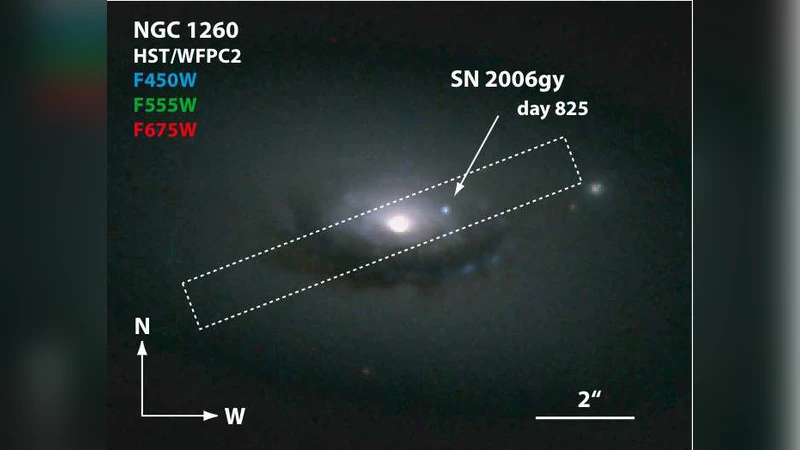
We present a detailed analysis of the extremely luminous Type IIn supernova SN2006gy using spectra obtained between days 36 and 237 after explosion. We derive the temporal evolution of the effective temperature, radius, expansion speeds, and bolometric luminosity, as well as the progenitor wind density and total swept-up mass overtaken by the shock. SN2006gy can be interpreted in the context of shock interaction with a dense CSM, but with quite extreme values for the CSM mass of 20 Msun and an explosion kinetic energy of at least 5e51 erg. A key difference between SN2006gy and other SNeIIn is that, owing to its large CSM mass, the interaction region remained opaque much longer. At early times, H-alpha widths suggest that the photosphere is ahead of the shock, and photons diffuse out through the opaque CSM. The pivotal transition to optically thin emission begins around day 110, when we start to see a decrease in the blackbody radius and strengthening tracers of the post-shock shell. From the evolution of pre-shock velocities, we deduce that the CSM was ejected by the progenitor in a 1e49 erg precursor event 8yr before explosion. The large CSM mass rules out models involving stars with initial masses around 10Msun. With the full mass budget, even massive M_ZAMS=30-40 Msun progenitor stars are inadequate. At roughly solar metallicity, substantial mass loss probably occurred during the star’s life, so SN 2006gy’s progenitor is more consistent with LBV eruptions or pulsational pair-instability ejections in stars with initial masses above 100 Msun. This requires significant revision to current paradigms of massive-star evolution. (abridged)
💡 Research Summary
This paper presents a comprehensive spectroscopic study of the exceptionally luminous Type IIn supernova SN 2006gy, covering observations from 36 to 237 days after explosion. High‑quality spectra were obtained with several large telescopes (Keck, Lick, HET) and reduced using standard procedures to produce calibrated fluxes. For each epoch the authors fitted a blackbody model to derive the effective temperature (T_eff), photospheric radius (R_bb), and bolometric luminosity (L_bol). Early on (≤70 days) T_eff dropped rapidly from ~11,000 K to ~8,000 K while R_bb expanded from ~3×10¹⁵ cm to ~5×10¹⁵ cm, maintaining an extraordinary L_bol of ~10⁴⁵ erg s⁻¹—about an order of magnitude brighter than typical SNe IIn.
Line profile analysis revealed a broad Hα component with velocities of ~4,500 km s⁻¹ and a narrow component at ~200 km s⁻¹, indicating that the photosphere lay ahead of the forward shock and that photons diffused outward through an optically thick circumstellar medium (CSM). Metal lines such as Fe II and Ca II were weak or absent at early times but emerged after ~110 days, marking the transition to an optically thin regime where emission from the post‑shock shell becomes visible.
To quantify the CSM, the authors combined the observed luminosity, diffusion timescale, and a ρ∝r⁻² wind density profile. They inferred a total CSM mass of ~20 M⊙ and densities of 10⁻¹⁴–10⁻¹³ g cm⁻³. Accelerating such a massive envelope requires a kinetic energy of at least 5×10⁵¹ erg, roughly twice that of a standard core‑collapse supernova.
By tracking the pre‑shock wind velocity (≈200 km s⁻¹) backward in time, they deduced a precursor outburst about eight years before core collapse, releasing ~10⁴⁹ erg. This energetic eruption is consistent with either a luminous blue variable (LBV) giant eruption or a pulsational pair‑instability (PPI) episode in a very massive star. The timing and energetics imply that the progenitor had already shed tens of solar masses into its surroundings prior to explosion.
The authors argue that low‑mass progenitors (~10 M⊙) cannot produce the required CSM mass, and even canonical massive stars of 30–40 M⊙ fall short. Consequently, they favor scenarios involving stars with initial masses >100 M⊙ that undergo LBV‑like eruptions or PPI mass ejections. This conclusion challenges current massive‑star evolutionary models, especially those that rely on metallicity‑dependent line‑driven winds for mass loss. The paper calls for refined theoretical frameworks and further multi‑wavelength observations (radio, X‑ray, high‑resolution spectroscopy) to better understand the physics of such extreme supernovae.
Comments & Academic Discussion
Loading comments...
Leave a Comment