Detecting planetary geochemical cycles on exoplanets: Atmospheric signatures and the case of SO2
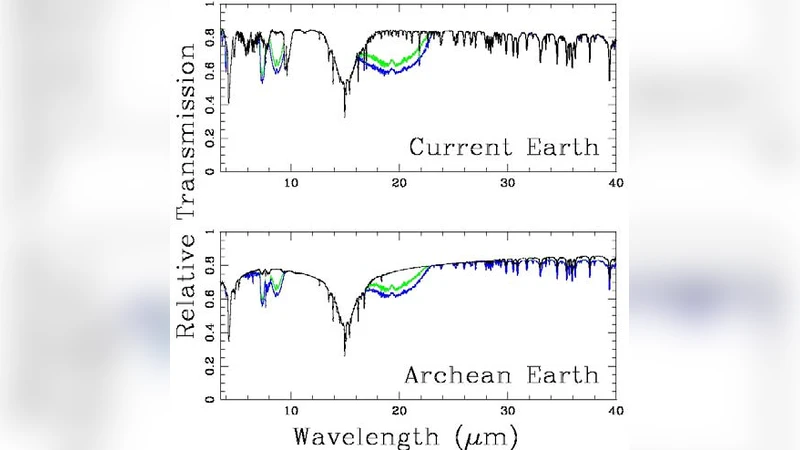
We study the spectrum of a planetary atmosphere to derive detectable features in low resolution of different global geochemical cycles on exoplanets - using the sulphur cycle as our example. We derive low resolution detectable features for first generation space- and ground- based telescopes as a first step in comparative planetology. We assume that the surfaces and atmospheres of terrestrial exoplanets (Earth-like and super-Earths) will most often be dominated by a specific geochemical cycle. Here we concentrate on the sulphur cycle driven by outgassing of SO2 and H2S followed by their transformation to other sulphur-bearing species which is clearly distinguishable from the carbon cycle which is driven by outgassing of CO2. Due to increased volcanism, the sulphur cycle is potentially the dominant global geochemical cycle on dry super-Earths with active tectonics. We calculate planetary emission, reflection and transmission spectrum from 0.4 to 40 micrometer with high and low resolution to assess detectable features using current and Archean Earth models with varying SO2 and H2S concentrations to explore reducing and oxidizing habitable environments on rocky planets. We find specific spectral signatures that are observable with low resolution in a planetary atmosphere with high SO2 and H2S concentration. Therefore first generation space and ground based telescopes can test our understanding of geochemical cycles on rocky planets and potentially distinguish planetary environments dominated by the carbon and sulphur cycle.
💡 Research Summary
The paper investigates how low‑resolution spectroscopy of terrestrial exoplanet atmospheres can be used to identify the dominant planetary geochemical cycle, focusing on the sulfur cycle as a test case. The authors begin with the premise that the surface and atmospheric chemistry of Earth‑like and super‑Earth planets will often be controlled by a single, planet‑wide cycle, most commonly the carbon cycle (driven by CO₂ outgassing) but potentially the sulfur cycle (driven by volcanic SO₂ and H₂S) under certain conditions. They argue that on dry super‑Earths with active tectonics, enhanced volcanism could make sulfur the primary geochemical driver.
To explore this, the study employs a coupled atmospheric chemistry–climate model that builds on Archean‑Earth and modern‑Earth scenarios. The model is run for a suite of atmospheric compositions ranging from highly reducing (oxygen mixing ratios 10⁻⁴–10⁻³) to mildly oxidizing, with SO₂ and H₂S concentrations varied from trace levels up to several tens of parts per million. The chemical network includes oxidation of SO₂ to H₂SO₄, formation of sulfate aerosols, and polymerization to elemental sulfur (S₈), allowing the authors to track the full transformation of volcanic sulfur gases.
Spectra are generated for three observational geometries—thermal emission, reflected light, and transmission during transit—covering the wavelength range 0.4–40 µm. Both high‑resolution (R≈1000) and low‑resolution (R≈100) spectra are produced. The low‑resolution results, which are most relevant for first‑generation space telescopes (e.g., JWST, ARIEL) and large ground‑based facilities (ELT, TMT), reveal several diagnostic features:
- A strong SO₂ absorption band centered at 7–8 µm that becomes prominent when SO₂ exceeds ~10 ppm.
- Composite H₂S/H₂SO₄ features near 3.9 µm and 4.6 µm; the presence of H₂SO₄ clouds adds a broad absorption between 9–10 µm.
- A weaker SO₂ line in the visible at ~0.6 µm, detectable only with higher signal‑to‑noise ratios.
These sulfur signatures are distinct from the classic carbon‑cycle markers (CO₂ bands at 4.3 µm and 15 µm). The authors perform sensitivity analyses that show, for a planet–star contrast of 10⁻⁴, a 10‑hour integration with a low‑resolution spectrograph can achieve a signal‑to‑noise ratio of ≥5 for the 7–8 µm SO₂ band, assuming the planet is warm enough to emit strongly in the mid‑infrared.
The paper also discusses observational strategy. Because the sulfur features lie at shorter mid‑infrared wavelengths than the dominant CO₂ bands, instruments optimized for 5–12 µm will be especially valuable for discriminating sulfur‑dominated atmospheres. Transmission spectroscopy can complement emission and reflection measurements, but the visible SO₂ line requires higher spectral resolution and longer exposure times.
In summary, the study demonstrates that even with modest spectral resolution, the presence of a sulfur‑driven geochemical cycle can be inferred from exoplanet spectra. This opens a pathway for comparative planetology: by cataloguing which planets show strong sulfur signatures versus carbon signatures, we can begin to map the diversity of planetary surface–atmosphere interactions across the galaxy. The work provides concrete predictions for upcoming missions and suggests that dry, volcanically active super‑Earths should be prioritized as promising targets for detecting sulfur‑cycle signatures.
Comments & Academic Discussion
Loading comments...
Leave a Comment