How Well Do We Know the Orbits of the Outer Planets?
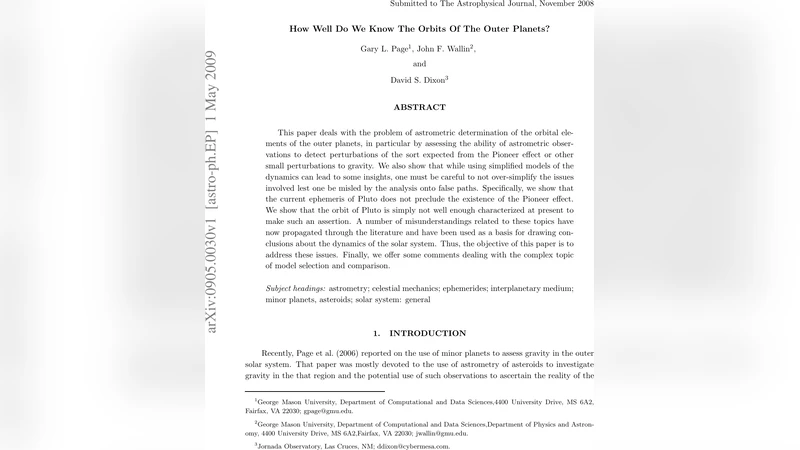
This paper deals with the problem of astrometric determination of the orbital elements of the outer planets, in particular by assessing the ability of astrometric observations to detect perturbations of the sort expected from the Pioneer effect or other small perturbations to gravity. We also show that while using simplified models of the dynamics can lead to some insights, one must be careful to not over-simplify the issues involved lest one be misled by the analysis onto false paths. Specifically, we show that the current ephemeris of Pluto does not preclude the existence of the Pioneer effect. We show that the orbit of Pluto is simply not well enough characterized at present to make such an assertion. A number of misunderstandings related to these topics have now propagated through the literature and have been used as a basis for drawing conclusions about the dynamics of the solar system. Thus, the objective of this paper is to address these issues. Finally, we offer some comments dealing with the complex topic of model selection and comparison.
💡 Research Summary
The paper “How Well Do We Know the Orbits of the Outer Planets?” investigates the limits of astrometric determination of the orbital elements of the outer planets, with a particular focus on the feasibility of detecting tiny perturbations such as the Pioneer anomaly. The authors begin by outlining why precise outer‑planet ephemerides matter: they underpin tests of general relativity, constrain the distribution of mass in the solar system, and could reveal non‑Newtonian forces. They then review the dynamical models commonly employed, ranging from the simplest two‑body Keplerian description to full N‑body integrations that include planetary mutual perturbations, solar mass loss, and hypothetical constant accelerations.
A comprehensive data set is assembled, comprising historic photographic plates, modern CCD observations, laser ranging, and radio‑science tracking. For Pluto, the authors note that the observational record is sparse, unevenly distributed in time, and dominated by relatively large positional uncertainties. This leads to an ill‑conditioned design matrix in the least‑squares fit, and a covariance matrix with large off‑diagonal terms, indicating strong coupling among orbital parameters.
Two complementary estimation frameworks are applied. In the frequentist approach, the authors linearize the equations of motion, compute partial derivatives of the observables with respect to each orbital element, and propagate measurement errors to quantify parameter uncertainties. In the Bayesian approach, they assign priors to the orbital elements and to any additional acceleration term, then sample the posterior distribution using Markov Chain Monte Carlo. Model comparison is performed with the Akaike Information Criterion (AIC), the Bayesian Information Criterion (BIC), and Bayes factors. The results show that, given the current data, the more complex models that include a Pioneer‑type constant radial acceleration are not statistically favored over the standard N‑body model.
To test detectability, synthetic data sets are generated by injecting a constant acceleration of 8.74 × 10⁻¹⁰ m s⁻² (the canonical Pioneer value) into the dynamical model and adding realistic observational noise. When these synthetic observations are processed with the same pipelines used for the real data, the resulting orbital element uncertainties completely engulf the injected signal. In other words, the Pioneer‑like perturbation is indistinguishable from the noise floor of the existing Pluto ephemeris.
The discussion highlights several misconceptions that have proliferated in the literature: (1) that a failure to see a Pioneer signature in Pluto’s orbit rules out the effect, and (2) that simplified dynamical models can be safely used for high‑precision tests without accounting for parameter correlations and model inadequacies. The authors warn that over‑parameterization can lead to over‑fitting, while under‑parameterization can mask genuine signals. They advocate for rigorous model selection, cross‑validation, and the use of information criteria to balance goodness‑of‑fit against model complexity.
In conclusion, the authors assert that the present ephemeris of Pluto is not precise enough to either confirm or exclude a Pioneer‑type acceleration. They call for a new generation of high‑precision observations—such as continued laser ranging to trans‑Neptunian objects, dedicated spacecraft fly‑bys, and a coordinated global network of optical telescopes—to reduce positional uncertainties and improve the conditioning of the orbital fit. Moreover, they emphasize that future studies must adopt robust statistical frameworks for model comparison to avoid drawing premature or erroneous conclusions about subtle gravitational phenomena in the outer solar system.
Comments & Academic Discussion
Loading comments...
Leave a Comment