The low level of debris disk activity at the time of the Late Heavy Bombardment: a Spitzer study of Praesepe
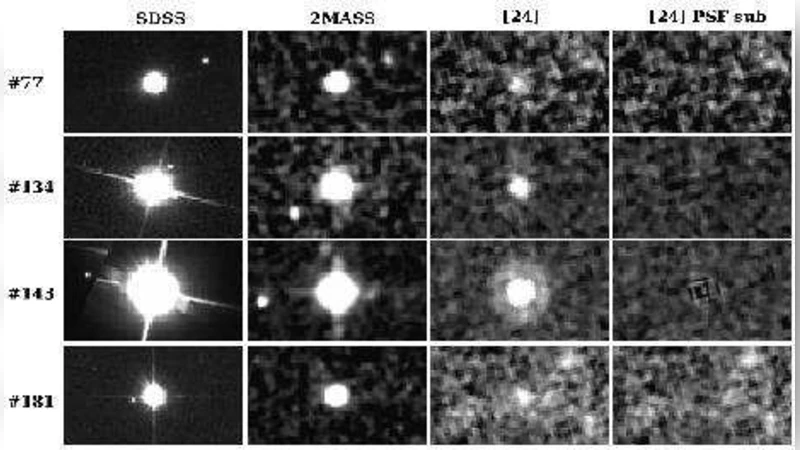
We present 24 micron photometry of the intermediate-age open cluster Praesepe. We assemble a catalog of 193 probable cluster members that are detected in optical databases, the Two Micron All Sky Survey (2MASS), and at 24 micron, within an area of ~ 2.47 square degrees. Mid-IR excesses indicating debris disks are found for one early-type and for three solar-type stars. Corrections for sampling statistics yield a 24 micron excess fraction (debris disk fraction) of 6.5 +- 4.1% for luminous and 1.9 +- 1.2% for solar-type stars. The incidence of excesses is in agreement with the decay trend of debris disks as a function of age observed for other cluster and field stars. The values also agree with those for older stars, indicating that debris generation in the zones that emit at 24 micron falls to the older 1-10 Gyr field star sample value by roughly 750 Myr. We discuss our results in the context of previous observations of excess fractions for early- and solar-type stars. We show that solar-type stars lose their debris disk 24 micron excesses on a shorter timescale than early-type stars. Simplistic Monte Carlo models suggest that, during the first Gyr of their evolution, up to 15-30% of solar-type stars might undergo an orbital realignment of giant planets such as the one thought to have led to the Late Heavy Bombardment, if the length of the bombardment episode is similar to the one thought to have happened in our Solar System. In the Appendix, we determine the cluster’s parameters via boostrap Monte Carlo isochrone fitting, yielding an age of 757 Myr (+- 36 Myr at 1 sigma confidence) and a distance of 179 pc (+- 2 pc at 1 sigma confidence), not allowing for systematic errors.
💡 Research Summary
This paper presents a comprehensive 24 µm Spitzer/MIPS study of the intermediate‑age open cluster Praesepe (age ≈ 750 Myr, distance ≈ 179 pc). The authors assembled a catalog of 193 probable cluster members that are detected in optical surveys, the Two Micron All Sky Survey (2MASS), and at 24 µm within a 2.47 deg² field. By comparing the observed 24 µm fluxes with photospheric predictions derived from optical–near‑IR colors, they identified infrared excesses indicative of warm debris disks. One early‑type (A‑type) star and three solar‑type (F‑G‑K) stars exhibit significant (>3σ) excesses. After correcting for sampling statistics, the debris‑disk fractions are 6.5 ± 4.1 % for luminous (early‑type) stars and 1.9 ± 1.2 % for solar‑type stars.
These fractions fit smoothly onto the well‑established decay curve of debris‑disk incidence with stellar age, confirming that the frequency of warm (∼1–10 AU) dust declines sharply by ∼750 Myr. The derived fractions are comparable to those measured for older field stars (∼1–10 Gyr), implying that the 24 µm excess population essentially reaches its long‑term baseline by this epoch. The authors also performed a bootstrap Monte Carlo isochrone fitting to refine the cluster’s fundamental parameters, obtaining an age of 757 ± 36 Myr and a distance of 179 ± 2 pc (1σ confidence), consistent with previous estimates.
A key discussion point is the differential evolution of debris disks around early‑type versus solar‑type stars. Early‑type stars retain detectable excesses for a longer period, likely because their higher luminosities sustain larger dust reservoirs despite stronger radiation pressure. Solar‑type stars, on the other hand, lose their warm dust more rapidly, reflecting lower initial disk masses and more efficient grain removal processes.
Beyond the observational results, the paper explores the implications for planetary system dynamics, specifically the Late Heavy Bombardment (LHB) scenario. Using simple Monte Carlo simulations, the authors model the probability that a solar‑type star experiences a giant‑planet orbital realignment (analogous to the hypothesized LHB trigger) within its first gigayear. Assuming an LHB‑like bombardment episode lasting ∼100 Myr, the simulations suggest that 15–30 % of solar‑type stars could undergo such an event. This estimate aligns with the observed low, but non‑zero, debris‑disk fraction at 750 Myr, supporting the notion that dynamical instabilities capable of generating a brief surge of collisional debris are relatively common in the early evolution of planetary systems.
The study acknowledges several limitations: the 24 µm sensitivity restricts detection to relatively massive dust belts; membership selection may still include field contaminants; and reliance on a single mid‑infrared wavelength provides limited constraints on dust composition, grain size distribution, and total disk mass. The authors propose that future observations with JWST/MIRI, ALMA, and high‑resolution radial‑velocity surveys will enable multi‑wavelength characterization of debris disks and direct detection of giant planets, thereby testing the link between dynamical instabilities and transient dust production.
In summary, the Praesepe analysis demonstrates that warm debris disks are rare by ∼750 Myr, confirming the rapid decline of inner‑system dust around both early‑type and solar‑type stars. Simultaneously, statistical modeling indicates that a substantial minority (≈ 15–30 %) of solar‑type stars may experience LHB‑like dynamical events within their first gigayear, suggesting that our Solar System’s bombardment history may not be unique but rather a common phase in planetary system evolution.