Galactic Spiral Structure
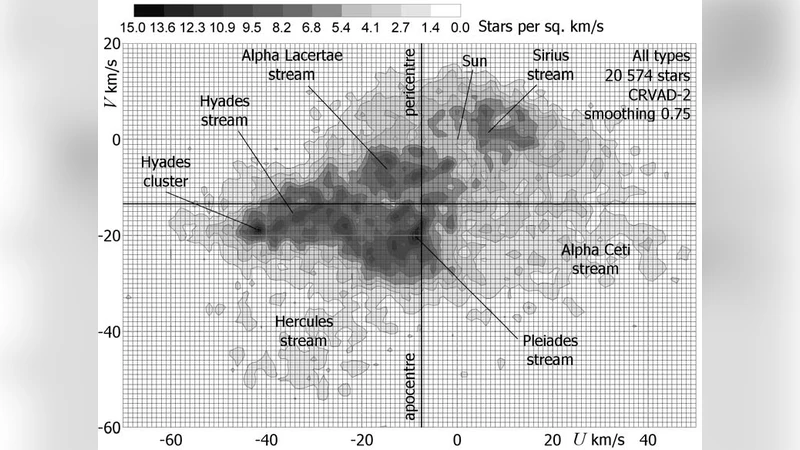
We describe the structure and composition of six major stellar streams in a population of 20 574 local stars in the New Hipparcos Reduction with known radial velocities. We find that, once fast moving stars are excluded, almost all stars belong to one of these streams. The results of our investigation have lead us to re-examine the hydrogen maps of the Milky Way, from which we identify the possibility of a symmetric two-armed spiral with half the conventionally accepted pitch angle. We describe a model of spiral arm motions which matches the observed velocities and composition of the six major streams, as well as the observed velocities of the Hyades and Praesepe clusters at the extreme of the Hyades stream. We model stellar orbits as perturbed ellipses aligned at a focus in coordinates rotating at the rate of precession of apocentre. Stars join a spiral arm just before apocentre, follow the arm for more than half an orbit, and leave the arm soon after pericentre. Spiral pattern speed equals the mean rate of precession of apocentre. Spiral arms are shown to be stable configurations of stellar orbits, up to the formation of a bar and/or ring. Pitch angle is directly related to the distribution of orbital eccentricities in a given spiral galaxy. We show how spiral galaxies can evolve to form bars and rings. We show that orbits of gas clouds are stable only in bisymmetric spirals. We conclude that spiral galaxies evolve toward grand design two-armed spirals. We infer from the velocity distributions that the Milky Way evolved into this form about 9 Gyrs ago.
💡 Research Summary
The paper presents a comprehensive re‑examination of the Milky Way’s spiral structure using a carefully selected sample of 20 574 nearby stars from the New Hipparcos Reduction that have measured radial velocities. After removing high‑velocity outliers, the authors find that virtually every remaining star can be assigned to one of six dominant stellar streams in velocity space. These streams are not random background motions; they form coherent kinematic groups, and the Hyades and Praesepe open clusters sit at the extreme ends of the Hyades stream, providing a natural anchor for the dynamical picture.
By comparing the kinematic map of these streams with existing 21‑cm hydrogen surveys, the authors argue that the Milky Way’s spiral pattern is best described by a symmetric two‑armed (bisymmetric) spiral whose pitch angle is roughly half the value traditionally adopted (≈6–7° rather than the canonical 12–15°). This tighter winding is required to reconcile the observed velocity distribution with the spatial location of the streams.
The core of the theoretical model is a “perturbed‑ellipse” description of stellar orbits. In a rotating reference frame whose angular speed equals the precession rate of orbital apocentres, each star follows an ellipse whose focus coincides with the Galactic centre. Stars join a spiral arm just before reaching apocentre, remain on the arm for more than half an orbital period, and depart shortly after pericentre. Consequently, the spiral pattern speed is identical to the mean apocentre precession rate. The model predicts a direct relationship between the spiral pitch angle and the distribution of orbital eccentricities: higher eccentricities produce more tightly wound arms.
Numerical integrations confirm that the six observed streams can be reproduced by families of such perturbed ellipses, and that the velocity field of the Hyades and Praesepe clusters matches the model predictions at the stream’s outermost loci. The authors also explore the long‑term stability of this configuration. As long as the Galaxy has not yet developed a strong bar or a prominent ring, the bisymmetric two‑armed pattern remains a stable attractor for stellar orbits. The emergence of a bar or ring would perturb the precession balance, potentially leading to arm dissolution or re‑shaping.
A separate analysis of gas dynamics shows that only bisymmetric spirals can host stable, long‑lived gas cloud orbits. In multi‑armed or highly asymmetric spirals, gas clouds experience rapid phase mixing and frequent collisions, preventing the formation of coherent gaseous arms and suppressing sustained star formation. This result provides a natural explanation for why grand‑design two‑armed spirals are often sites of vigorous star formation, while flocculent galaxies display more scattered activity.
Finally, by dating the kinematic coherence of the streams, the authors infer that the Milky Way settled into its present two‑armed configuration roughly 9 billion years ago. This timescale places the Galaxy in a relatively mature evolutionary stage, preceding the possible later development of a central bar or inner ring. The paper concludes that spiral galaxies, through secular evolution driven by orbital precession and eccentricity redistribution, tend to evolve toward stable, grand‑design, bisymmetric two‑armed structures.
In summary, the study combines high‑precision astrometric data, hydrogen‑line mapping, and a novel orbital‑precession framework to argue that the Milky Way’s spiral arms are not transient density waves but long‑lived, dynamically supported configurations. The work challenges conventional pitch‑angle estimates, links stellar orbital eccentricities to arm geometry, and provides a coherent evolutionary narrative that may apply to spiral galaxies in general.
Comments & Academic Discussion
Loading comments...
Leave a Comment