Nuclear constraints on properties of neutron star crusts
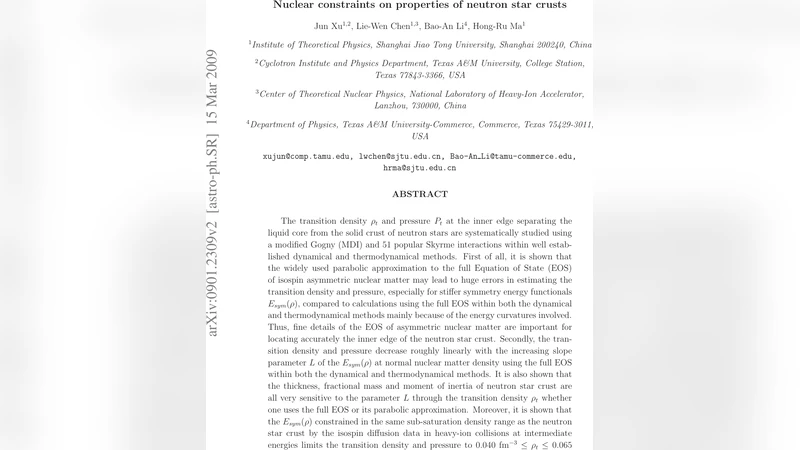
The transition density $\rho_{t}$ and pressure $P_{t}$ at the inner edge separating the liquid core from the solid crust of neutron stars are systematically studied using a modified Gogny (MDI) and 47 popular Skyrme interactions within well established dynamical and thermodynamical methods. It is shown that the widely used parabolic approximation to the full Equation of State (EOS) of isospin asymmetric nuclear matter may lead to huge errors in estimating the \rho_{t} and P_{t}, especially for stiffer symmetry energy functionals $E_{sym}(\rho)$. The \rho_{t} and P_{t} decrease roughly linearly with the increasing slope parameter $L$ of the $E_{sym}(\rho)$ using the full EOS within both methods. It is also shown that the thickness, fractional mass and moment of inertia of neutron star crust are all very sensitive to the parameter $L$ through the $\rho_{t}$. Moreover, it is shown that the $E_{sym}(\rho)$ constrained in the same sub-saturation density range as the neutron star crust by the isospin diffusion data in heavy-ion collisions at intermediate energies limits the transition density and pressure to 0.040$ fm^-3}< \rho_{t} < 0.065$ fm^-3 and 0.01 MeV/fm^3 < P_{t} < 0.26$ MeV/fm^3, respectively. These constrained values for the transition density and pressure are significantly lower than their fiducial values currently used in the literature. Furthermore, the mass-radius relation and several other properties closely related to the neutron star crust are studied by using the MDI interaction. It is found that the newly constrained $\rho_t$ and $P_t$ together with the earlier estimate of $\Delta I/I>0.014$ for the crustal fraction of the moment of inertia of the Vela pulsar impose a stringent constraint of R>= 4.7+4.0M/M_sun km for the radius $R$ and mass $M$ of neutron stars.
💡 Research Summary
The paper investigates the transition density (ρₜ) and pressure (Pₜ) at the inner edge separating the liquid core from the solid crust of neutron stars. Using a modified Gogny (MDI) interaction together with 47 widely employed Skyrme parameterizations, the authors apply two well‑established methods—dynamical stability analysis and thermodynamical equilibrium conditions—to locate the core‑crust transition. A key finding is that the commonly used parabolic approximation to the equation of state (EOS) of isospin‑asymmetric nuclear matter can produce large systematic errors, especially for EOSs with a stiff symmetry energy. When the full EOS is employed, both ρₜ and Pₜ decrease approximately linearly with the slope parameter L of the symmetry energy, E_sym(ρ).
The study then links the transition density to macroscopic crust properties. A lower ρₜ yields a thinner crust, reduces the fractional crust mass, and diminishes the crustal contribution to the total moment of inertia (I_crust/I_total). These sensitivities are crucial because pulsar glitch observations—particularly the Vela pulsar—require a minimum crustal moment‑of‑inertia fraction ΔI/I > 0.014. Consequently, the transition density directly constrains observable glitch phenomena.
To anchor the theoretical analysis in empirical data, the authors invoke isospin‑diffusion measurements from intermediate‑energy heavy‑ion collisions. These experiments constrain the symmetry energy in the sub‑saturation density region that overlaps the neutron‑star crust. Incorporating this constraint narrows the allowed range of transition parameters to 0.040 fm⁻³ < ρₜ < 0.065 fm⁻³ and 0.01 MeV fm⁻³ < Pₜ < 0.26 MeV fm⁻³, values significantly lower than the fiducial numbers (≈0.08 fm⁻³ and ≈0.5 MeV fm⁻³) often adopted in the literature.
Finally, the authors compute mass‑radius (M‑R) relations using the MDI interaction, imposing both the newly constrained ρₜ, Pₜ and the glitch‑derived moment‑of‑inertia requirement. The combined constraints lead to a stringent radius–mass inequality:
R ≥ 4.7 + 4.0 (M/M_⊙) km.
For a canonical 1.4 M_⊙ neutron star this translates into a minimum radius of roughly 9 km. This result tightens the permissible region of neutron‑star configurations and has direct implications for the interpretation of X‑ray observations, gravitational‑wave tidal deformability measurements, and the modeling of crust‑related phenomena such as thermal relaxation and magnetic‑field evolution.
In summary, the paper demonstrates that (i) the transition density and pressure are linearly correlated with the symmetry‑energy slope L when the full EOS is used; (ii) the parabolic approximation can severely misestimate these quantities for stiff EOSs; (iii) experimental constraints on the symmetry energy substantially lower the allowed ρₜ and Pₜ; (iv) crustal thickness, mass fraction, and moment of inertia are highly sensitive to ρₜ; and (v) combining the new transition constraints with pulsar‑glitch data yields a robust lower bound on neutron‑star radii as a function of mass. These insights provide a more reliable foundation for neutron‑star modeling and for extracting nuclear‑physics information from astrophysical observations.
Comments & Academic Discussion
Loading comments...
Leave a Comment