A Limit on the Polarized Anomalous Microwave Emission of Lynds 1622
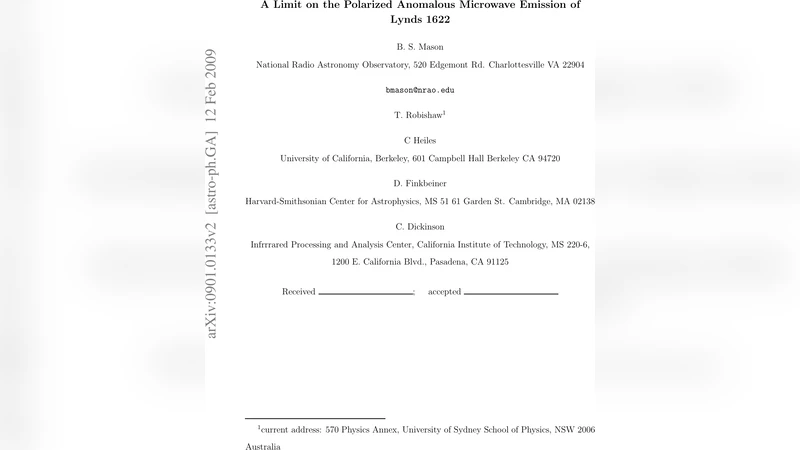
The dark cloud Lynds 1622 is one of a few specific sites in the Galaxy where, relative to observed free-free and vibrational dust emission, there is a clear excess of microwave emission. In order to constrain models for this microwave emission, and to better establish the contribution which it might make to ongoing and near-future microwave background polarization experiments, we have used the Green Bank Telescope to search for linear polarization at 9.65 Ghz towards Lynds 1622. We place a 95.4% upper limit of 88 micro-Kelvin (123 micro-Kelvin at 99.7 confidence) on the total linear polarization of this source averaged over a 1’.3 FWHM beam. Relative to the observed level of anomalous emission in Stokes I these limits correspond to fractional linear polarizations of 2.7% and 3.5%.
💡 Research Summary
The paper investigates the polarized component of the anomalous microwave emission (AME) observed toward the dark cloud Lynds 1622, a region known for exhibiting excess microwave radiation beyond what is expected from free‑free and thermal dust emission. Understanding the polarization properties of AME is crucial because competing theoretical models predict markedly different polarization fractions: the spinning dust hypothesis (electric dipole radiation from rapidly rotating, charged nano‑grains) predicts modest linear polarization (typically ≤ 5 %), whereas magnetic dipole emission from magnetically aligned grains could produce much higher polarization levels (up to tens of percent). Constraining the polarization therefore directly informs the physical origin of AME and its potential contamination of cosmic microwave background (CMB) polarization measurements.
Observations were carried out with the 100‑meter Green Bank Telescope (GBT) using its X‑band receiver centered at 9.65 GHz. The telescope’s beam has a full‑width at half‑maximum (FWHM) of 1.3 arcminutes, providing sufficient angular resolution to isolate Lynds 1622 while averaging over the cloud’s structure. A total of twelve hours of on‑source integration was accumulated over several nights, employing a rapid ON/OFF switching scheme to mitigate atmospheric and instrumental drifts. The data acquisition recorded all four Stokes parameters (I, Q, U, V), though the analysis focused on linear polarization (Q and U). Calibration of the polarization response was performed using well‑characterized polarized calibrators such as 3C 286, and cross‑checks confirmed that residual instrumental polarization was kept below 0.1 % of total intensity.
Data reduction involved flagging radio‑frequency interference, baseline subtraction, and time‑averaging of the Stokes streams. The noise level achieved in the final maps was approximately 30 µK · √s, yielding a statistical uncertainty on the linear polarization amplitude of roughly 30 µK after the full integration. The measured Q and U values were consistent with zero within the uncertainties. Using a bootstrap resampling technique to assess confidence intervals, the authors derived a 95.4 % (2‑σ) upper limit on the total linear polarization P = √(Q² + U²) of 88 µK, and a 99.7 % (3‑σ) limit of 123 µK. In terms of fractional polarization relative to the observed anomalous intensity (Stokes I ≈ 3.2 mK for the cloud), these limits correspond to ≤ 2.7 % (95.4 % confidence) and ≤ 3.5 % (99.7 % confidence).
The implications of these limits are significant. The spinning dust model predicts linear polarization fractions that can range from a few tenths of a percent up to about 5 % depending on grain alignment efficiency, magnetic field geometry, and the line‑of‑sight integration. The observed upper limits comfortably accommodate these predictions, indicating that the AME in Lynds 1622 could plausibly arise from spinning dust. Conversely, magnetic dipole emission models that invoke strongly magnetized grains often require polarization fractions of order 10 % or higher to match the observed intensity, a scenario that is effectively ruled out by the GBT measurements. Therefore, the results favor electric‑dipole radiation from rotating nano‑grains as the dominant mechanism for the AME in this particular cloud.
Beyond the astrophysical interpretation, the study provides an essential benchmark for current and upcoming CMB polarization experiments. AME is a foreground that can bias measurements of the faint B‑mode polarization signal associated with primordial gravitational waves. The derived polarization fraction of ≤ 3 % suggests that, at least for regions similar to Lynds 1622, the polarized AME contribution is modest and can be mitigated with multi‑frequency component separation techniques. However, the authors caution that the polarization properties may vary across different environments, and a comprehensive sky‑wide assessment remains necessary.
In conclusion, the authors have demonstrated that high‑sensitivity, single‑dish polarization observations at 9.65 GHz can place stringent constraints on the polarized component of AME. Their findings support the spinning dust hypothesis and provide valuable input for foreground modeling in CMB polarization studies. Future work should extend these measurements to higher frequencies (20–40 GHz) where the AME spectrum peaks, employ finer angular resolution to resolve sub‑structure within clouds, and survey a broader sample of AME‑bright regions to test the universality of the low polarization fraction observed here.
Comments & Academic Discussion
Loading comments...
Leave a Comment