A Binary Control Chart to Detect Small Jumps
The classic N p chart gives a signal if the number of successes in a sequence of inde- pendent binary variables exceeds a control limit. Motivated by engineering applications in industrial image proce
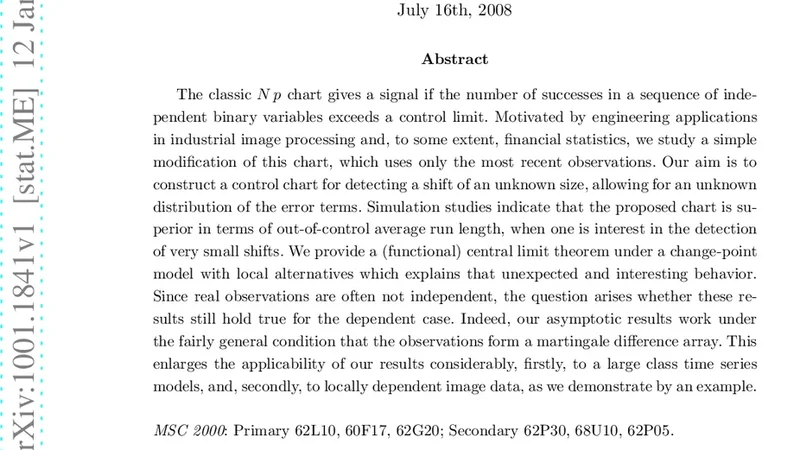
The classic N p chart gives a signal if the number of successes in a sequence of inde- pendent binary variables exceeds a control limit. Motivated by engineering applications in industrial image processing and, to some extent, financial statistics, we study a simple modification of this chart, which uses only the most recent observations. Our aim is to construct a control chart for detecting a shift of an unknown size, allowing for an unknown distribution of the error terms. Simulation studies indicate that the proposed chart is su- perior in terms of out-of-control average run length, when one is interest in the detection of very small shifts. We provide a (functional) central limit theorem under a change-point model with local alternatives which explains that unexpected and interesting behavior. Since real observations are often not independent, the question arises whether these re- sults still hold true for the dependent case. Indeed, our asymptotic results work under the fairly general condition that the observations form a martingale difference array. This enlarges the applicability of our results considerably, firstly, to a large class time series models, and, secondly, to locally dependent image data, as we demonstrate by an example.
💡 Research Summary
The paper introduces a novel binary control chart designed to detect very small shifts in a process, improving upon the classic N p chart which signals when the number of successes in a sequence of independent Bernoulli trials exceeds a control limit. The authors’ motivation stems from engineering applications such as industrial image processing and, to a lesser extent, financial statistics, where rapid detection of minute changes is crucial.
Core Idea and Construction
Instead of using the entire historical record, the proposed chart relies only on the most recent M observations (a moving window). Within this window the proportion of successes (\hat p_t) is computed; if (\hat p_t) crosses a pre‑specified upper or lower control limit, an out‑of‑control signal is issued. By keeping M relatively small, the chart gives higher weight to recent data, thereby avoiding the dilution effect that hampers the traditional N p chart when the shift is tiny.
Statistical Model and Asymptotics
The authors adopt a change‑point framework. Under the in‑control regime each observation (X_i) is Bernoulli with success probability (p_0). At an unknown time (\tau) the probability changes to (p_0 + \delta/\sqrt{N}), where (\delta) represents a local alternative of order (1/\sqrt{N}) – i.e., a very small shift. They prove a functional central limit theorem (FCLT) for the cumulative sum process
\
📜 Original Paper Content
🚀 Synchronizing high-quality layout from 1TB storage...